On this page
Empirical Close: Defer Skill-Side Tests to Natural Exercise
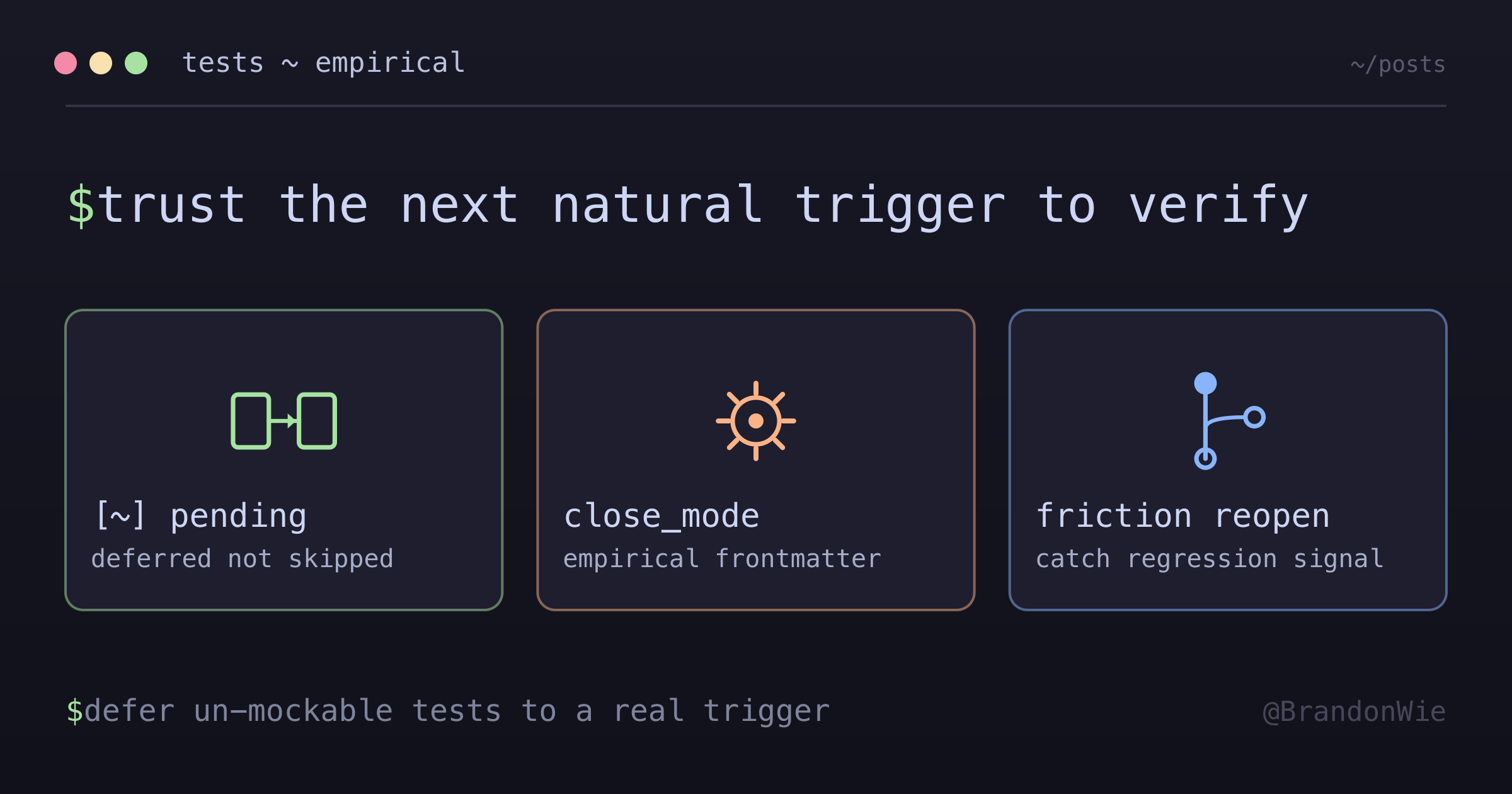
Some verification tests need a real trigger that no fixture replicates faithfully — interactive prompts, conversation parsing, AskUserQuestion flows. Marking the test [~] empirical-close-pending and trusting the next natural trigger to verify is hygienic when paired with a friction-log reopen.
Some verification tests require a real trigger that can’t be unit-mocked: interactive prompts, conversation parsing, AskUserQuestion flows. Three close-out paths exist on these:
- Force staging — stage a fake trigger to fire the test now. Pollutes real session state; staged fixture often diverges from real input shape.
- Defer + leave open — keep the task folder in
actives/, let it stale-warn at 7d. Risk: forgotten task, dashboard noise. - Empirical close — mark the test
[~] empirical-close-pending, archive the task anyway, trust the next natural trigger to verify. Reopen via friction log on regression.
Without an explicit pattern for path 3, tasks with un-mockable tests sit half-closed indefinitely or get force-staged with low-fidelity fixtures.
Three options, side by side
| Option | Pros | Cons |
|---|---|---|
| Force staging now | Test green on close; explicit verification | Pollutes session state; fixture ≠ reality; cost of restoration |
| Defer + leave open | No artifice | Stale-warns at 7d; dashboard noise; forgotten-task risk |
| Empirical close | No artifice + folder closes + signal preserved | Trust required; needs reopen mechanism |
Empirical close wins when the trigger is genuinely natural-only (e.g., a real conversation said “next session: do X” — no fixture replicates that faithfully) AND a friction-log reopen mechanism backs it. The cost is trust calibration; the benefit is task hygiene without low-fidelity tests.
What broke before the pattern was explicit
Four things made this messy when there was no recognized name for it:
- Distinguishing from “skip.”
[-]skipped means decided-not-to-test;[~]empirical-close-pending means deferred-to-natural-exercise. Without the distinction, archive looks like give-up. - Reopen mechanism is non-obvious. Without wiring the friction log to catch regressions matching the deferred test’s failure mode, empirical close becomes “delete and pray.”
- Trust calibration. First instance of a path needs explicit verification; empirical applies on later iterations once design is proven. Misapplying empirical to first-build paths skips the foundation check.
- Tooling drift. /wrap and /archive-task didn’t originally support
[~]close states; they’d error or treat them as blocking. The pattern needsclose_mode: empirical+close_notes:frontmatter to communicate.
The four-step pattern
Annotate the test in the task’s
todos.md:- [~] **Test N — {name}**: empirical close pending (YYYY-MM-DD). {Why no unit coverage}. Will exercise on next natural {trigger}. Reopen via friction log if {failure mode} occurs.Set task frontmatter:
status: completed
close_mode: empirical
close_notes: |
  {N/total} done; {M} empirical close pending (Tests X+Y).
  Reopen if {regression signal}.
Archive normally via
/archive-task. Don’t keep the folder open waiting for an empirical signal — that’s just a stale folder.Wire the reopen mechanism: add a friction-log pattern OR a /wrap warning that fires if the regression signal appears post-archive.
A concrete instance from my own tooling repo — the wrap-followup-persistence-fix close-out (2026-04-30), where the /wrap skill learned to persist follow-ups across sessions and Tests 4+5 shipped deferred:
- [~] **Test 4 — Conversation extraction**: empirical close pending
  (2026-04-30). Skill-side (Step 5.65), no unit coverage. Will exercise on next
  natural /wrap that has a conversation-only follow-up. Reopen via friction log
  if Step 5.65 fails to persist a real candidate.
- [~] **Test 5 — Loss audit**: empirical close pending (2026-04-30). Skill-side
  (Step 9). Pair with Test 4 — first time user chooses "Skip" on a real Step
  5.65 candidate, verify Step 9 lists it under "potentially-lost".
Plus frontmatter:
status: completed
close_mode: empirical
close_notes: |
  17/19 done; 2 [~] empirical-close pending (Tests 4+5). Reopen via
  friction log if Step 5.65 fails on a real conversation-only follow-up.
When it fits
Use empirical close for:
- Skill-side behavior tests that need conversation context (e.g., wrap’s Step 5.65 conversation extraction needs a real “next session: do X” mid-chat).
- AskUserQuestion flows where forcing the prompt + answering it artificially doesn’t validate real-world UX.
- Side-effect tests where rolling back the side effect is harder than catching a regression in production.
- Post-merge close — task done if PR merged + branch gone, regardless of whether final smoke ran (heuristic from 2026-04-30 embed-interview close).
Don’t use empirical close for regression-critical paths (payment, auth, data integrity — force the test), security tests (never trust empirical signal here), tests that CAN be unit-mocked (if a mock exists, write the unit test — empirical close is a fallback for the un-mockable), or the first time the path is built (the first instance needs explicit validation; empirical applies on later iterations once the design is proven).
Practical takeaway
Empirical close is task hygiene, not test laziness. The test still exists — it just runs in production instead of a fixture. The alternative to running the test is forgetting the task exists. Couple every empirical close with a friction-log reopen pattern; without it, empirical close becomes “delete and pray.” The post-merge variant (PR-merged + branch-gone = task done) is the same pattern applied to merge-state instead of test-state — both trust durable signal over local certainty.