On this page
Wrap Skill Follow-Up Persistence Architecture
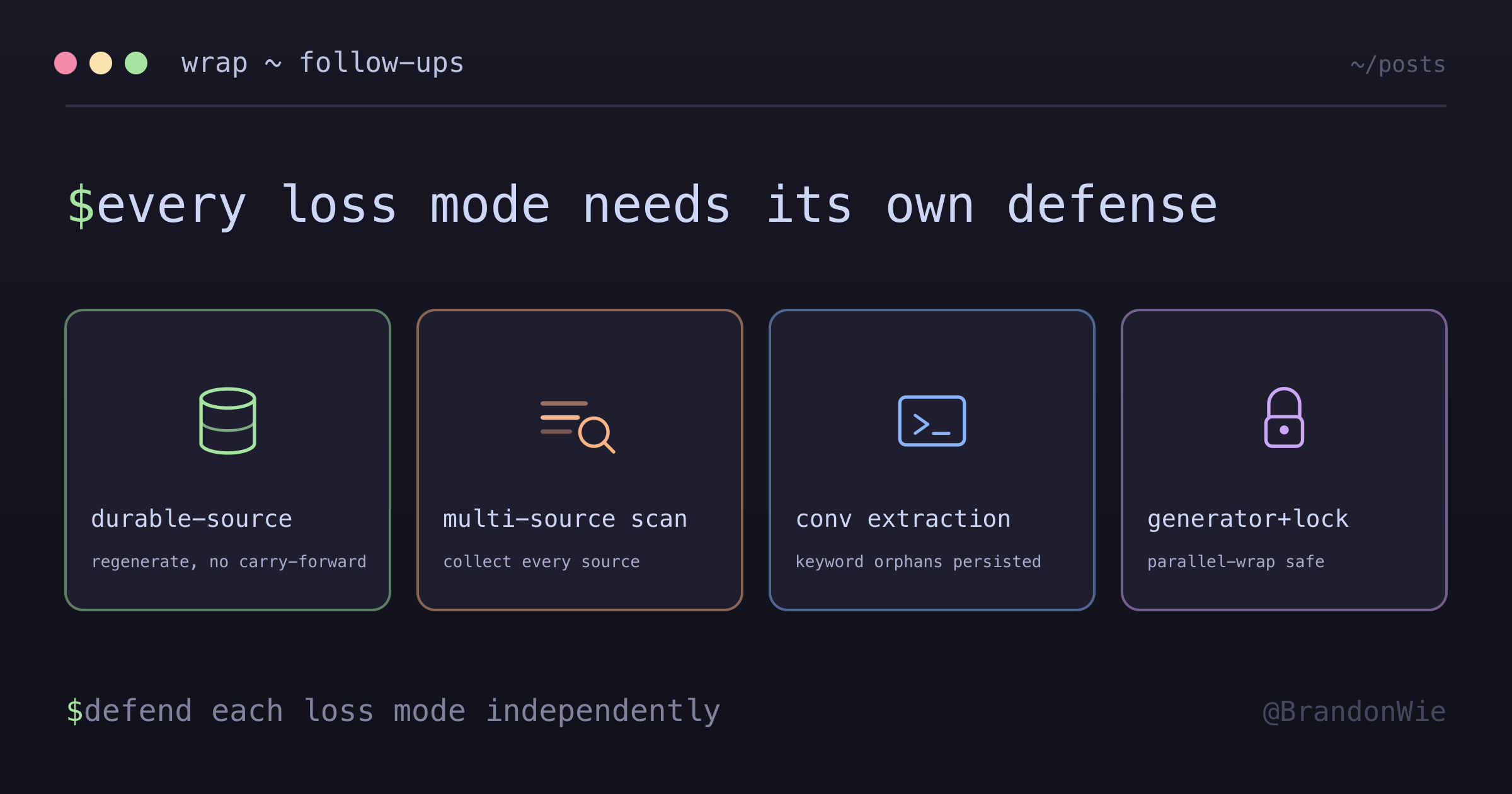
When a session-state dashboard regenerates from a single source (today's journal), unresolved follow-ups from prior sessions vanish silently on every rebuild. Compounded with single-source discovery and conversation-only mentions, follow-ups disappear three ways at once. The fix is a 4-layer architecture.
When a session-state dashboard regenerates from a single source (e.g., today’s journal), unresolved follow-ups from prior sessions vanish silently on every rebuild. Compounded with single-source discovery and conversation-only mentions, follow-ups disappear three ways at once. The fix is a 4-layer architecture that defends against each loss mode independently.
The four loss modes
- Full-overwrite regeneration — Priorities section rebuilt only from today’s signal, dropping yesterday’s unresolved items.
- Single-source discovery — only one file pattern scanned; project-level “Next Session” sections in
projects/{p}/todos.mdinvisible. - Conversation-only follow-ups — “next session: do X” mentioned but never journaled die at
/clear. - Untagged items — entries lacking
(project)prefix can’t route downstream.
The system here is my own session-wrap skill. /wrap runs a fixed sequence of numbered steps at the end of a coding session — journal what happened, then regenerate ACTIVE-STATUS.md, a dashboard of what is still open across projects. The step numbers below (5.65, 5.7, 9) are positions in that sequence, and v1.3.0 is a version of that skill, not of anything you can install.
Design evolution: 2026-04-28 → 2026-04-30
The original v1.3.0 design did in-skill carry-forward merge of prior ACTIVE-STATUS Priorities. By 2026-04-28, Step 5.7 was replaced by scripts/regenerate-active-status.js, a Node generator with .agents/locks/active-status.lock. Two reasons drove the change:
- Parallel-wrap concurrency safety. When two /wrap sessions race on the same dashboard, carry-forward merge can lose updates. The generator acquires a lock + treats
ACTIVE-STATUS.mdas durable-source-only output (never reads prior dashboard state). - Single source of truth. Carry-forward implicitly trusted the dashboard’s prior content as state; durable-source-only reads journal + project todos.md + actives folders directly. The dashboard reflects them, not the other way around.
The carry-forward test case became design-obsolete with this shift; the remaining merge logic (multi-source scan, resolution drop, dedup, tag derivation) all moved into the generator’s collectPriorities + collectProjectFollowups + withProject functions, covered by 20 unit tests in scripts/regenerate-active-status.test.js (all green as of 2026-04-30 close).
Both steps shipped as commits in my own tooling repo, which is private — so the design is the transferable part here, not the diff.
The four-layer pipeline
┌─────────────────────────────────────────────────────────────┐
│  Step 5.65 (NEW): Conversation Follow-Up Extraction         │
│   keywords → orphan_followups → batched persistence prompt  │
└────────────────────────────┬────────────────────────────────┘
                             ▼
┌─────────────────────────────────────────────────────────────┐
│  Step 5.7 sub-step 1: 4-source merge                        │
│                                                             │
│  prior_priorities (ACTIVE-STATUS)                           │
│    ∪ today_next (journal ### Next, project-tagged)          │
│    ∪ file_followups (canonical fallback chain):             │
│        - projects/{p}/actives/*/todos.md (open checkboxes)  │
│        - projects/{p}/todos.md § ## Next Session            │
│        - projects/{p}/PROGRESS.md § ## Next Session         │
│    − resolved (now [x] or in journal Done)                  │
│    → dedup ≥85% fuzzy → cap 15                              │
└────────────────────────────┬────────────────────────────────┘
                             ▼
┌─────────────────────────────────────────────────────────────┐
│  Step 9: Persistence Audit                                  │
│   counts per source + potentially_lost + untagged_warnings  │
└─────────────────────────────────────────────────────────────┘
Key invariants
- Durable-source-only, not merge. ACTIVE-STATUS regenerates from journals + project files directly. No carry-forward of prior dashboard state. Lock-protected for parallel-wrap safety.
- Original merge intent preserved at the durable-source layer:
prior_priorities ∪ today_signal ∪ file_sources − resolved, with fuzzy ≥85% dedup and a cap to prevent unbounded growth. - Multi-source additive scan — collect from every source that exists, not first-match. Each source has a documented purpose (per-task vs project-level vs legacy fallback).
- Conversation extraction with persistence prompt — keyword-triggered (
next session,follow-up,TODO:,come back to,defer, EN+KR), one batchedAskUserQuestion, options route orphans to journal Next / project todos.md / active task / Skip. - Soft enforcement, not hard block — derive
(project)tag from parent## Session:header automatically; warn on ambiguous; never block /wrap. - Audit-trail in final report — Persistence Audit emits counts per source, lists potentially-lost (Skip choices) + untagged warnings. User gets visual confirmation nothing slipped through silently.
What broke during implementation
Three things tripped the rollout:
- Pre-commit hook flattened the merge commit when
--no-ffwas specified on a clean fast-forward path. Git documents--no-ffas creating a merge commit in all cases, even when the merge could instead be resolved as a fast-forward — the hook rewrote it anyway. Effect was cosmetic (linear history vs branch context lost) but worth knowing. .me.mdprotection hook blocks creation as well as edits. Workaround: use plainindex.mdfor AI-authored task summaries; reserve.me.mdfor human-authored seed docs only. The lesson generalizes: a guard written as “never touch this file” usually also means “never bring it into existence,” so check which verb your hook actually blocks before you rely on it.- Markdownlint MD041 counts the first non-frontmatter line; H2 before H1 fails. Plan files need H1 immediately after frontmatter. The rule does skip files whose front matter carries a
titleproperty, which is why blog-style docs pass and plan files do not. I wrote that rule up separately in Markdownlint Pre-Commit: MD041 + MD001 Heading Gotchas.
When this fits
This pattern fits any cross-session state dashboard (priorities lists, task trackers, follow-up surfaces) that regenerates each session, skills that summarize work across multiple persistent surfaces (journal + project files + actives folders), and any tool where conversation-only mentions need to survive context clears. It does not fit single-source state where overwrite is intentional (generated reports that should reflect only the latest snapshot), real-time dashboards where carry-forward would mask current state, or throwaway debug output.
Practical takeaway
Cross-session state survives only when every loss mode has a defense. Durable-source-only regeneration kills the overwrite mode. Multi-source additive scanning kills the discovery mode. Keyword-triggered conversation extraction with a single batched prompt kills the conversation-only mode. Auto-derived project tags + soft warnings kill the untagged mode. The generator+lock pattern (vs in-skill merge) is what makes the architecture safe under parallel-wrap concurrency — and it’s worth the extra Node script even for a one-user tool.