On this page
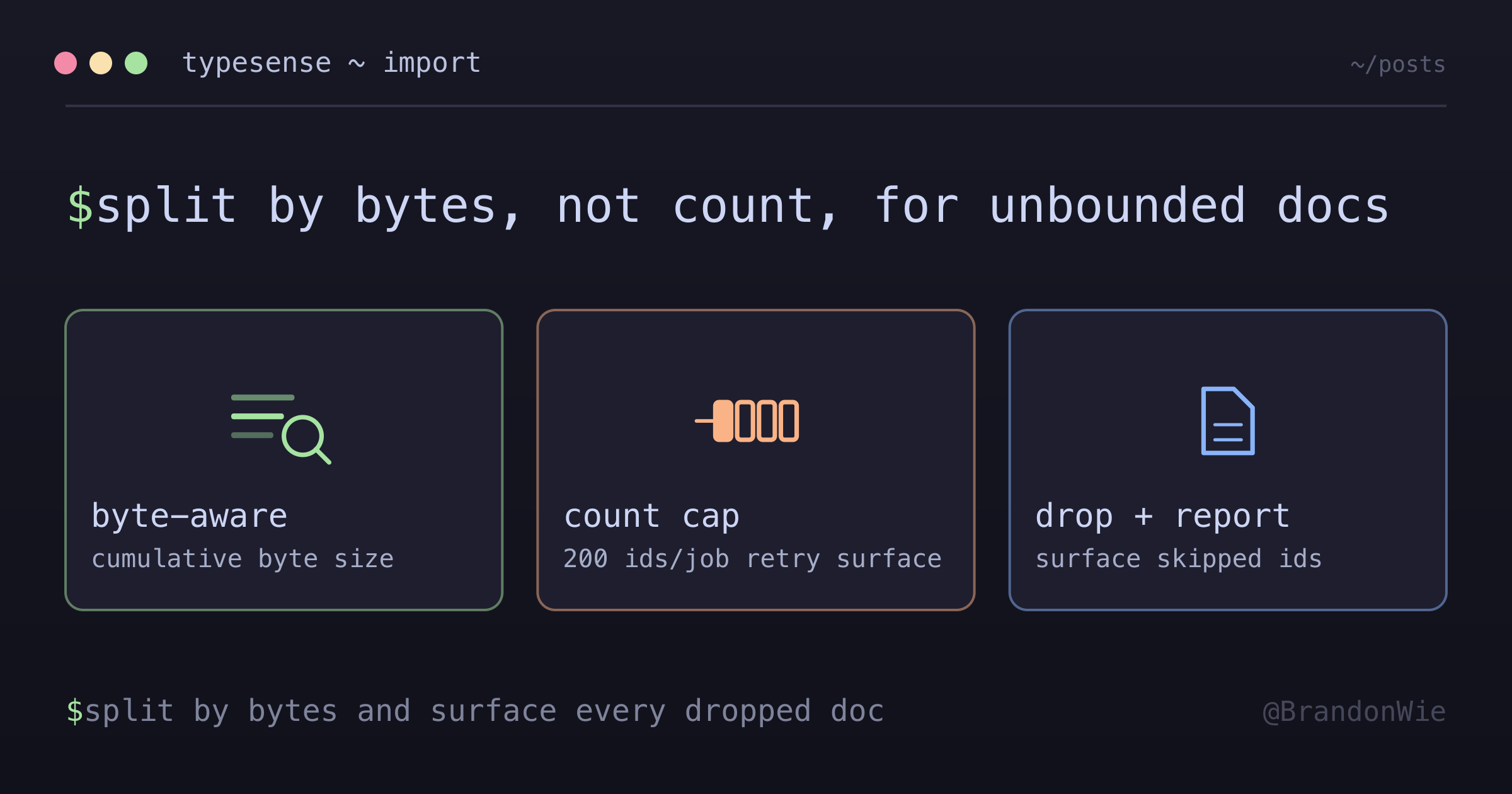
Byte-aware vs Count-based Chunking for Typesense documents/import
Two chunking strategies for Typesense bulk import. Picking the wrong one silently fails the day a single power user creates a multi-MB document.
A contacts sync worker shipped with CHUNK_SIZE = 500 and ran fine for
months — small fixed-string documents, comfortable headroom under the 40 MB
Typesense import cap. Then a second worker, indexing calendar blocks, reused
the same chunking strategy, and the math broke. A single block can carry a
multi-MB rich-text note, and the moment one chunk crossed the cap, the entire
import failed and the initial full-index backfill (the bootstrap that builds
the collection from empty) stalled. The fix wasn’t lowering the count; it was
switching strategies entirely.
The Two Strategies
Typesense’s documents/import endpoint accepts a JSON body with a hard cap
(40 MB at the time of writing — verify against your version). Any service
batch-syncing N documents needs a chunking strategy that keeps every HTTP
body under that cap. There are two natural strategies, with very different
failure modes:
| Strategy | Split by | Always safe? |
|---|---|---|
| Count-based | Fixed N docs/chunk | Only if N×max_doc < cap |
| Byte-aware | Cumulative serialized size | Yes (with safety margin) |
The mistake is defaulting to count-based for everything because “500 docs felt fine in dev.” Then a power user creates a single document with a multi-MB note, the chunk crosses 40 MB, the entire batch fails, and the initial index build never completes.
When Count-Based Is Fine
Count-based is the right call when ALL of:
- Document shape is uniform (no large free-text or blob fields).
- Worst-case single doc fits with room to spare (e.g.,
< 100 KB). - Chunk size × worst-case doc size leaves an order-of-magnitude headroom below the import cap.
Contacts is the textbook case. Schema is small fixed strings (email, displayName, photoUrl, sourceId). Worst case ~2 KB/doc; 500 × 2 KB
= 1 MB; 40 MB cap. Two orders of magnitude headroom — count-based is fine:
const CHUNK_SIZE = 500;
for (let i = 0; i < emails.length; i += CHUNK_SIZE) {
  const chunk = emails.slice(i, i + CHUNK_SIZE);
  await queue.add("contact-bulk-upsert", { emails: chunk });
}
// processor:
await typesense
  .collections("contacts")
  .documents()
  .import(docs, { action: "upsert" });
When You Need Byte-Aware
Switch to byte-aware splitting when ANY of:
- Schema has free-text fields (notes, descriptions, embedded markdown).
- Worst-case single doc could approach the cap.
- You can’t bound payload size at write time (user-generated content).
Calendar blocks fit all three. A single block’s note can be MB-sized. 200 docs × worst-case 200 KB = 40 MB before any single outlier — count-based would be a coin flip. Byte-aware tracks cumulative serialized size and splits before the cap:
import { Buffer } from "node:buffer";

const MAX_IMPORT_BYTES = 30 * 1024 * 1024; // 30 MB — 25 % margin under 40 MB cap

export function splitByByteSize<T extends { id?: string }>(
  docs: T[],
  maxBytes: number = MAX_IMPORT_BYTES
): T[][] {
  const groups: T[][] = [];
  let current: T[] = [];
  let currentBytes = 0;

  for (const doc of docs) {
    const docBytes = Buffer.byteLength(JSON.stringify(doc), "utf8");

    if (docBytes > maxBytes) {
      // Single-doc overflow — flag and skip; do not silently truncate.
      Sentry.captureMessage("Document exceeds Typesense import byte limit", {
        level: "warning",
        extra: { docId: doc.id, docBytes, maxBytes }
      });
      continue;
    }

    if (currentBytes + docBytes > maxBytes) {
      groups.push(current);
      current = [];
      currentBytes = 0;
    }

    current.push(doc);
    currentBytes += docBytes;
  }

  if (current.length > 0) groups.push(current);
  return groups;
}
Pair Byte-Aware with a Count Cap
Pure byte-aware can produce one huge job containing thousands of tiny docs, which is bad for retry granularity — a single failure forces a re-import of everything in that group. The robust shape is a count cap at the queue layer plus byte-aware splitting inside the processor:
// Listener already capped at 200 IDs/job for retry granularity;
// processor's byte-split handles the long-note tail within those 200.
const groups = splitByByteSize(docs);
for (const group of groups) {
  await typesense
    .collections("blocks")
    .documents()
    .import(group, { action: "upsert" });
}
The count cap (e.g., 200 IDs/job) bounds the retry surface; the byte-split inside handles outliers within those 200.
Key Points
- Cap with a safety margin. 40 MB Typesense cap → use 30 MB budget.
UTF-16 strings, protocol framing, and gzip header overhead all eat into
the budget, and the
JSON.stringifyestimate is approximate. - Single-doc overflow is its own decision. If one document already exceeds the cap, you have three choices: (1) skip + log, (2) fail the batch, (3) truncate field content. Skip + log preserves the rest of the batch and surfaces the outlier without corrupting search behavior. Truncating silently is the worst — search starts returning incomplete docs and nobody knows why.
- Count cap PLUS byte-aware is the robust shape for variable docs. The count cap (e.g., 200) bounds retry surface; the byte-split inside handles outliers.
- Estimate by
Buffer.byteLength(JSON.stringify(doc), 'utf8'). Don’t usestring.length— it counts code units, not bytes, and UTF-8 multibyte chars silently underestimate. Don’t useJSON.stringify(doc).lengtheither, for the same reason.
Why Count-Based Slips Through Tests
CI seed fixtures and local-dev databases rarely contain the multi-MB docs that prod accumulates after years of use. A 500-per-job count-based limit will pass every test and ship; the production backfill fails on day one for a single power user. A useful code review heuristic: any field that maps to a textarea or markdown editor in the UI is unbounded — use byte-aware.
Per-Job vs Per-Import Cap Confusion
A BullMQ job can carry the IDs of N documents to fetch and import. The job data payload (IDs only) is small; the eventual Typesense HTTP body (fetched + projected docs) is what hits the cap. Don’t mix the two: the count cap on job data limits retry surface; the byte-aware split inside the processor limits HTTP body size.
Sentry Signal Noise on the Single-Doc Overflow Path
Logging every overflow at error level floods alerts when a single bad
document recurs across N retries. Dropping to warning level and tagging by
subsystem and issue kind lets Sentry group the repeats instead of alerting per
retry. Whatever tag convention a project already uses works — something like area: search-integration plus issue: oversized_document groups by docId in
practice.
The Caller-Blind Trap
The first version of splitByByteSize returned just T[][]. Oversized
docs were skipped with a Sentry warning and continue. The caller — bulkUpsertDocs in the sketch below — had no signal. The doc was lost from
Typesense without surfacing in processor logs, and the success log printed
the requested count rather than the imported count, so the discrepancy never
showed up.
A review pass caught this before it shipped, and the return shape evolved to:
export interface SplitByByteSizeResult<T> {
  groups: T[][];
  skippedIds: string[];
}
Caller pattern:
async function bulkUpsertDocs(docs: Doc[], docIds: string[]) {
  const { groups, skippedIds } = splitByByteSize(docs);
  for (const group of groups) {
    await collection.documents().import(group, { action: "upsert" });
  }
  if (skippedIds.length > 0) {
    logger.warn(
      `Bulk upsert dropped ${skippedIds.length} oversize doc(s) ` +
        `ids=[${skippedIds.join(",")}]`
    );
  }
  logger.debug(
    `Bulk upserted ${docs.length - skippedIds.length}/${docIds.length} docs`
  );
}
The per-doc Sentry breadcrumb is retained for deep observability; the processor-level tail-warning gives operators a single log line per batch, carrying the owning-entity context — which account, which parent record, which document IDs — that the utility itself can’t see. And the success log subtracts the skipped count, so the ratio it prints is honest.
The Generalizable Lesson
Any utility that silently drops items must surface what was dropped. There are three reasonable shapes:
| Option | When |
|---|---|
| Throw | Caller can’t reasonably continue without all items |
| Truncate | Each item has a “shortened but valid” form |
| Drop + report | Items are independent; partial completion is acceptable; caller decides recovery |
splitByByteSize uses option 3 because (a) blocks are independent —
dropping one shouldn’t block the other 199, and (b) truncating note text
would corrupt search behavior. The return tuple is what makes option 3
honest — without it, the choice degenerates into “silently lose data.”
When to Use
- Count-based: uniform-shape collections — contacts, user accounts, reference codes, anything with bounded fixed-size fields.
- Byte-aware (with count cap): any collection with free-text — notes, descriptions, blog posts, comments, support tickets, audit log entries with payload field.
When NOT to Use
- Skip both and use individual
documents().upsertper doc when the volume is naturally small (< 50 docsper operation) — chunking adds complexity for no throughput win at low volume. - Skip byte-aware splitting if the only “large” field is bounded server-side (e.g., max-length validator at write time). Count-based with a generous cap is simpler and fits.
Takeaway
The strategy choice depends on whether your worst-case document is bounded. If schema guarantees a small upper bound, count-based wins on simplicity. If any field is user-generated free text, byte-aware is the only safe choice — and the moment you skip a doc, surface it back to the caller so the loss isn’t silent.