On this page
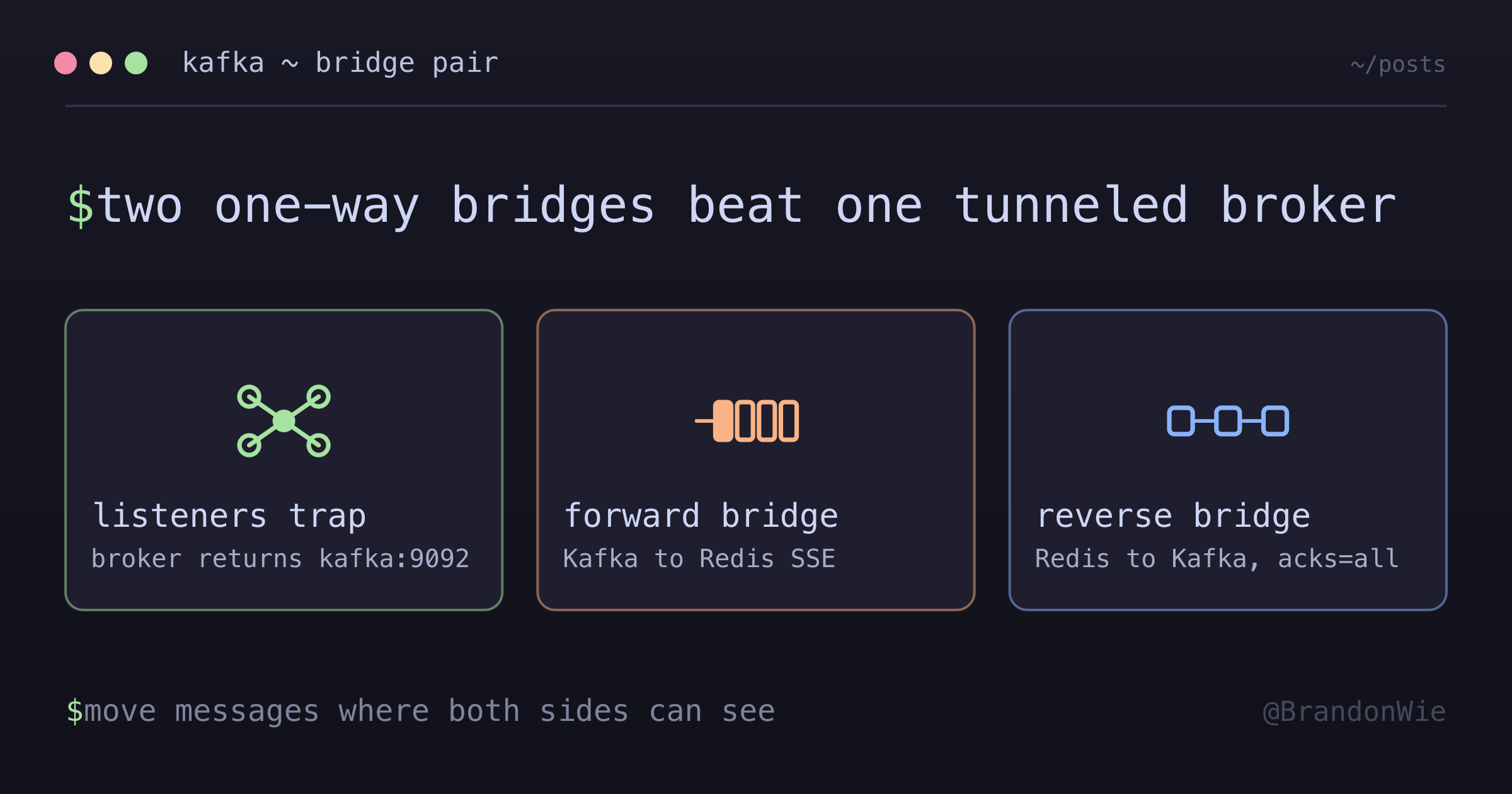
Symmetric Redis ↔ Kafka Bridge Pair for Cross-Cloud Event Flow
Cloud Run can't reach an internal Kafka broker — `advertised.listeners` always wins. A pair of unidirectional bridges through Redis keeps every invariant intact.
When a durable internal event bus (Kafka) and an ephemeral edge bus (Redis pub/sub) live on different network segments, a pair of unidirectional bridges — one per direction — beats a single bidirectional broker rule with tunneling. Each bridge is a dumb forwarder. Audit completeness is preserved by routing all producer-side traffic through the durable bus regardless of which compute tier originated the event.
Cloud Run runs the API. NAS hosts Kafka. The first connection through a
TCP tunnel works; the second fails because the broker tells the client
“reconnect to me at kafka:9092” — a Docker hostname Cloud Run can’t
resolve. Three obvious workarounds each break a different invariant.
The fourth — a pair of bridges through Redis — keeps every invariant
intact and replaces what would otherwise need 2× CF Tunnel TCP rules
plus a dual-listener Kafka config plus sidecar cold-starts.
The advertised.listeners Trap
Cloud Run (or any GCP/AWS edge tier) cannot reach a NAS-internal Kafka
broker directly. Kafka’s broker-discovery protocol returns the broker’s advertised.listeners value on every metadata response — typically the
Docker DNS name (kafka:9092) — which the cloud client cannot resolve.
Even with a TCP tunnel to port 9092, the first connection succeeds but
the second fails: the broker tells the client “next time, connect to
me at kafka:9092” and the client cannot.
The naive options each break a different invariant:
| Option | Breaks |
|---|---|
| Add a CF Tunnel + Kafka EXTERNAL listener + cloudflared sidecar on Cloud Run | Multi-container Cloud Run, fragile auth refresh, listener drift on broker upgrades |
| Make Kafka public + SASL/SSL | Security posture regression — exposes a stateful broker to the internet |
| Skip Kafka entirely on the edge tier; use only Redis pub/sub | Audit completeness — the durable hash-chained log loses every edge-originated event |
| Move publishing to the worker (Celery hop) | API HTTP latency couples to broker round-trip; weakens “stateless on Cloud Run” guarantee |
The Pattern: Two Unidirectional Bridges
Two small Go services, each running on the NAS-internal network. Together they make Kafka the durable backbone while Redis carries cross-cloud edge traffic.
[NAS Worker, Guardrails, Keycloak] ──► [Kafka] ──► [audit-service] ──► hash-chain log
                                          ▲   │
                                          │   ├─► [forward sse-bridge] ──► [Redis pub/sub] ──► [Cloud Run API SSE] ──► Browser
                                          │                                  ▲
                                          │                                  │
                                          └─◄ [reverse sse-revbridge] ◄──────┘
                                                                             ▲
                                                                             │
[Cloud Run API publishers]- Forward bridge (
Kafka → Redis): consumer groups subscribe to all SSE-relevant Kafka topics, republish each message verbatim to a reserved-prefix Redis pub/sub channel (sse:{topic}). Cloud Run API subscribes to those Redis channels for SSE fan-out — no Kafka client at the edge. - Reverse bridge (
Redis → Kafka): subscribes to the samesse:*channels via PSubscribe, strips the prefix, republishes each message to the matching Kafka topic withRequiredAcks=Allfor audit durability.
The producer side flips by environment. NAS-internal services keep
direct Kafka publishing (EVENT_BUS_BACKEND=kafka). Cloud Run
publishers route through Redis (EVENT_BUS_BACKEND=redis, default),
and the reverse bridge ensures their events still land in the
hash-chained audit log.
Why This Works
| Property | Mechanism |
|---|---|
| Cross-cloud reachability | Redis Cloud is mutually reachable from both NAS and Cloud Run via TLS URL — no tunnel, no broker-discovery fight |
| Audit completeness | Reverse bridge stamps a source: cloud-run-api provenance marker and republishes to Kafka; audit-service consumer is unchanged |
| No edge stateful client | Cloud Run never holds a long-lived Kafka connection; Redis pub/sub matches its scale-to-zero lifecycle |
| Independent failure domains | Each bridge has its own consumer group, error counter, and restart policy; Redis outage doesn’t take Kafka down (and vice versa) |
| Zero-tunnel cost | The two bridges replace what would otherwise need 2× CF Tunnel TCP rules + dual-listener Kafka config + sidecar cold-starts |
Key Points
- Pick a reserved channel prefix (
sse:here). Both bridges and any producer must agree on it. Drift between encode-side and decode-side silently routes events to non-existent channels, dropping them with no alarm. - Use PSubscribe in the reverse bridge, not SUBSCRIBE with an
explicit topic list. New topics added to the registry don’t require
a revbridge redeploy. Trade-off: any other writer to
sse:*would also be forwarded — the prefix is reserved by convention. - Stamp provenance per direction. Reverse-bridge republished
events get
source: cloud-run-api; direct NAS publishers getsource: nas-worker. audit-service queries can then filter by origin without parsing Kafka headers. - Acks=all on the reverse bridge, even though the forward bridge doesn’t need durability acks. Audit completeness > the ~5ms latency tax.
- Each direction needs its own metrics counter set.
bridge_messages_forwarded_totalandrevbridge_messages_forwarded_totalmust be distinguishable so a Grafana dashboard can graph both rates side-by-side.
Comment Drift Between Paired Bridges
When you mirror sse-bridge to build sse-revbridge, it’s easy to copy “consumer started” log strings into a service that’s actually a producer. Caught only on log inspection. The mitigation is mechanical: when paired services share most of their structure, treat the comments as part of the contract and review them with the same care as the metric names.
/healthz Semantics Asymmetry
sse-bridge pings Redis at startup (the output side); sse-revbridge
pings Redis at startup (the input side). Kafka on the producer side
is lazy in kafka-go.Writer — the connection happens on first WriteMessages. A green /healthz does NOT mean Kafka is reachable.
Operator alerts must include errors_total{type="kafka"} for the
producer-side bridge so a misconfigured broker URL surfaces before
the next deploy.
Audit-Loss Window During NAS Deploys
When sse-revbridge restarts, Cloud-Run-originated events publish to Redis with no subscriber receiving them — Redis pub/sub doesn’t buffer for offline subscribers. Acceptable during deploys; if zero-loss audit becomes a hard requirement, switch the reverse bridge from PSubscribe to a Redis Stream with consumer-group offsets so missed messages can replay.
JSON Parse Failure as a Real Risk
The forward bridge can be a dumb byte-forwarder (Kafka → Redis) since
Redis just relays bytes. The reverse bridge MUST parse to extract the
partition key from the payload — malformed JSON would otherwise be
republished to Kafka with an empty key, potentially corrupting
downstream consumers. Classify errors_total{type="json-decode"} separately from errors_total{type="missing-key"} so the operator can tell which
contract was violated.
When to Use
- A durable event bus exists on a private network (NAS, on-prem, VPC).
- A serverless edge tier (Cloud Run, Lambda, Vercel) needs to participate in the same event flow but cannot establish persistent connections to the durable bus.
- Audit-trail completeness is a hard requirement (compliance, security posture, tamper-proof log).
- An ephemeral edge bus (Redis pub/sub, NATS, MQTT) is already available and reachable from both sides.
When NOT to Use
- If the durable bus IS reachable from the edge tier (managed Kafka with public endpoint, Confluent Cloud, MSK Public). Direct connection wins.
- If audit completeness isn’t required — accept-gap with Redis-only on the edge is much cheaper.
- If event volume is high enough that two extra hops (~5-10ms each) blow the latency budget — direct VPC peering becomes worth the complexity cost.
- If the two bridges’ RAM cost exceeds your headroom (each ~30-100MB on the durable-bus side).
Pattern Precedents
The split isn’t novel. Larger systems keep landing on the same separation between a durable log and whatever actually moves messages around.
- LinkedIn calls Kafka its central data pipeline, far enough that Espresso’s replication moved off MySQL replication and onto Kafka, with derived-data platforms like Venice and the next-generation Databus built on top of the same log. The durable log sits underneath; the serving and derived stores are their own tier.
- Slack added Kafka in front of Redis for their async job queue instead of replacing Redis outright. Kafka is the durable buffer against memory exhaustion and job loss, and Redis keeps dequeue, dedup, in-flight tracking and retry. Same division of labour as the bridge pair, without a network boundary in the middle. Worth being precise about the scope: that write-up is about the job queue, not chat delivery, so it says nothing about how a message reaches a client.
- Discord moved its trillions of stored messages from Cassandra to ScyllaDB, and argued the move entirely on storage-engine grounds — repair speed, shard-per-core workload isolation, no garbage-collection pauses. That write-up never touches how a message reaches a client, so it isn’t evidence for the split itself. It’s the weaker, adjacent version of the point: once the durable tier is its own thing, you get to tune it on its own terms.
Anti-Patterns
| Anti-Pattern | Why Wrong |
|---|---|
| Single bidirectional broker rule with tunnel | Defeats advertised.listeners, fragile, multi-component |
| Make stateful broker public-facing | Security posture regression |
| Drop edge events from audit | Zero Trust violation; future compliance audit forces retroactive rebuild |
| Move all publishing to worker (Celery hop) | Latency tax on every API write; weakens stateless guarantee |
| Single bridge in one direction only | Either consumers or producers from the cloud tier remain unwired |
Takeaway
When the obvious workaround is “make the broker reachable” and every variation breaks something — security posture, audit completeness, edge-tier statelessness — the answer is usually to stop trying to reach the broker and start moving messages through a transport both sides can already see. A pair of dumb forwarders is cheaper to build, cheaper to operate, and cheaper to debug than one clever bidirectional rule.