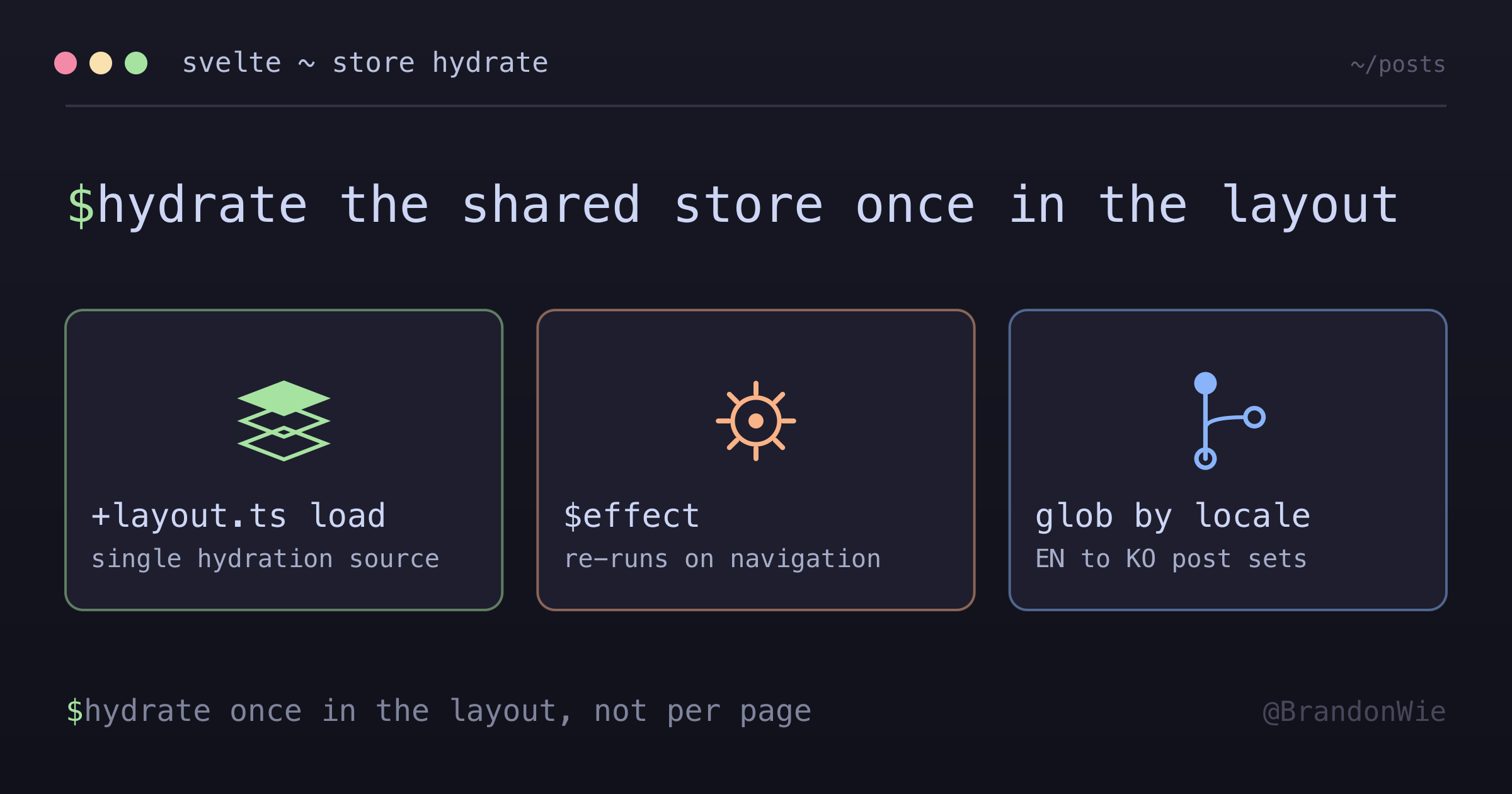
SvelteKit: hydrate a shared store site-wide from `+layout.ts`
A shared `writable` store populated by a single page's `onMount` is empty on every other route. Hydrate it once in the root `+layout` so every navigation carries it.
On this page
A shared writable store is the natural way to hand the same data to many
components in a SvelteKit app. But if you populate it from a single page’s
onMount, it is only ever filled on that one route — every other page reads an
empty store. I hit this while promoting a feature from one view to the whole
site, and the fix turned out to be a small change in where the hydration
happens, not how.
Where this came up
On this site the fuzzy command palette used to mount only inside the old terminal
view, and the posts store was hydrated by the home page’s onMount. When I
promoted the palette to a global Cmd/Ctrl+K surface, it suddenly needed posts
everywhere — /posts, /posts/[slug], /ko/*, and so on. On all of those
routes the store was empty, because the only thing that ever set it was a page
the user might never visit first.
Why a page onMount isn’t enough
+page.svelte’s onMount(() => posts.set(data.posts)) runs only on the page
that declares it. A consumer mounted site-wide — in the layout — reads whatever
is in the store at that moment, which is nothing on any route other than the one
that hydrates it. The route that owns the data and the route the user actually
lands on are not the same route, so the timing never lines up.
The fix is to make the layout the single hydration source. Two SvelteKit details make that clean:
datain+layout.svelteis the layout’s ownloadreturn — not the merged child-page data. So setting the store fromdata.poststhere does not collide with a page that also returnsposts.- Use
$effect, notonMount. The layout instance persists across client-side navigation, soonMountwould fire only once.$effectre-runs wheneverdatachanges, so an EN↔KO navigation swaps the locale’s post set.
The solution
Move the load to the root +layout.ts, and set the store from the layout
component:
// src/routes/+layout.ts
import type { LayoutLoad } from "./$types";
export const prerender = true;

const en = import.meta.glob("../content/posts/en/**/*.md", {
  import: "metadata",
  eager: true
});
const ko = import.meta.glob("../content/posts/ko/**/*.md", {
  import: "metadata",
  eager: true
});

export const load: LayoutLoad = ({ url }) => ({
  posts: collect(url.pathname.startsWith("/ko") ? ko : en)
});
<!-- src/routes/+layout.svelte -->
<script lang="ts">
import { posts } from '$lib/stores/posts';
let { data, children } = $props();
// Re-runs on every navigation whose layout data changes (folds per-page hydration).
$effect(() => { posts.set(data.posts); });
</script>The home page’s onMount(() => posts.set(...)) then gets deleted — the layout
owns hydration, and there is exactly one place that fills the store.
Page hydration vs layout hydration
Page onMount | Root layout $effect | |
|---|---|---|
| Runs on | one route | every navigation |
| Store on other routes | empty | populated |
Reacts to data change (EN↔KO) | no | yes |
| Right when | data is page-local | data is site-wide |
Why $effect and not onMount here
onMount fires once per component instance, and the root layout is a single
instance that survives client-side navigation. So onMount in the layout would
hydrate the store on first load and never again — fine until the data needs to
change with the route. $effect tracks data and re-runs when it changes, which
is exactly what locale-aware content needs: navigating from /posts to
/ko/posts changes data.posts, and the store follows.
One more SSG-specific touch: branch the eager import.meta.glob set on
url.pathname, so each prerendered route bakes in the right locale’s metadata at
build time.
When to keep it page-local
This is not an “always hydrate in the layout” rule. Keep the data in a page’s
onMount when:
- The data is only ever needed on one route.
- The store must NOT change across navigation — then
onMount-once is fine, and cheaper than a re-running$effect.
There is a cost worth naming, too: the global component (here the palette plus
Fuse.js) now ships in the shared layout bundle. If that weight matters, lazy-load
it with a dynamic import().
One thing that nearly tripped me
+layout.ts already existed on this project — it held only prerender and
trailingSlash. A plan written ahead of time that assumed it was a new file
would have clobbered that config. Reading the real file before extending it is
the boring lesson, but it is the one that actually mattered here.
Comments · github discussions
repo brandonwie/brandonwie.dev · category "Blog Comments" · term sveltekit-global-store-hydration