On this page
Stateless Auth DB-Column Drift
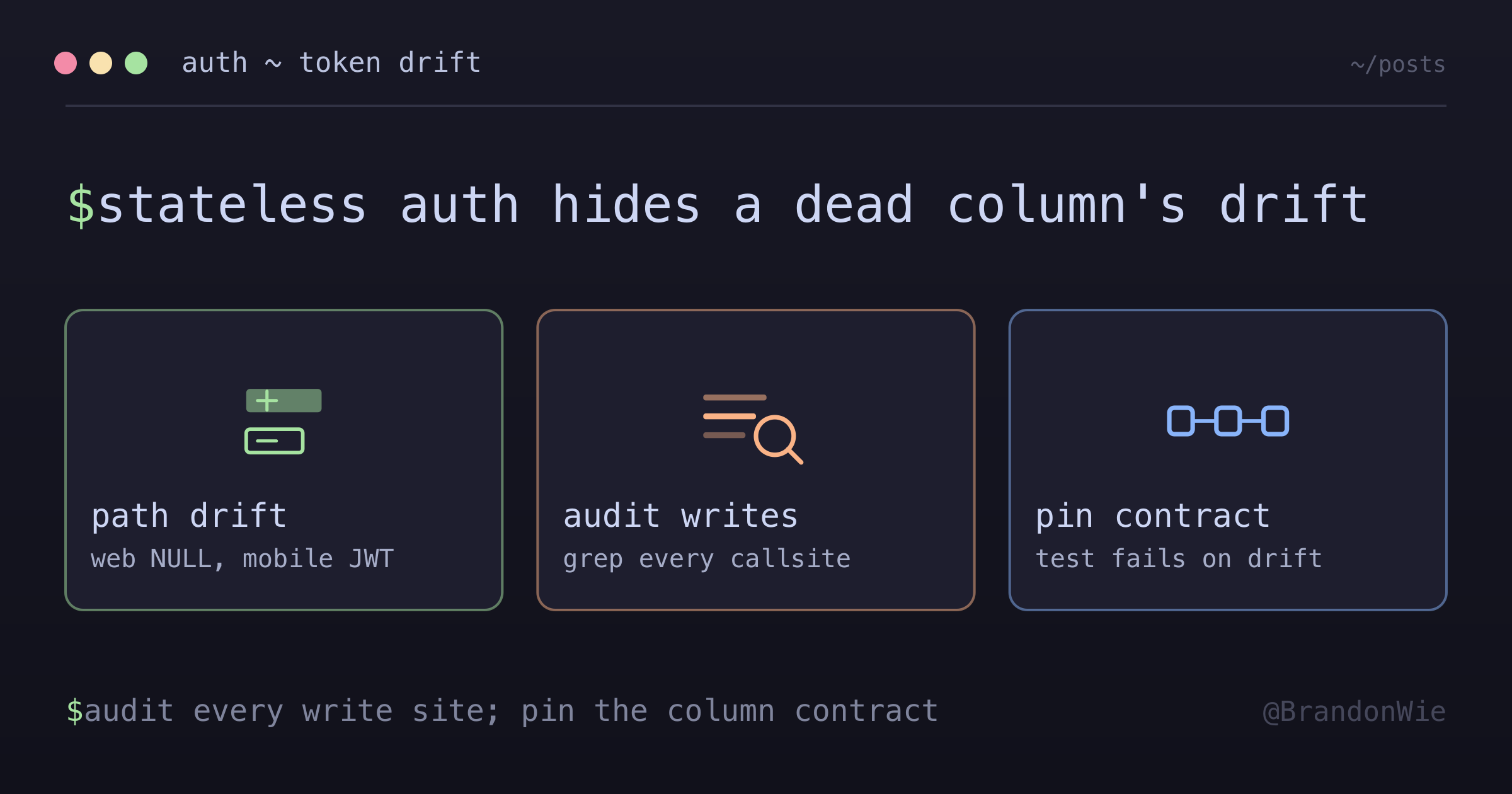
Auth migrated from stateful to stateless JWT validation. Tests pass. Mobile users have access_token populated; web users have NULL. The drift is invisible until ops queries the column.
Auth works. Mobile users log in fine. Web users log in fine. Both can
hit protected endpoints. But query users.access_token and half are
NULL — exactly the half that came in through the web path. The auth
guard doesn’t read the column anymore (stateless JWTs), so the drift
is invisible to user-facing behavior. It only surfaces when ops or BI
queries that column expecting data, and the bug is not in auth — auth
is fine. It’s a data-integrity contract drift downstream of the
migration.
Who, When, Where
This pattern shows up for backend engineers migrating auth from
stateful (DB-stored token compared on every request) to stateless
(JWT decrypted/verified, no DB lookup). It bites during partial
migrations where some code paths are updated but others aren’t, OR
when the DB column is “kept for backward compatibility” but write
semantics diverge between paths. Look in any auth subsystem with a users.access_token (or equivalent) column that is no longer
load-bearing for authentication itself.
What Drifts
When you migrate from stateful auth (guard reads user.access_token from DB and string-compares) to stateless auth (guard decrypts the
JWT, never queries the column), the column becomes functionally dead
— but the writes that populate it usually don’t get audited at the
same time. Different code paths end up with different write
semantics:
- Path A still writes the freshly issued JWT to the column on every login.
- Path B stops writing entirely (or preserves the old null value via a helper that no longer makes sense).
The auth guard works either way (it doesn’t read the column), so the drift is invisible to user-facing behavior. It only surfaces when:
- Ops/BI/Sentry queries the column expecting a non-null value.
- A new feature is added that DOES read the column, finding NULL for half the users.
- A future engineer trying to understand auth reads the column write-sites and gets a contradictory mental model (mobile writes JWT, web preserves null).
Why It’s a Gotcha
Two failure modes hide the drift:
- Tests pass. Auth-flow tests check that login succeeds and the
user can call protected endpoints. They don’t assert
users.access_token IS NOT NULLbecause the column isn’t load-bearing. Drift is invisible to the test suite. - The “stateless” comment is half-honored. Adding a comment
like
// STATELESS APPROACH — column kept for backward compat but not usedto one helper convinces the next reader that all writes have been audited. They haven’t — only the helper they’re reading was updated.
Fix #1: Decide the Column’s Fate Explicitly
When migrating to stateless auth, two options:
- Drop the writes. All paths stop writing. Add a migration to set the column nullable with no default. Delete the column in a follow-up after a deploy stabilizes. Document in an ADR.
- Keep writing consistently. Every issuance path persists the freshly issued token, even though no one reads it. Document the intent (audit trail / future feature / parity).
The wrong choice is “ambient” — neither documented nor enforced.
Fix #2: Audit Every Write Site
Grep for the column name (access_token, accessToken, etc.) and
inspect every callsite. If the helper that wraps the write changed
semantics — say a rotateRefreshToken helper now preserves whatever
was already in the row instead of writing fresh — every caller of
that helper inherits the change silently.
Fix #3: Pin the Contract with a Test
Even if the column is “not load-bearing,” add an integration test asserting the chosen contract:
-- write-consistently contract:
SELECT access_token FROM users WHERE email = '[email protected]'  → NOT NULL

-- drop-writes contract:
SELECT access_token FROM users WHERE email = '[email protected]'  → NULL
This converts an invisible drift into a CI failure. The test costs twenty lines and eliminates the entire class of “ops noticed in production” tickets.
When You Spot Drift in Production
- Check the auth guard first. If it’s stateless (decrypts JWT only, no DB read), the drift is contract-level, not auth-broken. Triage urgency accordingly — this is not a security incident.
- Pick a direction that matches the majority of paths. If 3 of 4 paths write JWT, fix path 4 to match. If 1 of 4 writes, drop the lone writer. Migrating the minority is cheaper than migrating the majority.
- Don’t backfill unless a downstream consumer actually breaks. Affected rows self-heal on next login; backfill migrations cost ops time and risk.
Why Investigation Lands on the Wrong Layer First
The first instinct is “the auth guard must be reading NULL” — but stateless guards don’t read at all. Time spent tracing the guard is wasted; the drift is downstream of auth, not in it. The fastest path to the actual cause is to grep for write sites of the column and diff their behavior across paths.
The “By-Design” Comment Misleads
A // STATELESS — column not used comment near one write site
implies the whole subsystem agreed. Only the helper that comment
lives next to actually behaves that way. Treat localized comments
as evidence about the local code, not the subsystem-wide contract.
A Specific Trap: Helper Preserves the Old Value
The shape that produces this is a refresh-token helper that takes no
access-token argument and reads user.accessToken off the row it
just loaded — NULL for a user who has never been through the writing
path. The caller’s freshly issued JWT is never persisted because the
helper never sees it. Subtle: the bug lives in the helper’s signature
(no token parameter) plus its choice of source (DB column instead of
the fresh JWT), not in any one obvious line.
Worked Example
Here is the asymmetry reduced to the smallest version that still shows the mechanism. Two login paths, one shared helper:
// The path that persists the issued token
async function loginFromMobile(user: User) {
  const accessToken = issueAccessToken(user); // fresh JWT
  const refreshToken = user.refreshToken ?? randomUUID();
  await users.updateTokens(user.id, accessToken, refreshToken); // ← column written
  return { accessToken, refreshToken };
}

// The path that does not
async function loginFromWeb(user: User) {
  const accessToken = issueAccessToken(user); // fresh JWT — returned, never persisted
  const refreshToken = await rotateRefreshToken(user.id);
  return { accessToken, refreshToken };
}

// The helper both paths trust
async function rotateRefreshToken(userId: string) {
  const user = await users.findById(userId);
  const refreshToken = randomUUID();
  // It has no access token to write, so it re-writes whatever the row
  // already held — NULL for anyone who only ever logs in via the web.
  await users.updateTokens(userId, user.accessToken, refreshToken);
  return refreshToken;
}
Both users are logged in. Both can call protected endpoints. Only one
of them has a non-NULL users.access_token.
The fix is mechanical — the web path writes the token it just issued, the same way the mobile path does:
async function loginFromWeb(user: User) {
  const accessToken = issueAccessToken(user);
  const refreshToken = user.refreshToken ?? randomUUID();
  await users.updateTokens(user.id, accessToken, refreshToken); // ← column written
  return { accessToken, refreshToken };
}
The next step (which the ADR should commit to) is deciding whether the column should exist at all once both paths agree.
Key Points
- Stateless auth makes the DB token column dead for auth but not necessarily for ops/BI/audit.
- A subsystem isn’t “stateless” until every write site agrees. One holdout creates path-dependent drift.
- The bug is invisible to user-facing tests because auth still works. CI catches it only if you explicitly assert the column contract.
- “Backward compatibility” is not a fix-direction — it’s a deferral. Pick drop-writes OR write-consistently; document the choice in an ADR.
When to Use
- Auditing a partially-migrated auth subsystem.
- Adding stateless JWT validation but keeping the legacy DB column “for compat”.
- Onboarding to an auth codebase where some paths persist tokens and others don’t.
- Investigating ops dashboards that show NULL token columns despite users being logged in.
When NOT to Use
- Pure greenfield stateless auth (no DB column at all — no drift possible).
- Pure stateful auth (DB column is load-bearing — drift would break login, not just dashboards).
Takeaway
A migration that works for the auth path can still break the data contract downstream of auth. The fix isn’t more clever code — it’s a deliberate, documented decision about whether the column has a purpose, applied consistently across every path that touches it, and pinned by a test that fails the day someone adds a new path that doesn’t get the memo.