On this page
Ruff Three-Gate Pre-Flight
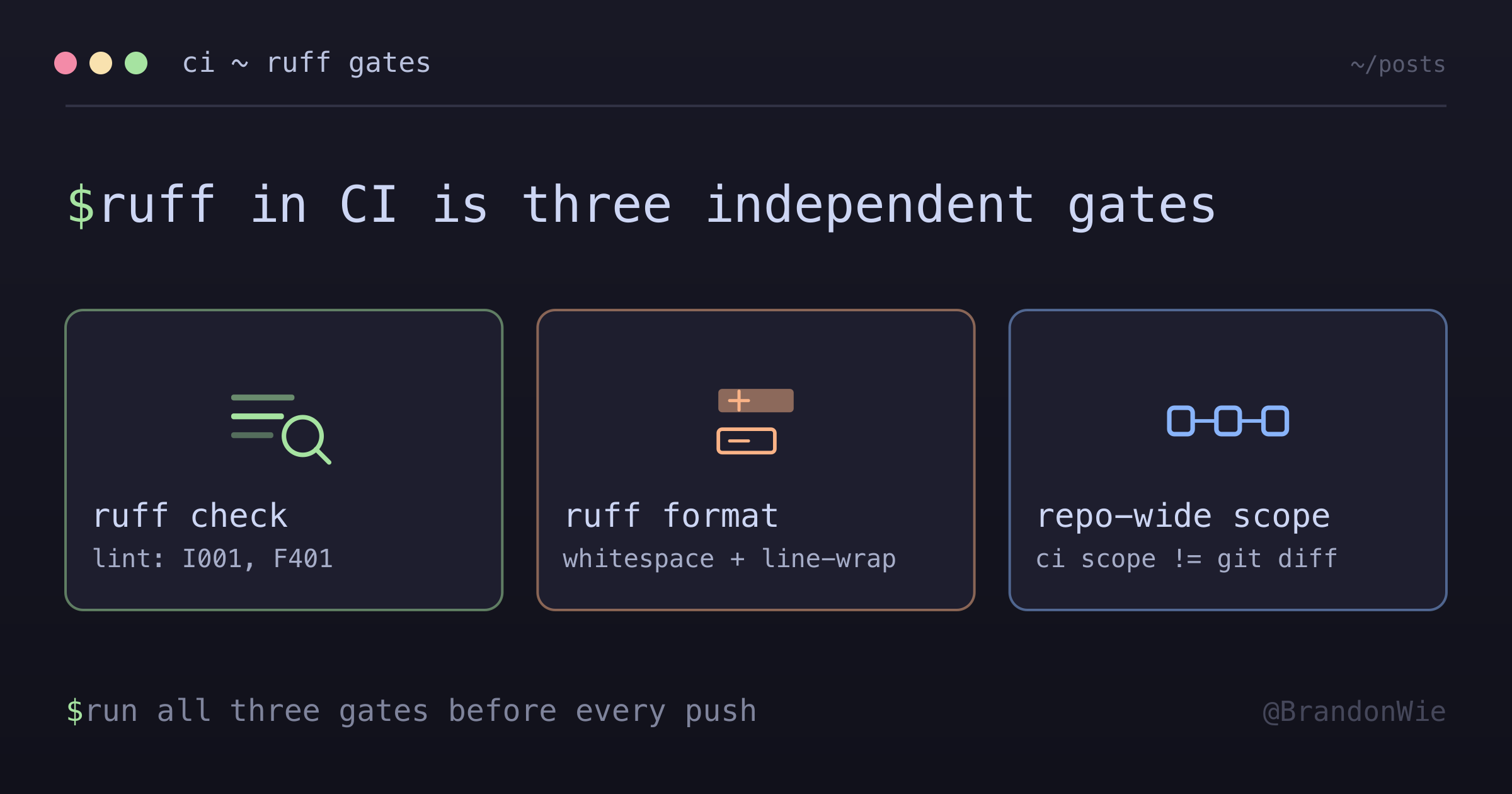
A push that turned into three CI cycles taught me Ruff in CI is three independent gates. A four-line shell function prevents the loop.
Ruff in CI typically runs three independent checks:
ruff check(lint),ruff format --check(formatter dry-run), and a lockfile / dependency integrity check. Each can fail in isolation. Running onlyruff checklocally catches lint errors but lets format failures through, costing a CI cycle per missed gate.
First push to the PR, CI came back red on ruff check — an I001 import
sorting violation. Easy fix, push again. Second cycle: ruff check was green,
but ruff format --check failed on the same files. Push the format fix. Third
cycle: format failed again — this time in a directory I had not touched on that
branch. Three CI cycles to learn that “ruff” in CI is actually three gates, and
the local pre-flight needs to mirror all of them.
The Three Gates
A common Ruff CI configuration runs three steps that look related but gate independently:
| Step | Command | Catches |
|---|---|---|
| Lint | ruff check {paths} | I001 import sorting, F401 unused imports, B-rules, etc. |
| Format | ruff format --check {paths} | Whitespace, line-length, arg-list wrapping |
| Lock-check | uv lock --check (or pip-tools / poetry equiv) | pyproject.toml and lockfile drift |
Running ruff check locally and seeing “All checks passed!” feels like green
CI. It is not. The format check is a separate command; the lockfile check is a
separate tool. CI runs all three; one local pass plays only one.
How the Failure Cycle Plays Out
Each missed gate eats one CI cycle:
- Push commit. CI runs
ruff check. Red. → fix. - Push fix. CI runs
ruff check(green now) ANDruff format --check. Red on format. → fix. - Push fix. CI runs all three. Red on lock-check (or on format in a different directory you didn’t touch but the suite does). → fix.
Each cycle costs CI minutes and wall-clock. On a quota-constrained runner, three failed cycles can burn enough minutes to block other deploys waiting in the queue.
The Pre-Flight Pattern
Run all three gates locally before every push:
# Per-directory pre-flight (run for each Python tree the CI suite touches)
ruff check {dir}                 # Gate 1: lint
ruff format --check {dir}        # Gate 2: format dry-run

# Repo-wide pre-flight (catches gates a repo-wide CI run hits)
ruff check . --quiet
ruff format --check .
If any gate is red, fix and re-run. Push only when all gates report clean.
The repo-wide pass matters because the CI job typically runs the checks across
the whole repo, while your local intuition is scoped to “the files I just
edited.” Drift in unrelated directories — for example, a Markdown linter in my
own tooling repo that auto-rewraps .agents/rules/*.md between my edits and CI
— will fail at CI time even though git diff looks clean.
Reusable Pre-Flight Script
A reusable shell function that loops over directories:
ruff_preflight() {
  local dirs=("$@")
  if [[ ${#dirs[@]} -eq 0 ]]; then
    dirs=(".")
  fi
  for d in "${dirs[@]}"; do
    echo "=== $d: lint ==="
    ruff check "$d" || return 1
    echo "=== $d: format ==="
    ruff format --check "$d" || return 1
  done
  echo "All ruff gates green."
}

# Usage
ruff_preflight src tests
Or as a Makefile target:
.PHONY: preflight
preflight:
	ruff check .
	ruff format --check .
	@echo "preflight ok"
Either form runs in a few seconds locally — far cheaper than a CI cycle.
Key Points
- Ruff’s three gates are orthogonal. Lint and format produce distinct diff sets. Lint flags unused imports; format flags line-wrap. They never overlap, so one passing tells you nothing about the other.
- Auto-fix flags differ. Lint has
ruff check --fix(and--unsafe-fixesfor the rest). Format hasruff format(no--fixflag — formatter is the fix). Mixing them up wastes time. - CI scope ≠ git diff scope. A rebase that touches one service directory may trigger format failures in another one you never opened, because the suite-wide format check doesn’t care which files you changed. Pre-flight repo-wide.
- Lockfile gate hides until format passes. Failed lint blocks format blocks lock-check in most CI configs (sequential job dependency). You may not see the lockfile failure until the prior gates pass.
- Format is non-negotiable. Ruff’s formatter is opinionated and stable.
Local manual formatting will drift from
ruff format; just run the formatter on every save (editor integration) and don’t fight it.
What Each Gate’s Auto-Fix Actually Does
A subtle one: ruff check --fix does NOT trigger ruff format. They are
separate commands. Running --fix and assuming format follows is the most
common version of the three-cycle loop. The fix-flag table:
| Gate | Fix command | What it touches |
|---|---|---|
| Lint | ruff check --fix | Auto-fixable lint violations only |
| Lint | --unsafe-fixes | Adds rules where Ruff is uncertain |
| Format | ruff format | Whitespace, wrapping, quote style |
--unsafe-fixes ships fixes for rules where Ruff is uncertain about behavior
preservation. For your own code, unsafe fixes are usually fine. For
pre-existing third-party files, prefer reviewing the diff before accepting.
When Pre-Existing Main Breakage Compounds
If main is already red on a Ruff gate, your branch’s clean diff still
triggers a hard block at CI time. The gate runs against the whole repo state,
not against your delta. Two paths:
- Same PR. Fix the pre-existing breakage in your PR with an explicit
scope-creep commit (
fix(format): ruff format pre-existing files). Reviewer knows what’s yours and what’s cleanup. - Separate hotfix. Land the cleanup as a tiny independent PR first; rebase your feature branch after.
Choosing depends on PR size and review urgency, but the option you should not
take is “skip the gate” — disabling Ruff in pyproject.toml removes the
safety net entirely, and the directory becomes a drift accumulator.
When to Use
- Before every push to a PR with Python changes.
- After rebasing onto
main(CI scope = full repo, your diff is partial). - When you see “ruff” in CI output for the first time on a project.
When NOT to Use
- Pure docs / non-Python changes — the gates won’t fire.
- Inside a hot debugging loop on a single file — running repo-wide pre-flight every save is overkill; rely on editor integration.
Anti-Patterns
| Anti-Pattern | Why Wrong |
|---|---|
ruff check --fix && git push | Skips format gate; one CI cycle wasted |
| Running ruff only on changed files | Misses suite-wide checks; rebases trigger drift in unrelated dirs |
Treating ruff and ruff format as one command | They’re orthogonal — different diff sets, different flags |
Adding --no-verify to push past failing pre-commit | Hides the gate locally; CI still catches; longer feedback loop |
Disabling ruff in pyproject.toml to “skip the failure” | Disables the safety net; the file becomes a drift accumulator |
Takeaway
If your CI runs Ruff, your pre-flight needs to run all of Ruff’s gates — not just the one whose error message you remember. A three-line shell function saves you the three-cycle loop. The cost is seconds per push; the savings is CI minutes plus the context-switch tax of waiting for red builds.