On this page
Plan-vs-Shipped Divergence Detection on Task Resume
When resuming a multi-session task, the plan.md written at task start may not reflect what is actually shipped now. Implementations evolve mid-flight, scope shifts, branches merge. A 3-minute pre-flight check prevents hours of executing obsolete work.
When resuming a multi-session task, the plan.md written at task start may not reflect what’s actually shipped now. Implementations evolve mid-flight: design decisions get revised, scope shifts, branches merge. Without a pre-flight check, a resume executes the plan’s framing literally — running obsolete tests, restating retired decisions, opening already-merged PRs.
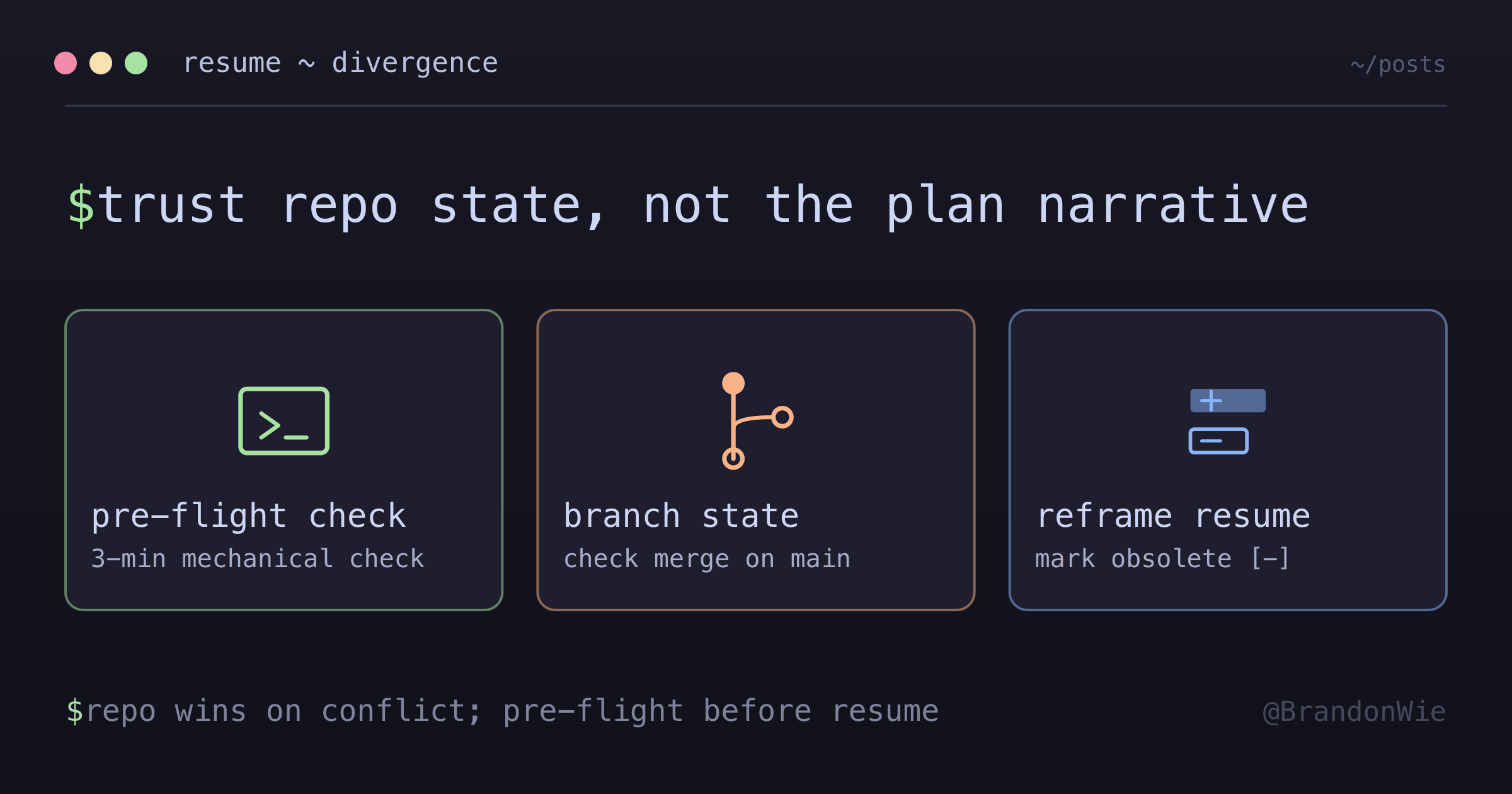
Trust the repo state, not the plan narrative. A 3-minute pre-flight prevents hours of executing obsolete work.
Why plans drift quietly
Four ways plans can mislead a resume:
- Plan narrative is sticky. Once a plan says “Path A/B/C decision pending,” that framing carries forward into triage outputs, journal Next bullets, and ACTIVE-STATUS Priorities. The framing persists past the reality. By the time of resume, multiple downstream artifacts repeat the outdated framing — easy to mistake for canonical truth.
- Section labels mislead. Plan §A, §B, §C may be COMPONENTS of one design (additive) or ALTERNATIVES (exclusive). The reader can’t tell without reading every section. The 2026-04-30 wrap-followup case had sections A-G as components, misread (in journal + triage) as A/B/C exclusive options.
- Branch state lies. Locally-deleted branches look like “task hasn’t started” until you check the merge commit on main.
git branch -adoesn’t surface remote-only branches that were merged + auto-deleted. - Tests evolve faster than plans. Implementation may add unit tests that obsolete plan’s manual verification list. Plan-driven resume re-runs manual tests; reality has unit suite covering the same intent.
Three options, side by side
| Option | Pros | Cons |
|---|---|---|
| Trust plan as-written | Fast resume; no exploration cost | Risk of executing obsolete work; high cost on missed-divergence |
| Re-spec from scratch | Guaranteed fresh framing | Throws away plan’s reasoning + decision context |
| Pre-flight check + reframe | Catches divergence in 3 min; reuses plan core | Requires discipline; user/agent must remember to run it on every resume |
Pre-flight check is cheap (3 min) and high-leverage (saves hours on missed-divergence). Re-spec is overkill for routine evolution; trust-as-written fails on multi-session tasks. The pre-flight reframes the plan in light of reality without throwing away its decision context.
What “divergence” looks like in practice
Concrete case from 2026-04-30, in my own (private) tooling repo: plan.md from 2026-04-25 said “Phase 5 blocks on Path A/B/C decision.” Reality 5 days later:
- Branch
feat/wrap-followup-persistenceno longer existed locally - Implementation merged to main as commit
46e23c05 - Design evolved: carry-forward merge (plan §B) was REPLACED by durable-source-only generator (
scripts/regenerate-active-status.js) for parallel-wrap concurrency safety - “Path A/B/C” was a misread — sections A-G were components, not alternatives
- 4 of 7 verification tests were already covered by 20 generator unit tests (all green)
- 1 test (carry-forward) was DESIGN-OBSOLETE because the path it tested was intentionally retired
Naive resume would execute all 7 manual tests. ~3 hours wasted.
The 3-minute pre-flight check
Before treating plan.md as ground truth on resume, run four mechanical checks:
Branch state:
git branch --show-current git branch -a | grep -i {task-slug} git log --oneline main..HEAD # commits ahead of main- Branch missing locally? → likely already merged
- Branch exists but no commits ahead? → already merged + branch stale
Commit history on critical files:
git log --oneline -15 main -- {plan-mentioned-files} # e.g., -- '.agents/skills/wrap/SKILL.md'- Recent commits referencing the task → implementation likely landed
- No commits → plan still pending
Peek at the actual files:
For each
## Critical Files to Modifyentry in plan.md, verify the plan-described changes are present. If the file content matches plan intent → plan is implemented.Test suite for the area:
ls scripts/{task-area}.test.* 2>/dev/null
node --test scripts/{task-area}.test.js
Existing test suite that postdates the plan → implementation evolved past the plan and added its own verification. Map plan tests to existing units before writing new ones.
Reframe the resume plan
After the pre-flight, the resume plan reframes:
| Plan said | Reality is | Action |
|---|---|---|
| “Decision pending” | “Decision was made + shipped” | Skip decision; verify shipped state |
| “Implement Phase N” | “Phase N already merged” | Skip; verify outputs |
| “Run 7 manual tests” | “20 unit tests cover 4+ of 7” | Map plan tests → unit tests; manual only the rest |
| “Open PR” | “Already direct-merged to main” | Skip PR step; mark [-] |
Mark obsolete plan items [-] superseded with rationale citing the divergence evidence (commit hash, file location, test name).
When this fits
The pattern applies on mid-flight task resume after >3 days idle, multi-session tasks where multiple agents/sessions touched the work, post-merge close-out where the task was operationally done before plan’s verification phase ran, and refactor handoffs where the original plan was outpaced by reality.
It does not apply to same-session resume (plan ≈ reality by definition), greenfield work (no shipped reality to diverge from yet), or plan-mode-only sessions (no implementation to compare against).
Practical takeaway
Repo state is canonical. Plan.md is a historical record of intent; shipped state is reality. On conflict, repo wins. Divergence is normal, not failure — implementation evolution is healthy. Pre-flight is cheap (3 min); missed-divergence is expensive (hours of executing obsolete tests). Document the divergence in the close so the next resume sees the why. Pair with empirical close — divergence often shifts tests from “manual” to “covered by unit suite” or “obsolete by design,” and the remaining un-coverable tests close empirically.
References
- Git —
git branch—-aand--show-current, the two flags the branch-state check leans on - Git —
git log— two-dot ranges (main..HEAD),--oneline, and limiting history to a path