NestJS @Headers Decorator Returns string | undefined
NestJS `@Headers('key')` returns `string | undefined`, not `string[]` — Express normalizes duplicate custom headers by joining them with comma-space.
On this page
In a NestJS controller, when you write @Headers('x-client-type') clientType?: string, what type should clientType actually be? If you look up Node.js’s IncomingHttpHeaders type, it is defined as { [key: string]: string | string[] | undefined }, which suggests any header value could be an array. That implies you should annotate the parameter as string | string[] | undefined and normalize the array before using the value.
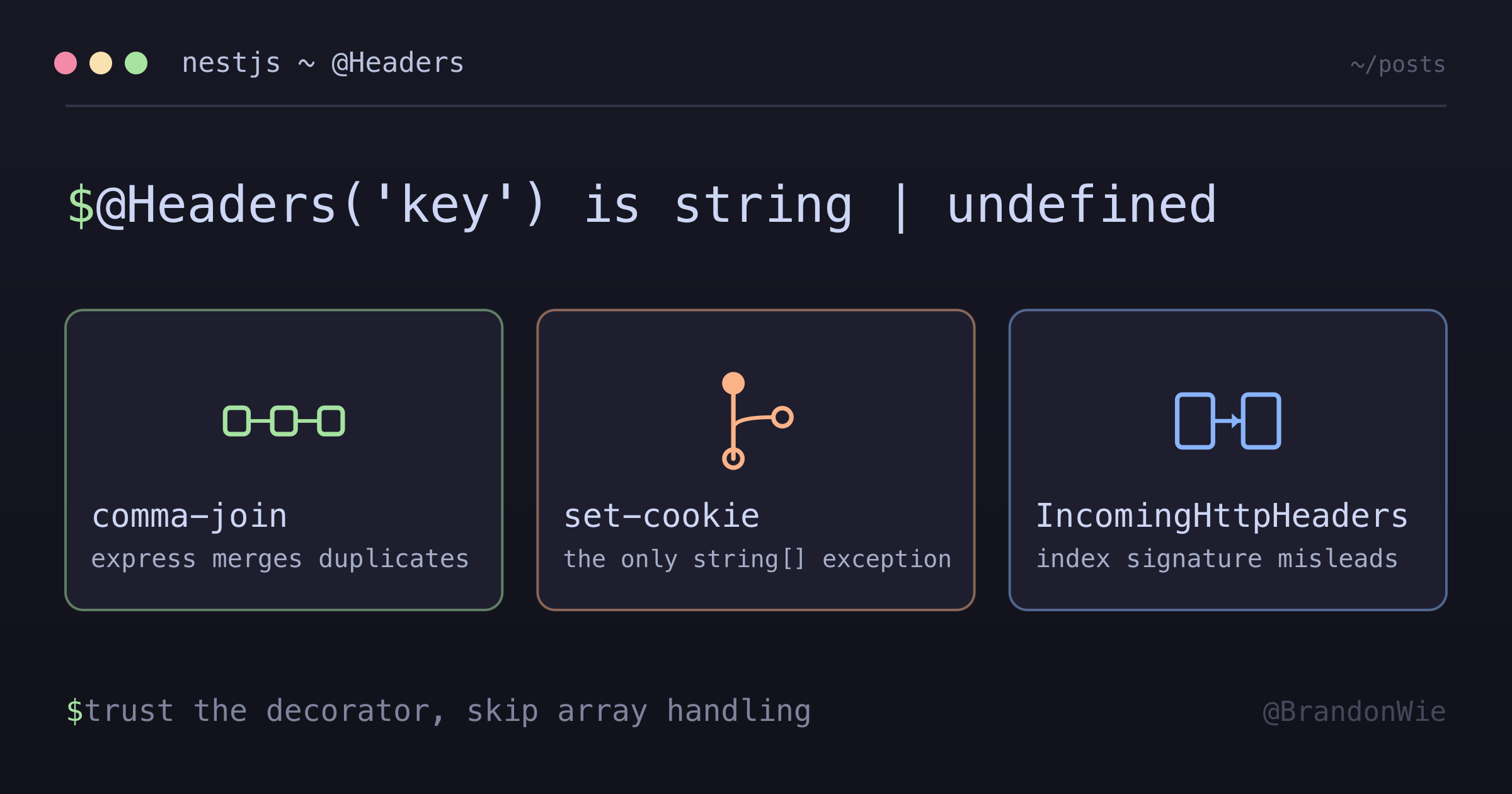
You do not need to do that. NestJS’s @Headers('specific-key') returns string | undefined for every custom header. The only exception is set-cookie, which remains string[].
I am writing this post because a Copilot review flagged clientTypeHeader?: string as incorrect on one of my PRs, citing Express’s raw type signature. The flag was a false positive, but it was articulate enough that I went into the Node.js HTTP source to confirm — and the answer is more specific than the IncomingHttpHeaders type suggests.
Why the type is narrower than string | string[]
Express (the HTTP framework underneath NestJS’s default adapter) normalizes duplicate custom headers before they reach your handler. If a client sends two X-Forwarded-For headers, Express joins them with , (comma-space) into a single string value. Your handler sees one string, not an array of two.
The set-cookie header is the sole exception. Node.js HTTP preserves set-cookie as an array because cookies cannot be safely joined — each value is its own header line with independent expiry, path, and flag semantics. Joining them with commas would produce corrupted cookies. So req.headers['set-cookie'] genuinely returns string[], and that is why the IncomingHttpHeaders index signature has to include the array form at all.
For every other header, req.headers[key] returns string | undefined, which is what NestJS @Headers('key') reflects at runtime.
What this means for your controllers
You can use the narrower type directly without any array normalization:
// Correct — no array handling needed
@Get()
findAll(
  @Headers('x-client-type') clientType?: string,
) {
  if (clientType) {
    return this.handle(parseClientType(clientType));
  }
  return this.handle('unknown');
}
If you want to be extra-defensive against a hypothetical framework change, you can annotate as string | undefined explicitly instead of relying on inference, but you never need to write string | string[] | undefined for a custom header.
When the broader type actually matters
set-cookieprocessing. If you grabset-cookievia@Headers('set-cookie'), treat it asstring[]— it is the real exception. In practice, most request handlers never touchset-cookieon the inbound side, since cookies are read via the separateCookieheader or a cookie parser middleware.- Raw
req.headersaccess. If you bypass NestJS decorators and readreq.headers[key]directly, you are looking at the broader Node.js type and your annotation needs to cover both variants.
Takeaway
@Headers('key') in NestJS controllers returns string | undefined for every custom header. Express’s normalization (joining duplicates with comma-space) is what makes this safe. The misleading part is the IncomingHttpHeaders type signature, which includes string[] in its index signature purely to accommodate set-cookie. Do not let that trick you into writing array-handling code you do not need.
If an AI reviewer flags the narrow annotation as wrong, the review is almost certainly looking at Express’s raw type in isolation instead of tracing what the NestJS decorator actually returns. For a broader look at that failure mode — and three other ways AI code review tools get framework behavior wrong — see AI Code Review Confusion Patterns. This exact case is the canonical example of what I call Cross-File Blindness: analyzing a type signature in one file without checking the decorator that consumes it.
Comments · github discussions
repo brandonwie/brandonwie.dev · category "Blog Comments" · term nestjs-headers-decorator-typing