Infrastructure Hardening Checklist
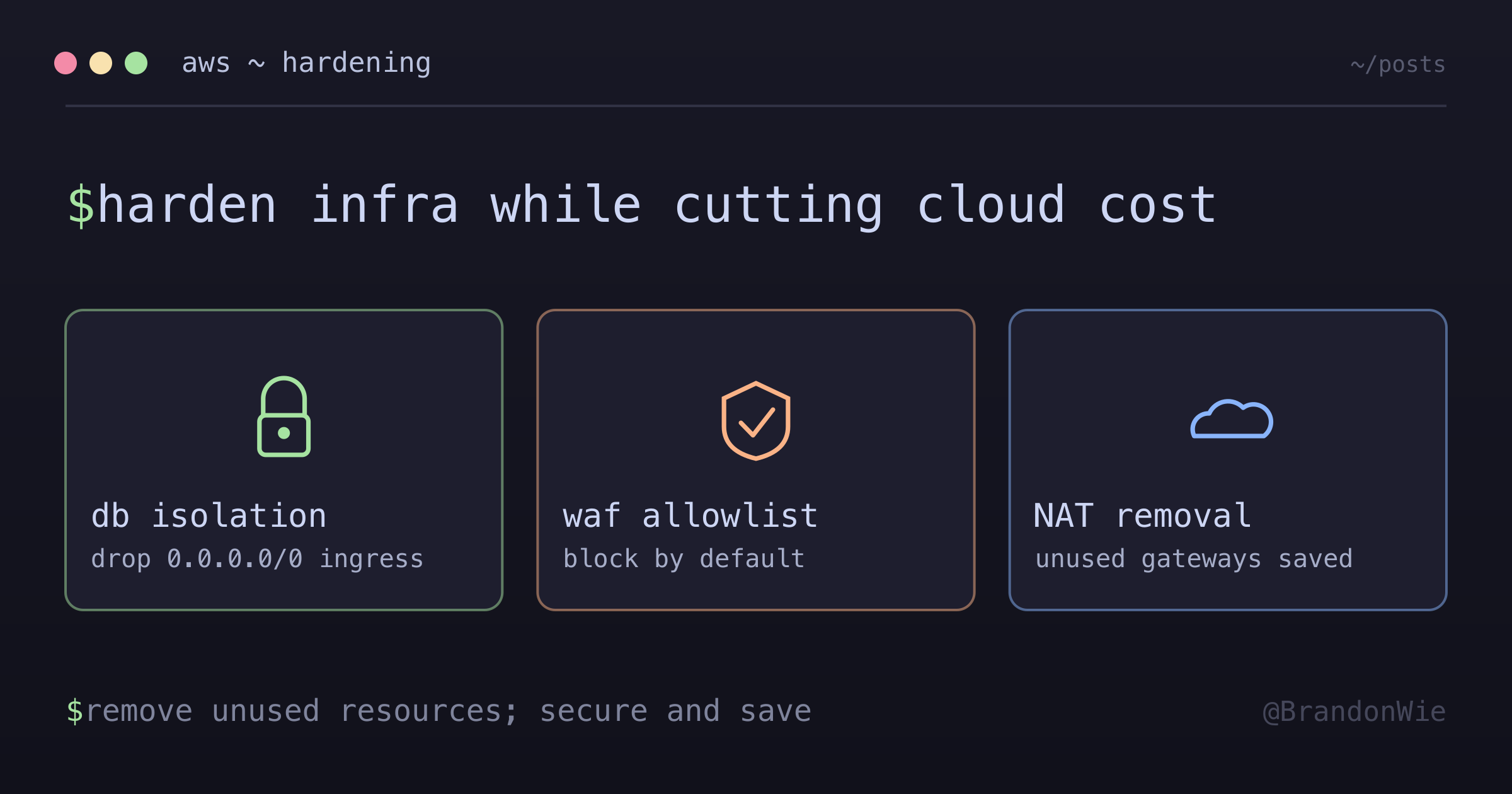
A security hardening checklist for AWS infrastructure: network isolation, WAF deployment, and the cost cuts that fell out of the same work.
On this page
In 2025 I ran a hardening pass over a single AWS environment: ECS services behind an ALB, with RDS and ElastiCache sitting behind them. This is the checklist that came out of that pass, grouped by area rather than by the order I worked through it.
Nothing on the list is novel. It is ordinary AWS practice, and the exhaustive
formal version of it lives in the CIS
Benchmarks. The two items I would
pull out are ordering constraints: add the developer IP rules before removing
0.0.0.0/0, and test every route before flipping the WAF into block mode. The
Implementation Order section at the end is a sequence I would recommend, not a
log of what I did first.
What Actually Changed
These numbers come from that one environment. They are not properties of the checklist, and I would not expect them to transfer.
| Change | What I observed | Monthly cost |
|---|---|---|
| WAF in block mode | Over 1,000 blocked requests per day in the WAF logs | +$30 |
| RDS + ElastiCache isolation | Both stopped accepting 0.0.0.0/0; reachable only from ECS and a few developer IPs | $0 |
| Unused NAT Gateway removal | No traffic at all in the metric window | -$90 |
| Net | -$60 |
My first draft of this note claimed a “95% risk reduction” and a “100% attack surface reduction.” I cut both. Without a stated risk model those are not measurements, and I did not have one — what I had was a security group that stopped answering the whole internet.
The cost column is worth reading on its own. Removing a NAT Gateway nobody was using paid for the WAF three times over, so this particular round of hardening came out cheaper than leaving the environment alone.
Network Security Checklist
Database Isolation
BEFORE: 0.0.0.0/0 access (entire internet)
AFTER: ECS security group + developer IPs only- RDS: Remove
0.0.0.0/0from security groups - ElastiCache: Remove
0.0.0.0/0from security groups - Add ECS security group as allowed source
- Add developer IPs (CIDR blocks) for direct access
- Remove unnecessary ports (e.g., 443 on database instances)
resource "aws_security_group_rule" "rds_from_ecs" {
  type                     = "ingress"
  from_port                = 5432
  to_port                  = 5432
  protocol                 = "tcp"
  source_security_group_id = aws_security_group.ecs.id
  security_group_id        = aws_security_group.rds.id
}

resource "aws_security_group_rule" "rds_from_dev" {
  type              = "ingress"
  from_port         = 5432
  to_port           = 5432
  protocol          = "tcp"
  cidr_blocks       = var.developer_ips  # ["x.x.x.x/32", "y.y.y.y/32"]
  security_group_id = aws_security_group.rds.id
}
Load Balancer Hardening
- Enforce TLS 1.2+ minimum
- Enable HTTP/2
- Optimize health check intervals
- Configure proper idle timeouts
resource "aws_lb_listener" "https" {
  load_balancer_arn = aws_lb.main.arn
  port              = 443
  protocol          = "HTTPS"
  ssl_policy        = "ELBSecurityPolicy-TLS13-1-2-2021-06"
  certificate_arn   = var.certificate_arn
}
NAT Gateway Review
Check for unused NAT Gateways:
# Check NAT Gateway metrics
aws cloudwatch get-metric-statistics \
  --namespace AWS/NATGateway \
  --metric-name BytesOutToDestination \
  --dimensions Name=NatGatewayId,Value=nat-xxxxx \
  --start-time 2024-01-01T00:00:00Z \
  --end-time 2024-01-31T00:00:00Z \
  --period 86400 \
  --statistics Sum
If zero utilization, consider removal (~$90/month savings).
WAF Deployment Checklist
- Deploy WAF with allowlist approach (block by default)
- Add all legitimate API routes to allowlist
- Add health check endpoints
- Add WebSocket/Socket.IO paths
- Test all routes before enabling block mode
- Set up CloudWatch logging for blocked requests
See WAF Allowlist Patterns for implementation details.
Database Backup Checklist
- Increase backup retention (7+ days recommended)
- Enable deletion protection
- Configure automated snapshots
- Test restore procedure
resource "aws_db_instance" "main" {
  # ...
  backup_retention_period = 7
  deletion_protection     = true
  skip_final_snapshot     = false
  final_snapshot_identifier = "${var.project}-final-snapshot"
}
Developer Access Checklist
Short-term (IP-based):
- Document developer IPs
- Add to security group rules
- Create process for IP updates
Long-term (recommended):
- VPN setup (AWS Client VPN or third-party)
- Bastion host for SSH tunneling
- AWS Systems Manager Session Manager
Monitoring Checklist
- CloudWatch alarms for security group changes
- WAF logging to CloudWatch Logs
- ALB access logging to S3
- AWS Config rules for security compliance
Implementation Order
The sections above are grouped by area, not by sequence. This is the sequence I would recommend for minimal disruption:
- WAF deployment - Deploy in monitor mode first
- Database isolation - Update security groups (no downtime)
- Developer access - Add IP rules before removing 0.0.0.0/0
- ALB hardening - TLS policy, health checks (minimal impact)
- NAT Gateway removal - After confirming no utilization
- Backup enhancement - Non-disruptive
Follow-up Improvements
After initial hardening:
- Private subnet migration for all resources
- Remote state backend with encryption
- AWS Secrets Manager for credentials
- VPN setup for developer access
- Infrastructure as Code security scanning
Key Lessons
- Security and cost can align - Removing unused resources improves both
- Incremental changes - Monitor between each change
- IP-based access is temporary - Plan for VPN/bastion
- Document everything - Security changes need audit trail
- Test before production - Verify in dev environment first
Comments · github discussions
repo brandonwie/brandonwie.dev · category "Blog Comments" · term infrastructure-hardening-checklist