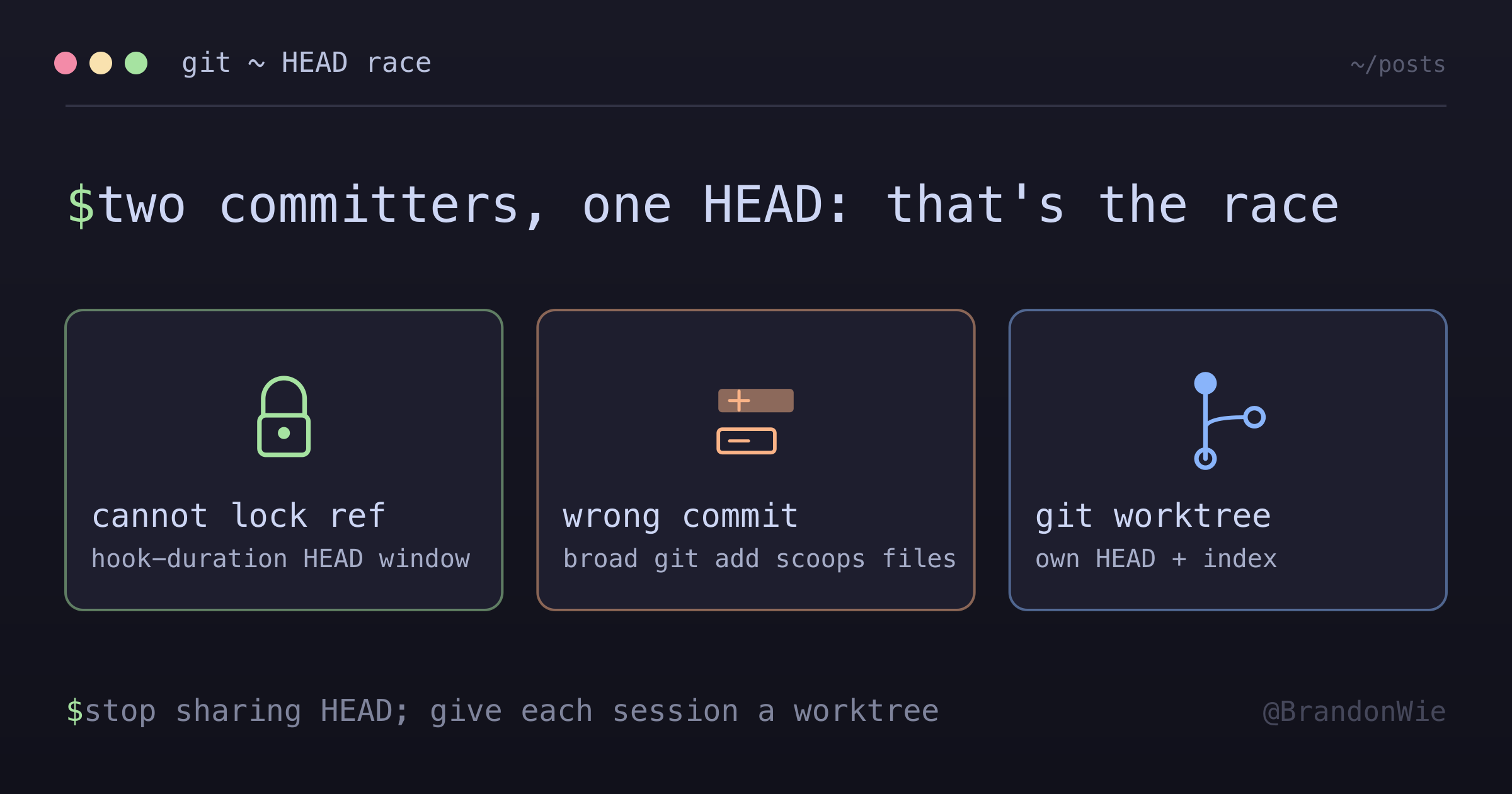
The pre-commit hook race that put my files in someone else's commit
Two sessions committing to one repo, a slow pre-commit hook, and `fatal: cannot lock ref HEAD`. The loud failure is the easy one — the quiet failure hands your staged files to the other session's commit under its message.
On this page
I had two agent sessions working in the same repository at once, and both tried to commit at roughly the same moment. One of them died mid-commit with:
fatal: cannot lock ref 'HEAD': is at <new-sha> but expected <prev-sha>That error is annoying but honest — it tells you something went wrong. The failure that actually cost me time was the quiet one, where the commit “succeeds,” the working tree goes clean, and my staged files turn out to be sitting in a completely different commit under a message I never wrote.
What the error is telling you
A git commit isn’t instantaneous. It reads HEAD (say <prev-sha>), runs the
pre-commit hook, and only then writes the new commit and advances the ref. In a
repo with a heavy hook — linters, formatters, codegen — that hook can take a few
seconds. If a second session commits during that window, it advances HEAD to
<new-sha> first. When my hook finally returns and git goes to move the ref, the
ref isn’t where the commit started, so git refuses to fast-forward the lock
atomically and aborts. That’s the whole race: the pre-commit hook duration is the
window, and a concurrent committer is the other racer.
The silent version is worse
The loud abort at least stops you. The quiet failure starts one level down, at
something I had wrong about git add: the index belongs to the repository, not
to my session. Anything I stage is visible to — and committable by — every other
session working in that checkout. The other session doesn’t have to do anything
unusual for this to bite. Its plain git commit picks up my staged files and
carries them into its own commit, under its own message.
A /wrap-style script that runs git add -A or git add <session-dir>/ across
the whole staging area just makes it wholesale. Now the two problems compound:
my files are staged, the other session’s git add scoops up everything else
too, and it all lands in its commit, under its message. My intended
commit message is gone, and the files are somewhere else in the log.
Here’s what that looked like when I hit it:
git commit -m "feat: scaffold the new skill"fails withfatal: cannot lock ref 'HEAD'.git statusshows a clean working tree — the files look committed.git ls-files <path>confirms they’re tracked.git log -1 --statshows them in a commit whose message is about completely unrelated work — the parallel session’s wrap commit.
The files functionally landed. The attribution and the commit-message intent did
not. The broad git add globs in wrap-style automation are the mechanism that
swept them up.
lint-staged has its own race
There’s a third failure in the same family, and this one isn’t git’s. lint-staged stashes the unstaged changes, runs the formatters over what’s staged, then restores the stash. If another session writes to those same files while the hook is running, the restore fails — it reverts to the original state and the commit aborts.
The misleading part is that the abort looks like a problem with my change, and it isn’t. Retrying once the other session goes quiet is the whole fix.
The abort path has a wrinkle I got wrong on the first pass. When the
stash/restore cycle gives up, lint-staged leaves a stash behind named
On main: lint-staged automatic backup, and my instinct was to treat it as
scratch and drop it. It isn’t scratch. That snapshot covers every modified path
in the checkout, which on a shared checkout means it also holds the other
sessions’ unstaged work. In my case that was seventeen paths, none of them mine.
Leave it in place until the people whose work it represents agree it can go, or
until a blob-by-blob comparison shows there’s nothing in it left to recover.
The fix is structural, not “make the hook faster”
It’s tempting to treat this as a performance problem and shave the hook down. That shrinks the race window but never closes it — any shared, mutable HEAD can still be advanced by another committer mid-hook. The real fix is to stop sharing HEAD at all: give each long-running parallel session its own git worktree.
A worktree has its own HEAD, working tree, and index, so there’s no shared
mutable state for git commit to race on. The path convention I use keeps them
tidy under the main repo:
<main-repo>/.worktrees/<branch-slug>/git -C <main> worktree add <main>/.worktrees/<branch-slug> \
-b <branch-name> <base-branch>Both sessions then commit independently, and when a worktree branch merges back, everyone sees the result — but the commit itself never races.
When a worktree isn’t practical — a quick fix in a checkout that’s already set
up, say — there’s a lighter option that works on the shared index as it is.
git commit -m ... -- <paths> commits only the paths you name and leaves the
rest of the index alone, so two sessions can land separate commits out of one
shared index. The trade-off is that a pathspec commit is built from a temporary
index rather than the one on disk, so the pre-commit hook doesn’t see quite what
it would in an ordinary commit. Worth checking against your own hook before
leaning on it.
Pushing has the same shape of problem as committing, and it’s easy to miss
because the command looks harmless. In a shared checkout, local main can be
carrying another session’s unpushed commits stacked on top of mine, so
git push origin main publishes their work too, at a moment they didn’t choose.
Pushing the exact commit keeps it to my own:
git push origin <sha>:refs/heads/mainCheck first that the commit’s parent is origin/main. If origin/main has
moved on, that push is no longer a fast-forward from my commit alone, and that
is the point to stop and take a fresh baseline, not to fall back to pushing the
branch.
The hook window isn’t the only window
The pre-commit race is a few seconds wide at most. There’s a second race in the same family that runs much longer, and I only caught it because I run a delta guard in my own tooling that exists to catch exactly this kind of thing.
The guard captures a baseline of the repository state before I start editing, then verifies that baseline again right before staging. The span between capture and verify isn’t a hook duration. It’s the whole length of the edit, which can run to minutes. With another session writing to the same repo, that window loses in three ways:
| Failure | What the other session did |
|---|---|
| Unexpected path | Created files that weren’t in the baseline |
| HEAD changed | Committed, so the recorded SHA no longer matches |
| Session path conflict | Nothing. My own path was already dirty at capture |
I hit all three in one session, while a parallel session was writing files and committing to the main branch alongside me.
The remedy was the same every time: re-capture a fresh baseline, and don’t override the guard. An override tells the tool to ignore evidence that the repository moved underneath it, which is the one thing the guard exists to notice. A fresh capture makes it correct again.
The third case has a wrinkle worth knowing if you build something similar. A path that’s already dirty when the baseline is taken has to be declared both as a session-owned path and as a mixed path, and the identical set has to go to the capture step and the verify step. Pass different sets to each and the verify disagrees with the baseline it’s checking against, which looks exactly like a real conflict.
If you’ve already been bitten
A few things that are worth knowing before you try to “fix” the history:
- The index is shared too, not just HEAD. A parallel session’s mixed
git resetcan silently unstage your staged set. Checkgit diff --cachedbefore retrying a commit, and re-stage by explicit path if needed. - Unmerged (
UU) index entries block every commit.git commitfails with “you have unmerged files” even when your pathspec does not touch the conflict. A parallel session’s stash-pop or merge conflict can wedge every other session until it is resolved. UUentries can self-resolve. If another session owns the in-flight operation, checkgit ls-files -u <path>and the worktree for conflict markers before intervening. Resolving its conflict from your session can clobber its work.- Force-push and
--amendare not recovery options here. The commit did happen — just under the wrong message. Amending the parallel session’s commit rewrites their history. Don’t. - Verify where the files actually went with
git ls-files <expected-path>andgit log -- <expected-path>; the latter shows which commit they landed in, andgit show <sha> --name-onlyshows everything else that commit swept up along with them. Do that before re-committing anything. A baregit commitin the other session is all it takes, which is the argument for using the pathspec commit form on a shared checkout from the start. Then there is nothing of yours sitting loose in the index for it to pick up. - There’s no clean re-commit. If your files are already tracked in the other
commit, re-staging is a no-op (
nothing to commit, working tree clean). The message asymmetry is now permanent in history. If attribution matters, the cleanest remediation is a follow-up commit with the intended message and scope and no file changes — a note in the log, essentially.
When worktrees are the answer (and when they aren’t)
Set them up when you’re designing multi-agent or multi-window workflows that share a repo, when you’re diagnosing missing or mis-attributed commits, or when you’re onboarding a task you expect to run concurrently with another session. The cheapest time to do it is before the work starts, not after the race.
You don’t need them for single-agent serial work — there’s no race window — and
this isn’t the explanation for an actual git push --force mishap, which is a
history rewrite, a different failure mode entirely.
The takeaway
cannot lock ref 'HEAD' reads like a timing hiccup, but it’s really a sign that
two committers share one HEAD. Faster hooks treat the symptom. Worktrees remove
the sharing, which is the only thing that actually ends the race, including the
silent variant where your work quietly ships under someone else’s name. The
wider version of the same problem is any tool that captures repository state and
verifies it later: its window is as long as your edit, and when it trips, the fix
is a fresh baseline rather than an override.
Comments · github discussions
repo brandonwie/brandonwie.dev · category "Blog Comments" · term git-pre-commit-parallel-session-head-race