On this page
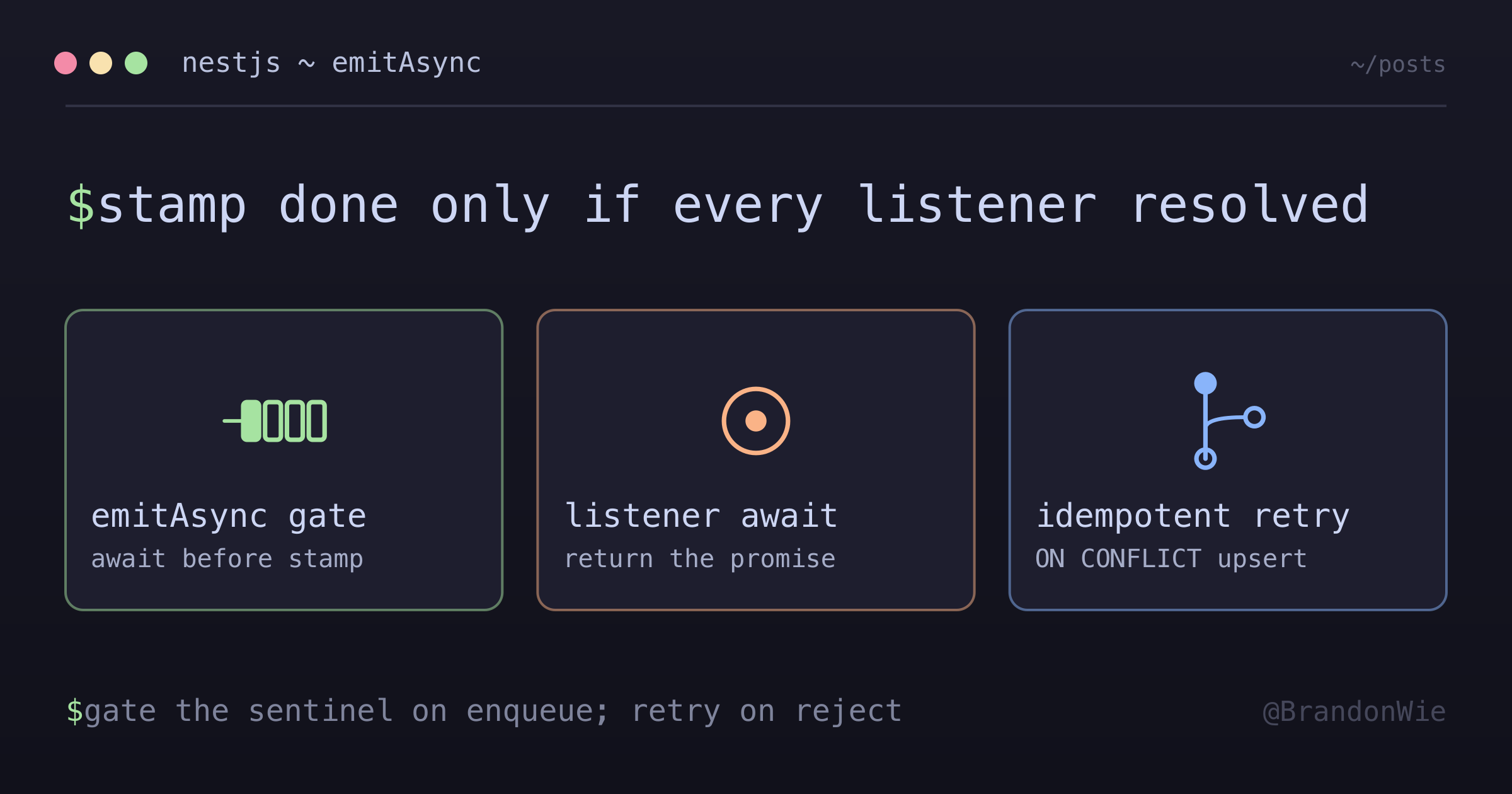
emitAsync Stamp Gating for Idempotent Bootstrap Retries
A bootstrap that emits sync to a queue then stamps "done" silently strands downstream when Redis blips. emitAsync gates the stamp on enqueue admission.
A bootstrap path I worked on wrote rows to Postgres, fired off per-row events
to a queue listener, then stamped a syncedAt sentinel. The code looked
correct. But when Redis blipped, the listener’s queue.add rejected into the
void — the emit was synchronous fire-and-forget, so the promise was detached —
and the stamp landed anyway. The next call short-circuited on the stamp, never
re-fanned-out, and the downstream search index stayed empty. Users searched and
got zero results with no exception surfaced anywhere.
How the Silent Failure Plays Out
A bootstrap path that fans out to a queue and writes a “done” sentinel afterwards has a silent failure mode when the emit is sync fire-and-forget:
- Service writes rows to DB.
- Service loops
eventEmitter.emit('topic', evt)per row.emitis sync and does NOT await listener returns. The listener doesawait queue.add(...), but that promise is detached. - Service writes
bootstrapped_at = now(). - Listener’s
queue.addrejects (Redis unreachable). The promise rejects to nowhere; the service has already committed the stamp. - Next request sees
bootstrapped_at IS NOT NULL, short-circuits to “read from local state”, and never re-fans-out. The downstream system (search index, cache, audit log) is permanently stale for those rows.
The DB rows are correct and the sentinel is set, but downstream has nothing in it, and nothing throws. The bug only shows up when a user later searches and gets zero results, by which point logs from the original Redis blip are long gone.
The Solution: Make the Emit Awaitable
Use EventEmitter2.emitAsync and gate the sentinel write on its resolution.
The contract becomes: the stamp only lands if every listener’s returned
promise resolved. Any rejection anywhere leaves the stamp un-set, so the
next call retries the whole bootstrap.
The examples below are a stripped-down version of the shape, with neutral names — a per-tenant sync source whose rows have to reach a queue before the “synced” stamp is allowed to land.
Step 1: Publisher exposes an *Async variant
@Injectable()
export class RecordEventPublisher {
  constructor(private readonly eventEmitter: EventEmitter2) {}

  // Sync fire-and-forget — fine for hot paths where caller doesn't care
  publishRecordUpserted(tenantId: number, recordId: string): void {
    this.eventEmitter.emit("record.upserted", { tenantId, recordId });
  }

  // Awaited — caller blocks until every listener's returned promise resolves
  async publishRecordsBulkUpsertedAsync(
    tenantId: number,
    sourceId: number,
    recordIds: string[]
  ): Promise<void> {
    await this.eventEmitter.emitAsync("record.bulk.upserted", {
      tenantId,
      sourceId,
      recordIds
    });
  }
}
emitAsync collects the listeners’ return values through Promise.all, so
it resolves to an array of whatever each listener returned. Reject anywhere
in any listener and the whole thing rejects.
Step 2: Caller awaits the emit, then stamps
async syncFromProvider(source: SyncSource): Promise<void> {
  const records = await this.provider.fetchRecords(source.id);
  if (records.length > 0) {
    await this.recordsService.bulkUpsert(source.tenantId, records);
    // Awaited — if the listener's queue.add rejects, this rejects, the stamp
    // below never runs, recordsSyncedAt stays NULL, and the next call retries
    // the whole bootstrap.
    await this.recordEvents.publishRecordsBulkUpsertedAsync(
      source.tenantId,
      source.id,
      records.map((r) => r.id),
    );
  }
  // Only lands if the emit succeeded — gates the sentinel on enqueue admission
  await this.sourceRepo.update(
    { id: source.id },
    { recordsSyncedAt: new Date() },
  );
}
Step 3: Listener does its work inside an awaited handler
@OnEvent('record.bulk.upserted')
async onRecordsBulkUpserted(evt: RecordsBulkUpsertedEvent): Promise<void> {
  if (evt.recordIds.length === 0) return;
  await this.queue.addBulk(/* N chunked jobs */);
}
Returning the promise (or awaiting inside an async handler) is what
makes emitAsync actually wait. A handler that swallows the promise
(void return, fire-and-forget inside) defeats the gating.
Key Points
- Gating contract: sentinel writes only land if
await emitAsyncresolves. Any rejection in any listener leaves the sentinel un-set, so the next call retries. - Idempotency is mandatory. The retry has to be safe, so
bulkUpsertneedsON CONFLICT DO UPDATEand the downstream writes need upsert semantics rather than plain inserts. Without idempotency, retry creates duplicates instead of healing the gap. - Transience is mandatory too. This is the precondition I never wrote down. “Un-stamped gate, so the next call retries” only heals if the next call can plausibly succeed. Redis being unreachable qualifies. A deterministic failure does not: the gate then re-runs the identical doomed work forever. Idempotency and transience are separate requirements, and I only checked the first one.
- Naming convention. The
*Asyncsuffix on the publisher method signals that callers mustawait. SyncpublishXand asyncpublishXAsynccan coexist on the same publisher, since different call sites care about different things. - Empty payload edge case. Skipping the emit on empty input is the easy half, since there is no work to enqueue. Whether to still stamp is the harder half. Stamping on empty avoids a pointless re-fetch when the source genuinely has no data; not stamping forces a retry that will also fan out nothing. Either is defensible; pick one and write the choice down.
Listener-Side Swallowing Breaks the Gate Silently
If any @OnEvent handler is declared async but its body fires queue.add without await, the handler returns undefined immediately
and emitAsync sees a resolved listener even though enqueue is in flight.
Worse: a post-resolve rejection becomes an unhandled rejection with no
visible error on the gating path.
The fix is mechanical: every awaited-emit handler has to return await (or just await) the work it depends on. A unit test that mocks queue.add to reject and asserts the publisher’s *Async method rejects
is what pins the contract in place.
A Deterministic Failure Turns the Gate Into a Permanent Loop
Three months after shipping this pattern, the same bootstrap path produced the exact silent-staleness bug the gate was written to prevent, reached from the other side. That one surprised me, because the gate itself never misbehaved.
bulkUpsert built a single INSERT ... ON CONFLICT binding six params per
row, so any source above 10,922 rows exceeded Postgres’ 65,535
bind-parameter ceiling and threw. That ceiling is not a tunable: the wire
protocol’s Bind message counts parameters in an Int16, so one statement
can never carry more. And that throw is deterministic: same input, same
failure, every time. The gate did precisely what it promised. recordsSyncedAt stayed NULL, so the next call retried, and the retry
re-fetched from the upstream provider and threw again. Every request,
indefinitely.
What made it invisible was the caller’s error isolation, which read as correct on its own:
// Degrade to an empty wrapper so one broken source can't 500 the endpoint
const result = await this.bootstrapOne(tenantId, sourceId, source).catch(
  (err) => {
    this.logger.error(`Bootstrap failed for tenant=${tenantId}: ${err.message}`);
    return { tenantId, sourceId, label: source.label, records: [] };
  },
);
Composed with the gate, those two reasonable pieces produce a state no reviewer of either one would predict: affected tenants get zero records forever, every request burns a full upstream fetch, and the only trace is a log line that reads like a transient blip precisely because it recurs so often.
The fix I landed on kept the gate and went after the determinism instead, chunking the upsert so the bind-parameter ceiling stops being reachable. Two diagnostics look worth building in from the start, and I wish they had been there:
- Count the retries. A gate that has left the same sentinel un-set N times for the same key is reporting a deterministic failure rather than a flaky dependency, and logging at a higher severity past a small N would have made this loud.
- Ask whether the catch can distinguish. A
catchthat degrades identically for “token expired” (transient, user-fixable) and “input too large for one statement” (deterministic, code bug) has erased the exact distinction the gate depends on.
Multiple Listeners on the Same Topic
emitAsync waits for ALL listeners. If you add a downstream consumer
(e.g., analytics) that does slow IO inside the same handler, every
bootstrap call now blocks on it. Either move slow consumers to a
different topic or fire them on a separate sync emit from inside the
awaited handler so the listener-of-listeners decoupling is explicit.
Wrapping in a TypeORM Transaction Is Usually Not the Answer
A common impulse: “make the DB write + sentinel atomic in a txn.” For
the bootstrap case there’s typically only one DB write before the emit,
so the txn wraps a single statement (already atomic via Postgres
autocommit). The real bug is sequencing (sentinel between writes), not
atomicity. A txn doesn’t fix the gating problem, and it adds a
long-running transaction holding row locks across an await to a queue
server, which is bad practice.
When to Use
- One-shot bootstrap paths where a sentinel decides whether to re-fan-out (TTL stamps, “first sync done” flags, materialized-view refresh markers).
- Any flow where the upstream side-effect (DB write) must precede the downstream side-effect (queue enqueue), but failure of the downstream must prevent declaring “done”.
- Multi-listener fan-outs where all listeners must succeed before the caller can claim the operation completed.
When NOT to Use
- Hot-path single-emit fire-and-forget, where
emitstays the right call for low-latency cases, provided the listener failure is recoverable by other means (e.g., per-row retry from a poll loop). - Cases where the listener’s work is slow and the caller can’t afford to block on it. Split those into a fast acknowledgement listener + a separate slow worker.
- When you have no idempotent retry path, since gating without idempotency just trades one bug (silent stale state) for another (duplicate rows on retry).
- When the failure on the gated path is deterministic rather than transient. An un-stamped gate only heals a gap the next call can plausibly close, so a failure that reproduces on identical input turns the gate into a permanent retry loop instead (see “A Deterministic Failure Turns the Gate Into a Permanent Loop” above).
Takeaway
Sync emit + post-emit stamp is one of those patterns that looks correct
in code review and survives every happy-path test. The bug only appears
when an external dependency blips at exactly the wrong moment. emitAsync plus listener await plus stamp-after-emit composes a gate that turns
that silent failure into a clean retry, assuming the bootstrap path is
already idempotent. The part I’d add now: also check that the failures
you’re gating against are actually transient. A retry loop only heals a
gap it can eventually close, and I found that out the slow way.