On this page
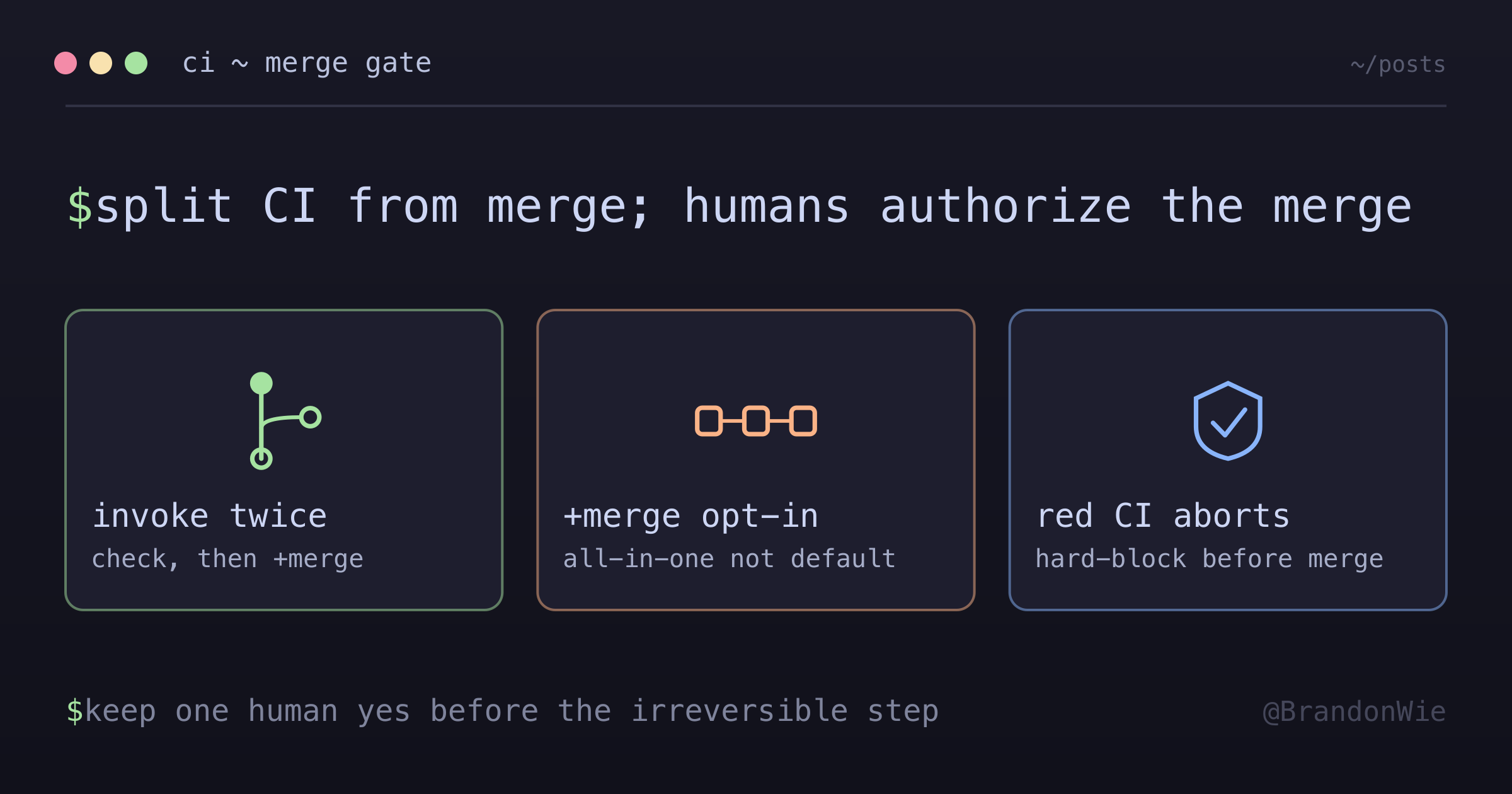
Two-Phase Invocation as a Manual Merge Gate
When a CI/CD automation skill supports an "all-in-one" mode (`/skill +flag`), the all-in-one mode should be opt-in, not the default. Splitting invocations preserves a meaningful pause point between CI green and the irreversible merge.
/crucio-ship runs three logical phases for a PR-to-prod ship. Each phase has very different reversibility properties, and bundling them into one invocation conflates the easy parts with the irreversible parts.
| Phase | Action | Reversibility |
|---|---|---|
| 1 | Dispatch + watch CI on the PR branch | Read-only |
| 1.5 | gh pr merge --merge --delete-branch | Irreversible (without revert PR) |
| 2 | Dispatch deploy + verify chain fires | Production-affecting |
Phase 1.5 is the one that matters. Once gh pr merge --merge lands the commit on the base branch, the way back is a second pull request that reverts the merge commit — cheap, but no longer free, and it leaves a trail.
The skill supports +merge as an arg that runs all three phases in one invocation. Convenient — but it removes the “operator looks at green CI and decides to authorize merge” step. For a portfolio prod environment with manual smoke tests, that gate has real value. The skill itself doesn’t need modification — invoking with vs without +merge IS the gate.
Invoke twice, on purpose
The pattern is to invoke twice instead of once with +merge:
First invocation:  /crucio-ship       → Phase 1 only (CI dispatch + watch)
                                        → Hard-blocks on red CI
                                        → Reports green/red status
                                        → EXITS

[operator inspects logs, decides to ship]

Second invocation: /crucio-ship +merge → Phase 1 (re-runs — wasteful) +
                                          Phase 1.5 + Phase 2
The “Phase 1 re-runs” cost is real but the cycles are cheap (~10min CI run on a small change). For larger CI suites, the skill could grow a +from=phase1.5 arg to skip already-verified phases, but that’s YAGNI for now.
There’s an alternative for high-CI-cost cases: instead of re-invoking the skill, manually execute Phase 1.5 + 2 using the loaded skill content as a runbook. This skips the re-CI cost entirely. Trade-off: you’re hand-running steps the skill would otherwise script. Fine for an interactive session, not for unattended automation.
Why the gate is the value
Three reasons this pattern justifies its overhead:
- High-blast-radius automation should default to multi-step. The single-shot mode should require an explicit flag, not be the default. Default behavior is what gets used when nobody is paying attention; the safe path should be the default.
- The gate is the value, not the skill code. The skill itself doesn’t need new code; the invocation pattern provides the gate. Don’t conflate “skill design” with “skill use” — sometimes how you call a tool is the design.
- Cheap re-runs make split-invocation viable. If Phase 1 cost \$50/run, the re-run penalty would force a different design. Cheap CI is what makes this pattern affordable.
- Document the split as the recommended path. Otherwise operators discover
+mergefirst, use it once, and never go back.
What the design got wrong
Two things bit during use:
- The naming is asymmetric.
/crucio-ship(no flag) is “Phase 1 only” and/crucio-ship +mergeis “all phases.” Reading skill docs, it’s not obvious that omitting the flag is the gated path. Clearer naming would be/crucio-ship-check+/crucio-ship-execute, but the flag-based design is already shipped, and renaming a deployed skill costs more than it gains. - Re-invoking the skill costs ~10min of CI re-run. For small changes this is acceptable; for large changes (full test suite) it’s not. Workaround: hand-execute Phase 1.5 + 2 from the skill content as a runbook in the same session, skipping the re-CI cost.
When this fits
Use a multi-invocation split when:
- Production deploys where the operator should consciously authorize the irreversible step (merge, push to main, dispatch deploy).
- Multi-phase automation where intermediate state (CI green) is itself meaningful information the operator wants to inspect.
- Skills with hard-block gates (red CI = abort) — the gate is what you came for; don’t bypass it with auto-everything.
Don’t bother with the split when the automation is truly low-blast-radius (preview deploys, dev environments, internal tooling — all-in-one is fine), when shipping is unattended/cron-driven (CI bot, Renovate auto-merge — the gate is meaningless when no human is waiting), or when the gate would just be rubber-stamping. If the operator’s decision is always “yes, ship,” the gate is theater. Either improve pre-merge signals or accept auto-shipping.
Practical takeaway
For high-stakes automation, opt-in for the all-in-one path and split invocation as the default. The gate between “CI green” and “merge merged” is one of the cheapest places to insert a human check, and a 4-round AI-reviewed PR still benefits from one human “yes, merge now” before the irreversible step. The skill code doesn’t need to change — how you call the skill is the design.
References
gh pr merge— GitHub CLI manual — the Phase 1.5 command, including-m, --mergeand-d, --delete-branch- Reverting a pull request — GitHub Docs — a merged PR is undone by a new PR that reverts the merge commit, which is why Phase 1.5 is the gate
automerge— Renovate configuration options — the unattended case where a human gate has nothing to gate