On this page
Forward Links Only: A Zettelkasten Where Backlinks Are Computed
3B stores the link an author can maintain, derives the reverse edge later, and makes the struggle behind a note part of the knowledge itself.
The backlink maintenance trap
A bidirectional knowledge graph sounds responsible until you have to maintain it.
Suppose note A references note B. The useful thing to write while authoring note A is obvious: “this note relates to B because of this reason.” The tempting thing to also write is the reverse edge on note B: “A links here.” That second edge feels complete, but it is not new knowledge. It is bookkeeping.
Bookkeeping drifts.
The next time note A changes, note B’s reverse edge may not change with it. A file moves and the reverse path goes stale. A link is removed from one side and forgotten on the other. The graph still looks richly connected, but some of that richness is a lie.
3B avoids that class of rot by refusing to store the reverse edge. It stores only the forward link the author is already thinking about. Backlinks are computed later by walking the stored forward links.
That sounds like a small schema choice. In practice, it is the maintenance economics of the whole knowledge base.
Atomic notes are graph nodes
The 2026-06-14 architecture model describes the knowledge layer as 940 atomic, frontmatter-typed entries across 15 category folders. Treat those numbers as model-snapshot facts, not a promise that the live filesystem will stay frozen. The structure matters more than the count.
Each durable note lives under knowledge/{category}/ as a kebab-case Markdown
file. The category gives the note a home. The tags classify cross-cutting
concerns. The frontmatter records metadata the rest of the system can read:
status, dates, confidence, references, publishing state, usage history, and
forward links.
The body is not free-form scratch. Knowledge entries follow a 5W1H shape:
- The Problem
- Difficulties Encountered
- The Solution
- When to Use
- When NOT to Use
Decision-shaped entries add options considered and the reason the chosen approach won. That keeps a note atomic without making it contextless. It tells a future reader not only what the answer is, but why the answer was worth writing down.
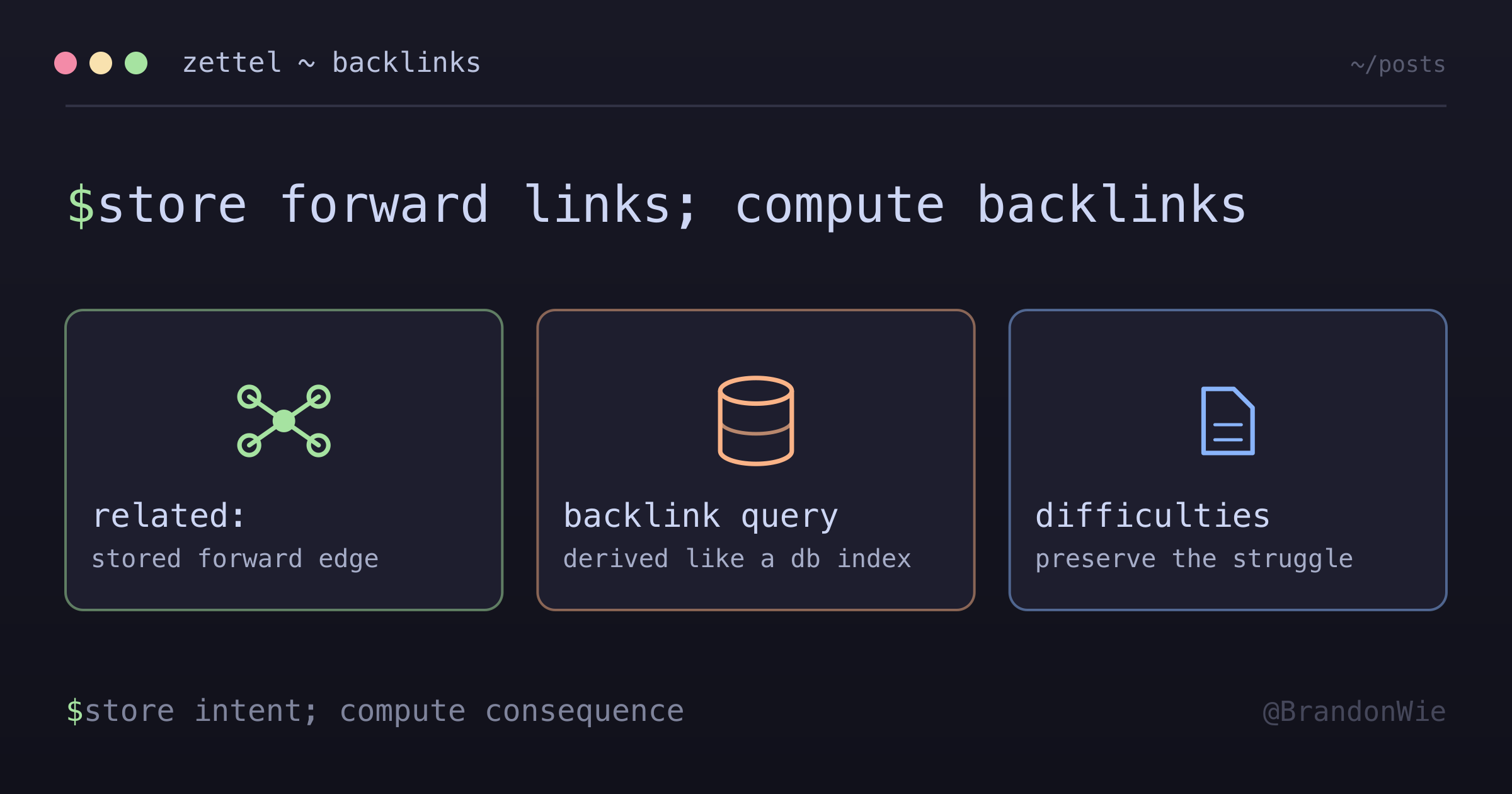
related: is the stored edge
The stored link lives in frontmatter:
related:
  - path: ../devops/example-pattern.md
    context: "Why this note points there"
That context field is not decoration. A bare path says two notes are
connected. The context says why. Without it, future readers and retrieval tools
inherit an edge with no semantics.
3B keeps link metadata in frontmatter for the same reason it keeps rule routing in frontmatter: the graph edge is part of the source. It should be reviewable, parseable, and available to tooling without scraping prose sections like “Related” or guessing from inline mentions.
This also keeps authoring discipline clear. The writer owns the forward claim: while writing this note, I know it points to that note for this reason. The writer does not own every future reverse listing that might mention this note. That reverse listing is derived.
Backlinks are a query, not an authoring burden
If note B wants to know who points at it, the system can answer by scanning all
stored related: links and selecting entries whose path targets B. That is a
query. It is not a field the author should maintain.
This is the same basic move as a database index. PostgreSQL’s documentation puts it plainly: “Once an index is created, no further intervention is required: the system will update the index when the table is modified,” and indexes “can be added to and removed from tables at any time.” The table holds the canonical fact. The index is a derived lookup shape you can drop and rebuild without losing anything. A reverse index over notes behaves the same way. A manually edited reverse edge does not — you have to trust it, because there is nothing to rebuild it from.
Note-taking tools reached the same split, just higher up. Obsidian’s backlinks documentation defines a backlink as “a link from another note to that note” and fills the pane from notes that contain an internal link to the active note. The reverse view exists because the tool computes it, not because anyone typed it. 3B makes the split one layer lower, in the schema itself: there is no reverse field to edit, so there is nothing that can drift away from the forward links.
3B’s schema makes the rule explicit: forward links are stored; backlinks are
computed. 3B’s own Markdown authoring rule reinforces it by pushing links into
frontmatter and banning wiki-style [[shortcuts]] in note bodies. The YAML
schema documents the linking strategy directly: external references are URLs,
forward links are internal related: entries, and reverse edges are computed
from those forward links.
The generated knowledge/_index.md is one downstream surface of that choice.
Graph tools and retrieval layers can read the same forward-link facts and build
whatever reverse view they need. The source notes stay simple.
The dashed edge is the important one. It is useful, but it is not authored.
Categories keep the graph human-sized
Forward links solve edge maintenance. They do not solve placement.
3B uses 15 category folders in the June 11 model snapshot. Categories are not
arbitrary personal moods; they are documented in knowledge/_categories.md with
examples and exclusions. devops, backend, ai-ml, and general dominate
the distribution. One category collects work-specific material that does not
transfer outside the system it came from, so it is excluded from public
publishing by default.
There is also a threshold for creating a new category: five or more orphan notes. That constraint matters. Without it, every note can argue for its own folder, and the taxonomy becomes another thing to maintain. With it, categories emerge only after enough pressure accumulates.
The result is a two-level model: folders give a stable primary home, tags describe cross-cutting dimensions, and forward links connect concepts across homes. The graph can stay rich without turning the directory tree into a graph itself.
Why the difficulty section matters
The unusual part of 3B’s knowledge template is not “The Solution.” Every knowledge base has solutions.
The unusual part is that “Difficulties Encountered” is required.
That section captures the dead ends, misleading signals, wrong assumptions, and friction that made the answer non-obvious. It is easy to cut those details when cleaning up a note. It is also how you erase the most reusable part of the learning.
A polished answer tells future-you what to do. The difficulty narrative tells future-you why the wrong path looked plausible. For agent-assisted work, that is especially valuable. Agents often fail in repeated shapes: trusting stale summaries, broadening scope, reading generated output as source of truth, missing a frontmatter rule. Capturing the struggle makes those patterns searchable and reusable.
It also makes later blog posts better. A post that only states the final system is a tour. A post that preserves the problem, the confusion, and the resolution has an arc.
How the graph feeds the rest of 3B
The knowledge layer is not an archive at the edge of the system. It is the distilled layer other workflows feed and query.
/wrap and /archive-task promote session working state into durable
knowledge. Frontmatter gives retrieval tools structured fields. references: support publication credibility. when_used: records reuse. The blog: block
lets selected entries sync to brandonwie.dev. The privacy matrix keeps private
areas, including work-specific categories, out of public/index surfaces.
That means the Zettelkasten is not separate from the agent harness. It is one of the harness’s memory surfaces. The same note can help a future session retrieve a design pattern, feed a blog post, and explain why a past workaround was rejected.
The forward-links-only rule is what keeps that graph cheap enough to maintain. Every extra manual field has to earn its place. Reverse edges do not.
What this pattern buys and what it costs
The main benefit is trust. If a note says it points to another note, that is an authored claim with context. If a reverse edge appears in a graph view, it is computed from authored claims. You know which layer you are looking at.
The second benefit is authoring speed. When writing a note, you add the links you actually mean. You do not leave the file to patch every target’s reverse metadata.
The cost is that reverse views require tooling. A plain file read will not show every backlink unless some index or query layer computes it. 3B accepts that cost because the alternative is worse: stale bidirectional metadata that looks complete but cannot be trusted.
This is the general 3B pattern again: store source facts once, compute derived views, and make the boundary explicit.
Store intent, compute consequence
The forward link is intent. The author knows, at the moment of writing, why this note points to that one.
The backlink is consequence. It follows mechanically from all the forward links in the corpus.
3B stores intent and computes consequence. That is why the knowledge base can be a graph without asking the author to maintain every edge twice. It is also why the required difficulty narrative belongs in the note: the goal is not only to remember the answer, but to preserve the path that made the answer worth remembering.
A durable knowledge base does not get durable by storing more fields. It gets durable by storing the fields a human can keep true.