Why your updater keeps re-enabling the Claude plugins you disabled
I kept a couple of plugins deliberately off, ran my updater, and they came back on. The script provably never re-enabled anything — because the re-enable was not the script's to begin with. Here is the snapshot-and-reassert guard that stopped the toil.
On this page
I keep a couple of Claude Code plugins and MCP servers deliberately turned off. I
set enabledPlugins["x"]: false (or add the server to disabledMcpjsonServers),
go about my day, run my toolchain updater — and find the thing switched back on.
Disable it again. Next update, back on again. After the third round of this I
stopped treating it as a fluke and went looking for whatever kept flipping the
switch.
The frustrating part was that I could look straight at my updater and “prove” it wasn’t the culprit. The proof was wrong, but it took me a while to see why.
The proof that lied
My updater enumerates claude plugin list, filters to the enabled plugins, and
only calls claude plugin update on those — the awk filter drops any row marked
Status: ... disabled. There is no claude plugin enable anywhere in the
script. You can grep it top to bottom and convince yourself it cannot possibly
re-enable anything. I convinced myself, twice.
Two things kept the bug out of focus. First, a no-op update hides it completely:
if every plugin is already on the latest version, the update barely touches
settings.json, the disabled set survives untouched, and the logs from that run
look innocent. The bug only fires when a plugin actually installs a new
version — so half my test runs “exonerated” the updater. Second, there are
several look-alike vectors that flip disabled→enabled and present identically:
- the
settings.jsonatomic-rename symlink trap, where aclaude pluginwrite swaps the symlink for a regular file; enableAllProjectMcpServers: truequietly turning on every project.mcp.jsonserver;- marketplace reconciliation re-applying enable-defaults.
I chased the wrong one of those for a while before stepping back.
What was actually happening
enabledPlugins["x"]: false is not a hard uninstall. It is cosmetic, reversible
state that lives in settings.json. When claude plugin update <name> installs
a real new version — or claude plugin marketplace update reconciles the catalog
— the Claude CLI rewrites settings.json itself, and that rewrite can reset
enabledPlugins and disabledMcpjsonServers back to their enabled defaults.
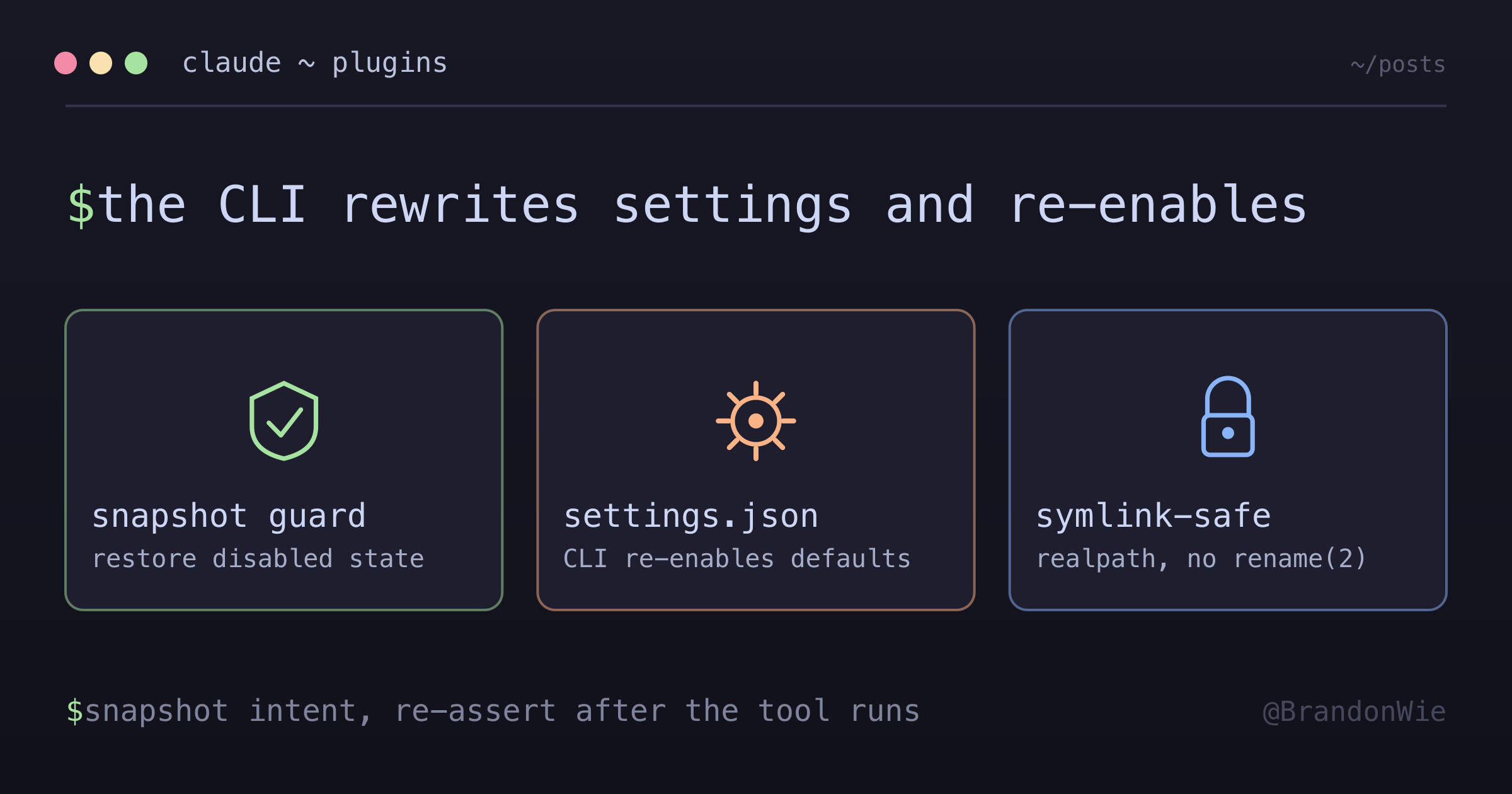
That is the whole trick. The re-enable is the CLI’s own write, not a command my script chose to run. My careful enabled-only loop was irrelevant, because the flip happened as a side effect of the CLI’s settings reconciliation. No amount of auditing the script would ever find it — it wasn’t in the script.
The fix that doesn’t care which vector fired
Once I understood the re-enable could come from any of several places, I stopped trying to fix the specific mechanism and wrapped the whole update in a snapshot-and-reassert guard:
- Before anything touches Claude, snapshot the disabled set — every
enabledPluginsentry that isfalse, thedisabledMcpjsonServerslist, andenableAllProjectMcpServers— for each config profile. Dedupe byfs.realpathSync()so profiles that symlink to the same source-of-truthsettings.jsonget recorded once. - After the update and its verify step, re-resolve each profile’s
settings.jsonfresh (the update may have broken a symlink mid-run), then re-assert the snapshot — set back tofalseanything that flipped on, re-add droppeddisabledMcpjsonServersentries, restoreenableAllProjectMcpServersif it was explicitly off.
Two details matter for correctness. The write has to be symlink-safe: write
to the realpath of settings.json, in place, so it follows the symlink and
truncates the target instead of doing the rename(2) that would replace the link
with a regular file. That rename is itself one of the re-enable vectors — you do
not want your fix to trigger the bug. And the guard should only re-assert prior
disables: a plugin the update newly installed was never in the snapshot, so it
stays enabled. The guard restores intent; it does not freeze the plugin set.
In my own setup this lives in a small preserve-disabled-state.js with
--snapshot / --restore modes, called from the updater right after preflight
and right after verify. The shape is what matters, not the filename.
Why a guard instead of fixing the mechanism
| Option | Pros | Cons |
|---|---|---|
| Snapshot → re-assert guard (chosen) | Mechanism-agnostic; auto-fixes; produces a before→after diff | Writes settings.json (needs symlink-safety + backup) |
| Chase the specific CLI mechanism | Targeted | Fragile — Claude-internal behavior shifts across versions, and more than one vector can fire |
| Diagnostic before→after diff only | Non-mutating; proves the behavior | Doesn’t fix the toil — you still re-disable by hand |
Chasing one specific Claude-internal behavior is fragile precisely because the behavior is undocumented and changes across CLI versions, and because several vectors can produce the same symptom. The guard sidesteps all of that: whatever turned the plugin back on, the after-pass turns it back off. I kept a non-mutating diff mode around too, because seeing the before→after is what convinced me the guard was doing the right thing rather than papering over a different bug.
When this applies
Reach for it when an updater — /sync-update-everything, a cron job, a setup script — runs
claude plugin update or claude plugin marketplace update and you keep
specific plugins or MCP servers intentionally disabled, and you’ve watched them
come back on after updates.
Skip it if you never disable anything (there’s no intent to preserve), or if you
disable for capability removal rather than a cosmetic hide — in that case
re-asserting false only hides the plugin, it doesn’t uninstall it, so you want
to remove the entry from installed_plugins.json and delete the cache directory
instead.
The takeaway
If a setting you control keeps reverting, check whether something else owns the
file you’re writing to. Here the CLI treated settings.json as its own to
reconcile, so the durable fix was never a better disable command — it was
snapshotting my intent and re-asserting it after the tool had taken its turn.
Comments · github discussions
repo brandonwie/brandonwie.dev · category "Blog Comments" · term claude-plugin-update-reenables-disabled