On this page
Anthropic Prompt Cache TTL + Cost Mechanics
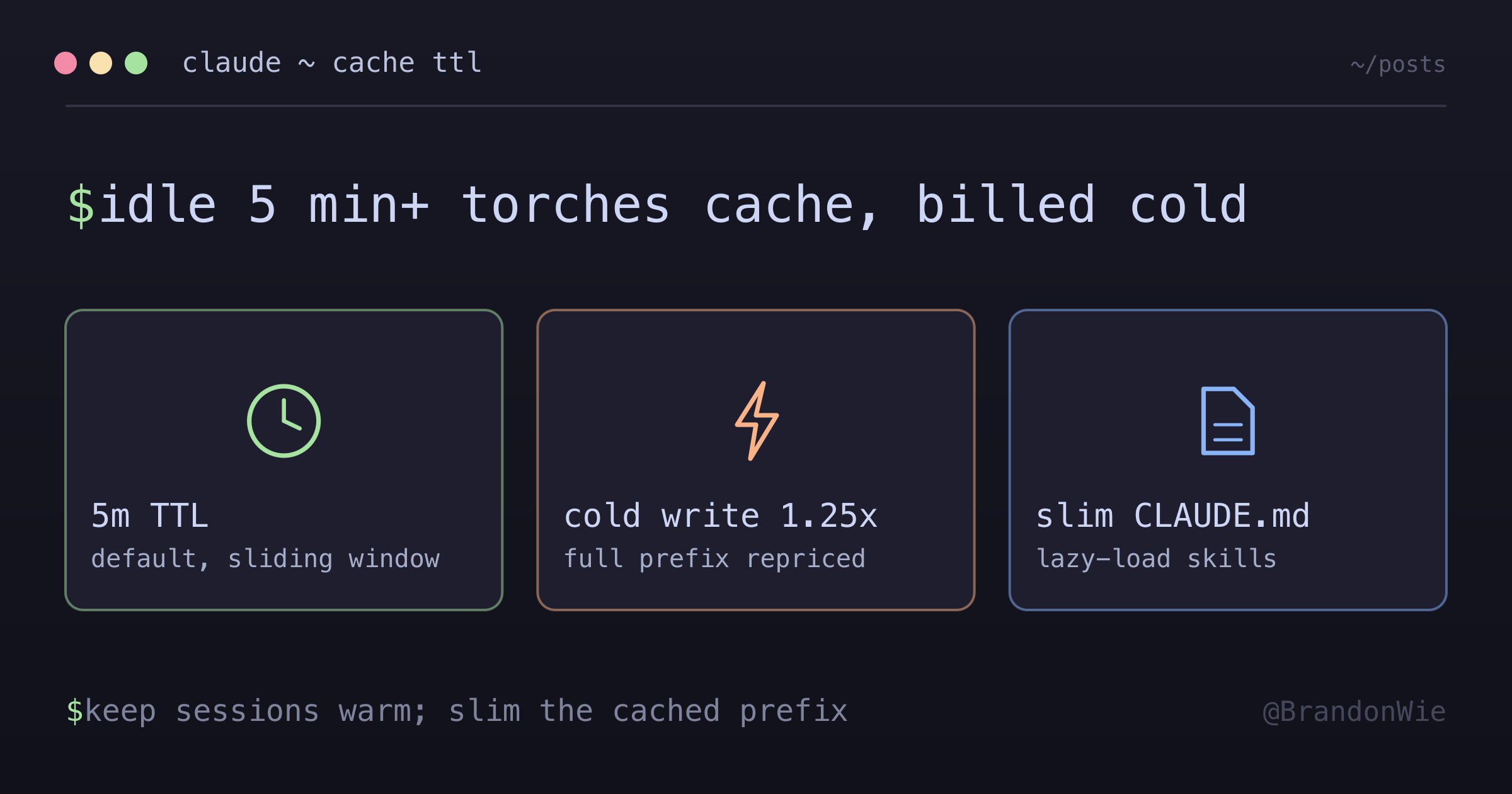
Anthropic silently dropped Claude Code's prompt-cache TTL from 1 hour to 5 minutes around early March 2026. Without explicit awareness, idle gaps ≥5 min between messages evaporate the cache and force a full cold cache-write on the next message — pricing it at 1.25× base input on the entire conversation prefix.
Anthropic silently dropped Claude Code’s prompt-cache TTL from 1 hour to 5 minutes around early March 2026 (issue #46829). Without explicit awareness, idle gaps ≥5 min between messages evaporate the cache and force a full cold cache-write on the next message — pricing it at 1.25× base input on the entire conversation prefix (system prompt + tools + CLAUDE.md + every prior turn). On a 200K-token Opus session that’s ~$1.25 per resume; across a working day this can raise per-session cost 30–60%.
Pre-regression, sessions running 1h+ between messages stayed warm. Post-regression, walking-away patterns (lunch, meetings, focus blocks) cost real money — and many users didn’t notice because there was no announcement, no release-note line, no banner.
Cache mechanics, verified
TTL options
| TTL | Default? | Refresh behavior |
|---|---|---|
| 5 min | YES (post-2026-03 regression) | Each cache hit resets the timer (sliding window). Active sessions stay warm forever. |
| 1 h | Opt-in via cache_control: { ttl: "1h" } on API requests | Same sliding-window behavior, longer dead-clock. NOT user-selectable in Claude Code today. |
Pricing multipliers (vs base input)
| Operation | Multiplier vs base input |
|---|---|
| Cache read (hit) | 0.10× (10%) |
| Cache refresh on hit | 0.10× (same as read) |
| 5m cache write (cold/miss) | 1.25× |
| 1h cache write (cold/miss) | 2.00× |
Claude Opus 4.7 numbers: base input \$5/MTok, 5m write \$6.25, 1h write \$10, read/refresh \$0.50, output \$25.
What “5m vs 1h is 2x more expensive” actually means
The “2×” claim circulating in user discussions compares 1h cache write to uncached base input (2.0× vs 1.0×). The ratio of 1h write to 5m write is 1.6× (2.0 / 1.25). Both are correct depending on the comparison frame; the “2×” framing only makes sense vs uncached.
What invalidates the cache
The cache key is a hash of the full prefix in order: system prompt + tool definitions + CLAUDE.md + conversation history. Changing any portion invalidates everything from that point onward.
| Change | Effect |
|---|---|
Edit CLAUDE.md mid-session | Prefix changes → all cache dies → every subsequent message reprocessed |
| Add/remove MCP server mid-session | Tool defs change → full invalidation. Claude Code’s design locks tool list at startup to prevent this. |
| Switch model (Opus ↔ Sonnet) | Different model = different cache. tool_choice changes also invalidate. |
| Timestamp / dynamic content in system prompt | Prefix differs every turn → never hits |
/compact | Safe — Claude Code rebuilds the conversation summary AFTER the same cached prefix (system + tools + CLAUDE.md). Prefix reuse is intentional. |
/clear | Wipes session, next message cold |
Why Claude Code’s design leans so hard on cache
Per Thariq Shihipar (Claude Code engineer) — prompt caching is the architectural constraint around which the product is built. They declare SEVs when cache hit rates drop. Concrete design choices that exist for cache reasons:
- Tool list locked at session start. Adding an MCP tool mid-session would change the prefix → invalidates everything. Claude Code refuses to register new tools after startup.
- Plan mode adds tools, never swaps. When plan mode was built, the obvious design was “swap to read-only tools.” Cache-aware design: keep ALL tools in the prompt always; add
EnterPlanModeandExitPlanModeas additional tools; send mode change as a user message. Tool defs never change between plan mode and normal mode. - Compaction is a fork, not a rebuild. Compaction request uses the identical prefix as your current conversation (same system prompt, tools, CLAUDE.md). Only the messages portion gets summarized. Prefix KV cache is reused.
Without prompt caching, a 100-turn Opus coding session can cost \$50–\$100 in input tokens. With 90% hit rate, ~\$10–\$19. This economics is why Claude Code Pro (\$20/mo) is viable.
The same inversion shows up outside Claude Code billing. Huang et al. (2026, p.11) report spending 14.18M input tokens against Codex’s 8.23M and still paying less — \$6.89 vs \$10.28 — because 13.32M of those tokens were cache hits (~94%). What surprised me there: “load more context” is not the same thing as “costs more” until the hit rate is actually measured. I can’t check that on my own setup yet — my usage log has no cached_input_tokens field at all, so I don’t know my real hit rate, and until I do I shouldn’t be treating heavier rule or knowledge loading as cheap.
Cost math for an Opus 4.7 200K-token prefix
| Scenario | Cost |
|---|---|
| Cold write on resume after 5min idle | 200K × \$6.25/MTok = \$1.25 |
| Subsequent in-window message | 200K × \$0.50/MTok = \$0.10 |
| 12 pings/hr (cache-keepalive idle) | 12 × ~\$0.10 = \$1.20/hr (if you used a keepalive) |
| 10-resume day without keepalive | ~\$12.50 just in cold-write tax |
| Same session w/ cache-keepalive | ~\$5/day (continuous warm) |
For Pro/Max subscribers: cache misses don’t bill \$ (flat fee), but they consume rate-limit (5hr / weekly Opus quota). High cache miss rate burns your quota faster.
Cost levers user-controllable in Claude Code
| Lever | Action |
|---|---|
| Keep sessions active | Don’t let cache expire mid-task. Type a filler turn before a known break. A keepalive pinger helps only on API/token billing; on Pro/Max it burns quota. |
| Slim CLAUDE.md | Loaded at session start → sits in cached prefix forever. Move workflow detail to skills which lazy-load on invoke. |
| Lock MCP servers up front | Don’t toggle servers mid-session. Configure .mcp.json once. |
| Pin model per session | Don’t switch Opus ↔ Sonnet inside one task. |
| Subagents for verbose ops | Heavy file reads / log dumps → subagent. Verbose tokens stay in subagent context, only summary returns. |
/compact is fine | Designed cache-aware. Use freely when context fills. |
Monitor /usage | Cache hit ratio below 90% = something invalidating prefix. Investigate. |
| Avoid agent teams unless needed | ~7× tokens vs solo session (each teammate has own context). |
| Start new session for unrelated tasks | Stale conversation = bigger cache write each turn even at 90% hit. |
Mixing TTLs at the API layer
Both 1h and 5m can coexist in a single API request. Constraint: 1h cache entries must appear before any 5m entries in the prefix. Billing partitions into three positions: A (highest cache hit), B (highest 1h breakpoint after A), C (last cache breakpoint). Charged: read for A, 1h write for (B - A), 5m write for (C - B).
For Claude Code users this is moot — Anthropic chose 5m default and exposes no flag to flip TTL. API users can set ttl: "1h" per breakpoint.
When cache awareness does not matter
- One-off short sessions (under 30K tokens, single message exchange).
- Sessions where prefix invalidation is unavoidable (rapid CLAUDE.md iteration, MCP debugging).
- Pro/Max subscribers who never approach rate limits — cache misses cost rate-limit only, not \$.
Practical takeaway
The cache TTL regression is silent and the cost is real — \$1.25 per cold-write on a 200K-token Opus session, multiplied by however many idle gaps fall over 5 minutes. The user-controllable levers are: keep sessions active (a filler turn before a break; keepalive only when API/token billing is the right trade-off), slim CLAUDE.md (move workflow detail to lazy-loaded skills), lock MCP servers up front, pin the model per session, and use subagents for verbose ops so heavy tokens never enter the cached prefix. /compact is cache-safe by design — use it. Watch /usage for cache hit ratios below 90%; that’s the signal that something in your setup is invalidating the prefix.
References
- Prompt caching — Claude API Docs
- Manage costs effectively — Claude Code Docs
- Cache TTL silently regressed from 1h to 5m around early March 2026 (issue #46829)
- Anthropic: Claude quota drain not caused by cache tweaks (The Register)
- How Prompt Caching Actually Works in Claude Code (Abhishek Ray)
- MemoHarness: Agent Harnesses That Learn from Experience (Huang et al., 2026)