Alembic with Async SQLAlchemy
Configuring Alembic migrations to work with SQLAlchemy's async engine
On this page
You run alembic init, swap your database URL to use asyncpg, run
alembic upgrade head, and get a cryptic error about synchronous engines. The
default env.py that Alembic generates does not work with async drivers. Here is
the bridging pattern you need, plus every pitfall I hit along the way.
The Problem
Alembic assumes a synchronous database engine. Its generated env.py calls
engine_from_config(), which does not support async drivers like asyncpg or
aiosqlite. Without the correct bridging pattern, migrations either fail at
runtime or — worse — autogenerate produces empty migration files with no
indication of what went wrong.
The fix lives in an Alembic cookbook page, not the main tutorial. If you follow the getting-started guide and plug in an async URL, you will hit a wall.
The Pitfalls
Each of these cost me debugging time. None of them produce helpful error messages.
Default env.py is sync-only. Alembic’s generated env.py uses
engine_from_config(), which does not support asyncpg. No error at import
time — it fails only when you run a migration.
Empty autogenerate migrations. Forgetting to import model modules before
accessing Base.metadata silently produces migrations with no operations.
Alembic does not warn you that Base.metadata.tables is empty.
run_sync bridging is non-obvious. The pattern of wrapping a sync callable
inside connection.run_sync() is the key to making this work, but it is buried
in a cookbook page rather than the main docs.
ConfigParser % interpolation conflict. config.set_main_option("sqlalchemy.url", url) passes through Python’s configparser, which treats % as interpolation syntax (%(name)s). When Pydantic’s PostgresDsn.build() URL-encodes special characters in passwords ({ → %7B, [ → %5B), the % triggers ValueError: invalid interpolation syntax. The fix: .replace("%", "%%") before calling set_main_option(). This is a common gotcha with auto-generated passwords containing special characters.
Connection pooling confusion. The default pool class works for long-running apps but causes connection leaks or warnings in short-lived migration scripts. This leads to misleading debugging sessions where the pool, not your migration logic, is the problem.
PostgreSQL enum extension is DDL-only. ALTER TYPE ... ADD VALUE cannot run
inside a transaction block. Alembic wraps migrations in transactions by default,
so adding a value to an existing enum type fails with a “cannot be executed
inside a transaction block” error. You must use op.execute() with
autocommit isolation or run the statement outside the transaction context. The
downgrade path is even worse: PostgreSQL does not support removing values from an
existing enum type. You need to create a new type without the value, migrate all
columns to the new type, and drop the old one.
The Solution
Replace Alembic’s default env.py with this async-aware version:
# alembic/env.py
import asyncio
from sqlalchemy import pool
from sqlalchemy.ext.asyncio import async_engine_from_config
from alembic import context

# Import Base and all models
from app.db import Base
from app.models.user import User    # noqa: F401
from app.models.note import Note    # noqa: F401

target_metadata = Base.metadata

def do_run_migrations(connection):
    context.configure(
        connection=connection,
        target_metadata=target_metadata,
    )
    with context.begin_transaction():
        context.run_migrations()

async def run_async_migrations():
    connectable = async_engine_from_config(
        config.get_section(
            config.config_ini_section, {}
        ),
        prefix="sqlalchemy.",
        poolclass=pool.NullPool,
    )
    async with connectable.connect() as connection:
        await connection.run_sync(do_run_migrations)
    await connectable.dispose()

def run_migrations_online():
    asyncio.run(run_async_migrations())
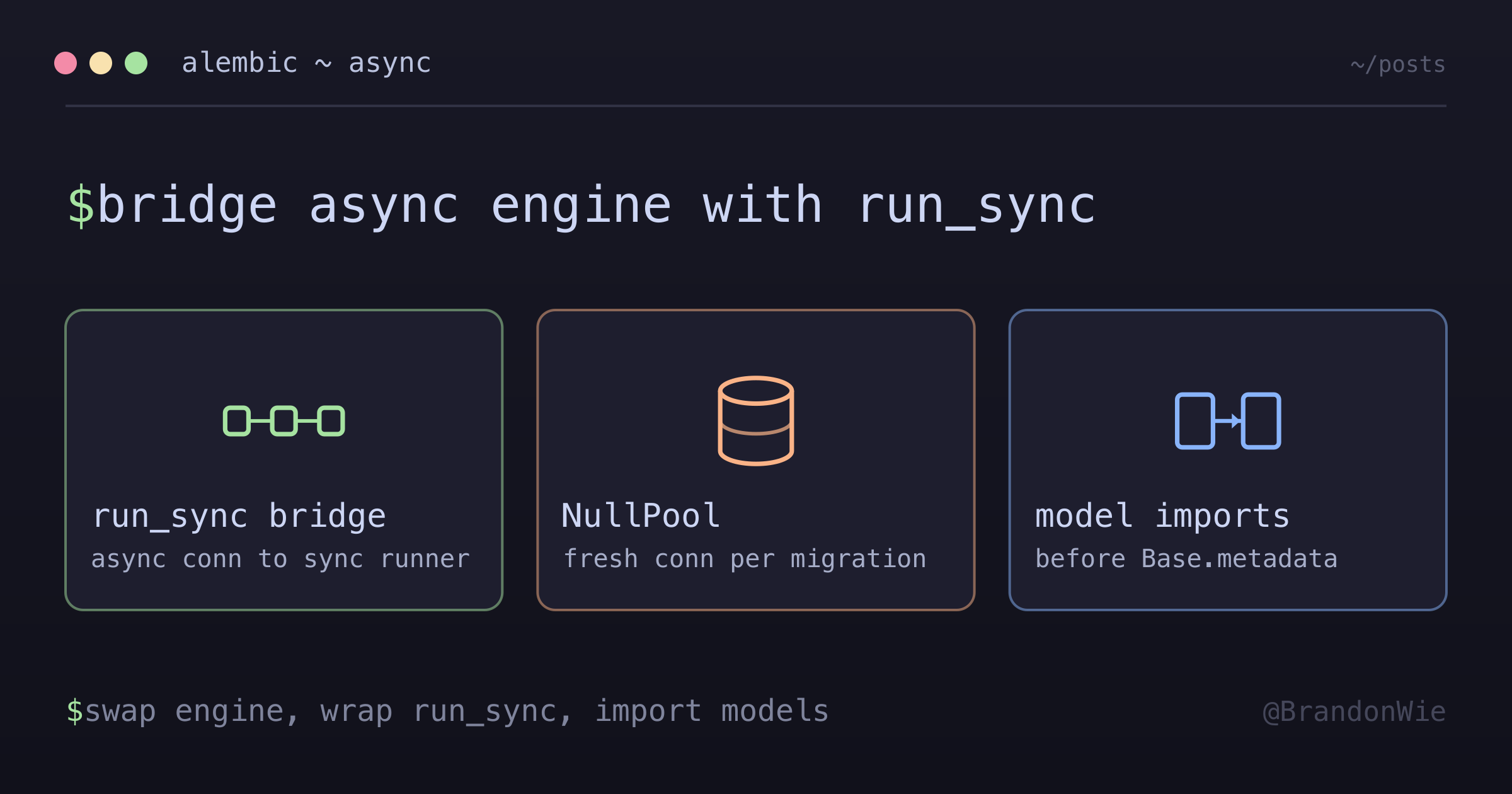
Three things happen here that differ from the default:
async_engine_from_config()replacesengine_from_config()connection.run_sync()bridges the async connection to Alembic’s sync migration runnerNullPoolreplaces the default connection pool
alembic.ini Configuration
[alembic]
script_location = alembic

# Use async driver in URL
sqlalchemy.url = postgresql+asyncpg://user:pass@host/db
Why NullPool
Migrations are short-lived operations. Connection pooling adds overhead with no
benefit — each migration run creates one connection, runs DDL statements, and
exits. NullPool creates a fresh connection each time and closes it immediately
after use. No leaked connections, no pool-related warnings.
Gotcha: Model Imports
This is the most common source of “empty migration” confusion:
# Models MUST be imported before accessing Base.metadata
# Otherwise autogenerate won't detect tables

from app.models.user import User    # noqa: F401
from app.models.note import Note    # noqa: F401

# NOW this contains all table metadata
target_metadata = Base.metadata
Without the imports, Base.metadata.tables is empty and
alembic revision --autogenerate generates an empty migration. The # noqa
comments are intentional — linters flag these as unused imports, but they are
side-effect imports that register models with SQLAlchemy’s metadata registry.
Common Commands
# Create a new migration
alembic revision --autogenerate -m "add users table"

# Apply migrations
alembic upgrade head

# Rollback one step
alembic downgrade -1

# Show current revision
alembic current
When to Use
- Any project using SQLAlchemy 2.0+ async engine (asyncpg, aiosqlite) that needs Alembic migrations
- FastAPI or other async frameworks where the ORM layer is async
- Projects where autogenerate is desired for migration creation
When NOT to Use
- Synchronous SQLAlchemy projects — Standard
env.pyworks fine; adding the async bridging pattern is unnecessary complexity - Non-SQLAlchemy ORMs — Tortoise ORM, SQLModel (if using its own migration tool), or Django ORM have their own migration systems
- Schema-less databases — MongoDB, DynamoDB, and other NoSQL stores do not use Alembic
- One-off scripts or notebooks — If you only need to create tables once
(e.g.,
Base.metadata.create_all()), Alembic is overkill
The Pattern in One Sentence
Replace engine_from_config with async_engine_from_config, wrap your sync
migration runner in connection.run_sync(), use NullPool, and import every
model before touching Base.metadata. That is the entire recipe — everything
else is debugging the consequences of missing one of those four steps.
Comments · github discussions
repo brandonwie/brandonwie.dev · category "Blog Comments" · term alembic-async-sqlalchemy