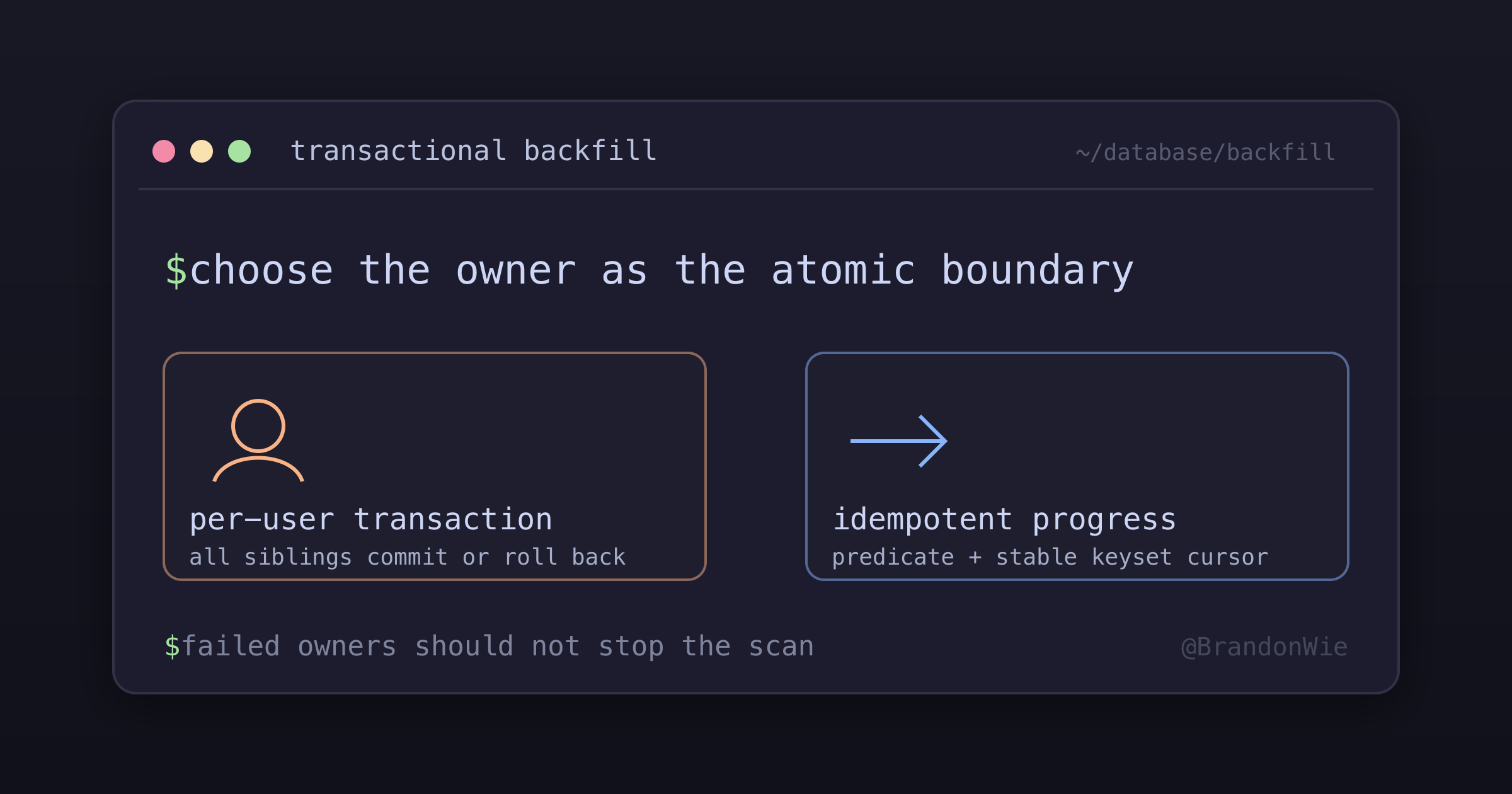
Per-User Transactional Backfill Atomicity
A large data backfill (classify legacy column into new columns) needs a unit of atomicity. Per-row single-statement writes give failure isolation but produce...
On this page
A backfill that updates several rows for one user needs a clear failure boundary. One transaction for the entire dataset holds locks too long, while independent row updates can leave a single user half migrated.
The middle ground is one transaction per owning user. That sounds mechanical until one row fails validation: should the backfill keep the valid siblings, or roll the user’s entire batch back?
Choosing between skip-invalid and prevalidate-then-abort
Skipping the bad row maximizes forward progress, but it violates an all-or- nothing user contract. The user ends in a mixed state, and verification inherits a long tail of partially migrated owners.
Prevalidating every row and aborting on the first invalid value keeps the contract honest. One bad row blocks that user until the data is repaired, while later users can still proceed in their own transactions.
Carry failure detail across rollback
A typed error can carry row-level failures out of a transaction that no longer exists:
class BackfillValidationError extends Error {
  constructor(readonly failures: FailureDto[]) {
    super('User backfill validation failed');
  }
}

for (const userId of userIds) {
  try {
    const committed = await dataSource.transaction(async (manager) => {
      const rows = await loadEligibleRows(manager, userId);
      const failures = validate(rows);

      if (failures.length > 0) {
        throw new BackfillValidationError(failures);
      }

      return updateEligibleRows(manager, rows);
    });

    totals.updated += committed.updated;
  } catch (error) {
    if (error instanceof BackfillValidationError) {
      totals.usersFailed += 1;
      totals.failures.push(...error.failures);
      continue;
    }
    throw error;
  }
}
TypeORM requires every operation in the callback to use the provided transactional entity manager. Merge per-user counters into the run totals only after that callback returns; counts created inside a rolled-back transaction must contribute nothing.
Preserve concurrency safety and progress
Each update should repeat the eligibility predicate, such as
new_col_a IS NULL AND new_col_b IS NULL. If a legitimate concurrent write
wins, affected === 0 means “skipped because state changed,” not transaction
failure.
That predicate also makes reruns idempotent. Completed rows disappear from the next selection, so the retry mechanism is another run rather than a hand-built list of IDs.
Iterate over distinct owner IDs in stable order with keyset pagination:
SELECT DISTINCT owner_id
FROM items
WHERE new_col_a IS NULL AND owner_id > $1
ORDER BY owner_id
LIMIT $2;
The cursor advances on the owner ID, not on the shrinking eligibility set. Permanently invalid users can keep failing without trapping the entire scan on one page.
Soft-deleted rows need an explicit decision too. TypeORM reads may exclude them by default while direct updates still reach them. Include or exclude them deliberately and prove the choice with a test.
Practical takeaway
Per-owner transactions fit backfills where one owner’s rows must move together and failures should not stop later owners. They are a poor fit for truly independent rows, where single-statement updates are simpler, or for owners so large that one transaction would hold locks for too long.
The final completion signal is not “the endpoint ran.” It is that no eligible unmigrated rows remain and every failed owner has an actionable report.
Comments · github discussions
repo brandonwie/brandonwie.dev · category "Blog Comments" · term per-user-transactional-backfill-atomicity