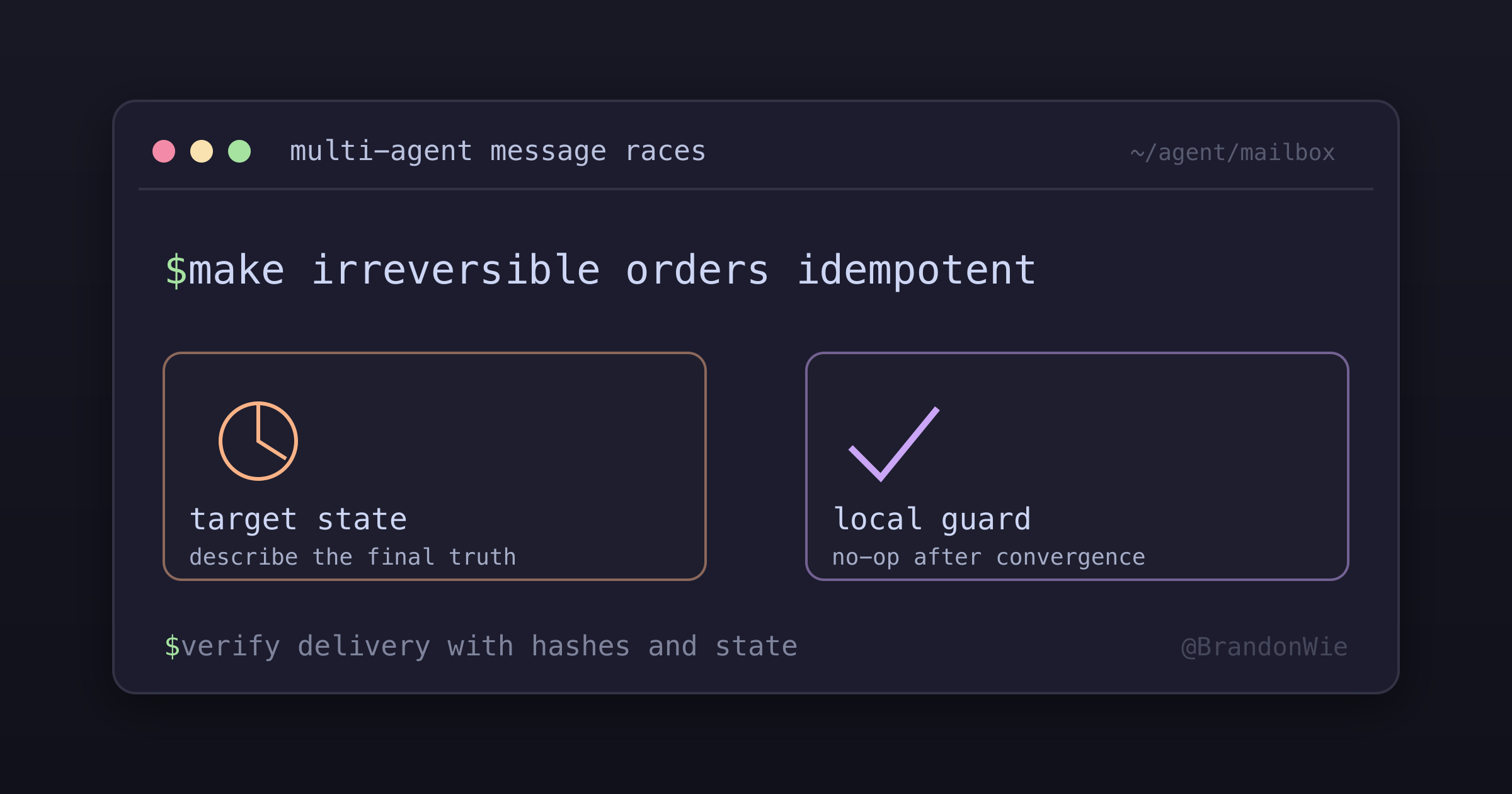
Multi-Agent Message-Race HOLD Discipline
In mailbox-style multi-agent orchestration (a master session sending orders to teammate sessions), messages and work interleave without transactional...
On this page
An async agent mailbox does not provide a transaction around “send an order, execute it, and receive the report.” A HOLD can arrive after a push has already finished, while a completion message can cross a newer correction in transit.
I hit three versions of that race in one orchestration session. Treating them as disobedience would have made the situation worse: repeating the command could have created a duplicate commit or a second history rewrite.
Model orders as target states
The safest instruction describes the state that must be true, not an action that must run:
Target: branch contains the fix folded into the feature commit.
Guard: if that state is already pushed, do not rewrite it again.
Verify: report the current commit hash and remote branch hash.
This shape is idempotent. A teammate that receives the order twice verifies the same target twice, but performs the irreversible mutation at most once. AWS describes the same property for retry-safe APIs: retransmitting a request should not add another side effect.
Put the stop guard with the executor
Only the executor knows whether it has already committed or pushed. A lead that sent HOLD cannot assume the message arrived before the guarded action.
Every irreversible order should therefore include a local precondition:
type State = { localHash: string; remoteHash: string; targetHash: string };

function shouldRewrite(state: State): boolean {
  return !(
    state.localHash === state.targetHash &&
    state.remoteHash === state.targetHash
  );
}
The exact probe changes by operation, but the pattern stays the same: read live state, compare it with the target, and no-op when it already converged.
Verify delivery through state evidence
Silence does not prove that an order arrived. In my case, an amend request was followed by a report containing the unchanged commit hash. Because an amend necessarily changes the hash, the report proved that the newer order had not taken effect.
This is stronger than interpreting the teammate’s wording. Compare the reported artifact with the ordered target: commit hashes, file checksums, PR state, or test results.
Sequence overlapping work
Agent teams expose a shared task list and direct teammate messaging, but those coordination tools do not make simultaneous edits transactional. When two tasks touch the same file or history, make the dependency explicit: the second task starts only after the first reports a verified state.
Before reissuing an order that might have raced, probe the repository again. The correct follow-up is often “state confirmed; stand down,” not another execution.
Practical takeaway
Use this discipline whenever orders and completion reports travel asynchronously, especially around amend, rebase, force-push, deployment, or other hard-to-reverse actions. It adds little value to a synchronous single-agent tool loop where the caller blocks until each operation returns.
Duplicate confirmations are the intended safe failure mode. Two agents agreeing that the target already exists cost a message; executing the mutation twice can cost the history.
Comments · github discussions
repo brandonwie/brandonwie.dev · category "Blog Comments" · term multi-agent-message-race-hold-discipline