GitHub PR Review API - Inline Comments
How to create PR reviews with inline comments using the GitHub API via `gh` CLI.
On this page
The Problem
I wanted to post a PR review with several inline comments from the command
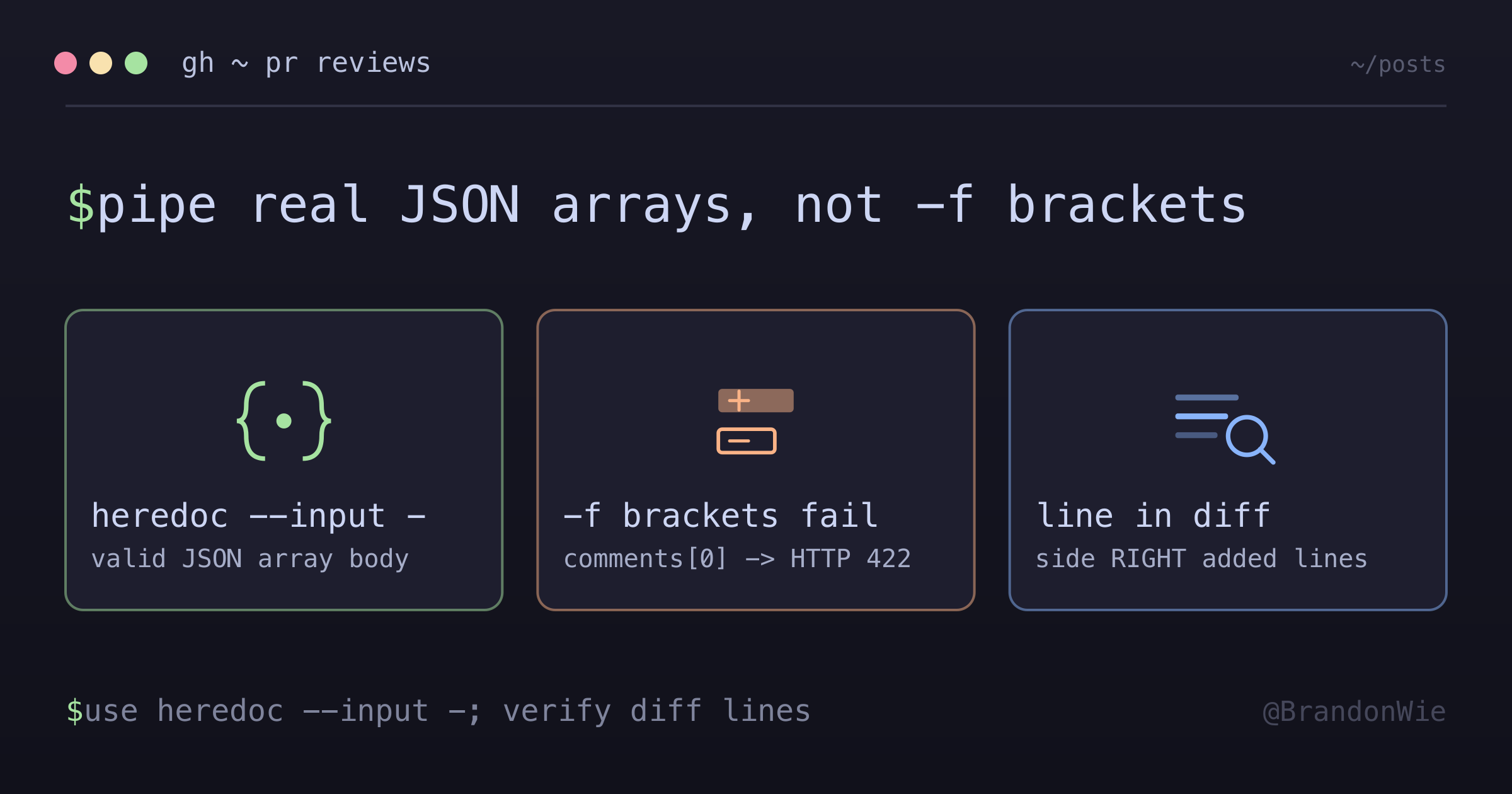
line. The obvious-looking approach — gh api with a numeric bracket index for
the array — fails:
# ❌ WRONG - causes HTTP 422 error
gh api repos/{owner}/{repo}/pulls/{PR}/reviews -X POST \
  -f event="COMMENT" \
  -f body="Review body" \
  -f "comments[0][path]=file.ts" \
  -f "comments[0][line]=123" \
  -f "comments[0][body]=Comment text"

# Error: "For 'properties/comments', {...} is not an array. (HTTP 422)"
gh api --verbose prints the request body, which explains it (gh 2.97.0):
{
  "body": "Review body",
  "comments": {
    "0": {
      "body": "Comment text",
      "line": "123",
      "path": "file.ts"
    }
  },
  "event": "COMMENT"
}
A number inside brackets is just another nested object key, so comments
becomes an object with a "0" key. The API wants an actual JSON array.
Difficulties Encountered
- Bracket notation looks like array syntax —
gh apisupportskey[subkey]=valuefor nested objects, socomments[0][path]looks like indexing into an array. It is not. No warning is emitted locally; the request goes out and GitHub rejects it. - Unhelpful 422 error — The response says “is not an array” but does not
echo the payload it received, so the mismatch is invisible until you add
--verboseand read the serialized JSON yourself. - Line numbers must exist in the diff — Even with valid JSON, a comment aimed at a line that is not part of the PR diff is rejected with another 422 rather than being placed somewhere approximate. You have to cross-reference the diff to pick line numbers.
- Heredoc quoting subtlety — With an unquoted heredoc delimiter, the shell
expands backticks and
$variablesinside the JSON body, which mangles code snippets inside comment text.
Two Ways to Send a Real Array
1. Empty brackets, not a numeric index
The gh api manual documents the array form explicitly: “To pass nested values
as arrays, declare multiple fields with the syntax key[]=value1,
key[]=value2.” Its own example builds an array of objects with
properties[][property_name]=..., and the same shape works here. Repeating a
subkey starts a new array element:
gh api repos/{owner}/{repo}/pulls/{PR}/reviews -X POST \
  -f event="COMMENT" \
  -f body="Review body" \
  -F "comments[][path]=src/lib/calendar/normalize-timezone.ts" \
  -F "comments[][line]=244" \
  -F "comments[][side]=RIGHT" \
  -F "comments[][body]=TZID normalization: non-standard values are mapped to IANA identifiers first." \
  -F "comments[][path]=src/lib/calendar/normalize-timezone.ts" \
  -F "comments[][line]=307" \
  -F "comments[][side]=RIGHT" \
  -F "comments[][body]=DST gap detection: the date library silently shifts times that do not exist."
Two details matter here. Use -F, not -f, for line — -f sends every
value as a string, so line arrives as "244" instead of 244. And the
brackets must be empty: comments[], never comments[0].
I had read past that paragraph in the manual and reached for the index form out of habit. The 422 was correct; my mental model of the flag was wrong.
2. Heredoc with --input -
Once comment bodies are multi-paragraph Markdown, the flag list gets long and hard to read. Piping the JSON directly is the version I keep:
cat << 'REVIEW_JSON' | gh api repos/{owner}/{repo}/pulls/{PR}/reviews -X POST --input -
{
  "event": "COMMENT",
  "body": "## Self Review\n\nKey implementation points explained below.",
  "comments": [
    {
      "path": "src/utils/calendar.ts",
      "line": 244,
      "side": "RIGHT",
      "body": "### 📌 TZID Normalization\n\nExplanation here..."
    },
    {
      "path": "src/utils/calendar.ts",
      "line": 307,
      "side": "RIGHT",
      "body": "### 📌 DST Gap Detection\n\nExplanation here..."
    }
  ]
}
REVIEW_JSON
Both routes produce the same payload. The heredoc is easier to generate from a script and easier to eyeball before sending; the flag form is shorter for one or two short comments. Neither is more “correct” than the other.
Key Points
Comment Structure
| Field | Required | Description |
|---|---|---|
path | Yes | File path relative to repo root |
body | Yes | Comment content (supports Markdown) |
line | No | Line number in the NEW version of the file |
side | No | "RIGHT" for new code, "LEFT" for deleted code |
Only path and body are required per comment in the REST reference. line
and side are optional, and side defaults to "RIGHT". In practice you still
want line (or the alternative position field) — that is what anchors the
comment to a specific spot in the diff. At the top level, body is required
when event is COMMENT or REQUEST_CHANGES.
Line Number Requirements
The line must be a line that appears in the PR diff.
- Use lines with
+prefix (added lines) →side: "RIGHT" - Context lines (no prefix) may or may not be commentable
- Deleted lines (
-prefix) →side: "LEFT"
To find valid line numbers:
# Get the PR diff to see which lines are actually changed
gh pr diff {PR_NUMBER} -- {file_path}
JSON Escaping
| Character | Escape As |
|---|---|
| Double quote | \" |
| Newline | \n |
| Backslash | \\ |
| Tab | \t (avoid, use spaces) |
Single-Quoted Heredoc
Use 'REVIEW_JSON' (single quotes) to prevent shell expansion:
# Single quotes prevent $variable and `backtick` expansion
cat << 'REVIEW_JSON' | gh api ...
{
  "body": "Code: `const x = 1;`"  # Backticks preserved
}
REVIEW_JSON
Event Types
| Event | Description |
|---|---|
COMMENT | General comment (no approval status) |
APPROVE | Approve the PR |
REQUEST_CHANGES | Request changes before merge |
Omitting event entirely creates a PENDING review you can submit later.
Complete Example
PR_NUMBER=123
OWNER=example-org
REPO=example-repo

cat << 'REVIEW_JSON' | gh api repos/${OWNER}/${REPO}/pulls/${PR_NUMBER}/reviews -X POST --input -
{
  "event": "COMMENT",
  "body": "## Self Review 🔍\n\nExplaining the key implementation points of this PR.",
  "comments": [
    {
      "path": "src/lib/calendar/normalize-timezone.ts",
      "line": 244,
      "side": "RIGHT",
      "body": "### 📌 TZID normalization\n\n**Why it is written this way:**\n\nNon-standard TZID values get mapped to IANA identifiers before parsing."
    },
    {
      "path": "src/lib/calendar/normalize-timezone.ts",
      "line": 307,
      "side": "RIGHT",
      "body": "### 📌 DST gap detection\n\n**The problem:**\n\nDuring a DST transition the date library silently shifts times that do not exist."
    }
  ]
}
REVIEW_JSON
Response
On success, the API returns the created review object:
{
  "id": 1234567890,
  "html_url": "https://github.com/example-org/example-repo/pull/123#pullrequestreview-1234567890",
  "state": "COMMENTED",
  "submitted_at": "2026-01-15T09:00:00Z"
}
When to Use
- Automating self-review comments on your own PRs (explaining complex logic)
- CI/CD pipelines that post inline review comments (lint results, test coverage, security findings)
- Bulk-commenting on multiple files/lines in a single API call rather than clicking through the GitHub UI one by one
When NOT to Use
- Simple PR descriptions — If your notes apply to the PR as a whole, use the PR body or a single top-level comment instead of inline comments
- Non-diff lines — The API only accepts lines present in the diff; do not use this for commenting on unchanged code (use a regular issue comment)
- High-frequency automation — GitHub rate-limits API calls; posting reviews on every commit in a busy repo will hit limits quickly
- Draft PRs you will rewrite — Inline comments are tied to specific diff line numbers and become orphaned when you force-push new commits
Common Errors
| Error | Cause | Fix |
|---|---|---|
| HTTP 422 “not an array” | Using -f comments[0][...] | Use comments[][...] or heredoc JSON |
| HTTP 422 “line not in diff” | Invalid line number | Verify line is in PR diff |
| HTTP 404 | Wrong PR number or repo | Check PR exists |
| HTTP 403 | No write access | Check permissions |
Comments · github discussions
repo brandonwie/brandonwie.dev · category "Blog Comments" · term github-pr-review-api-inline-comments