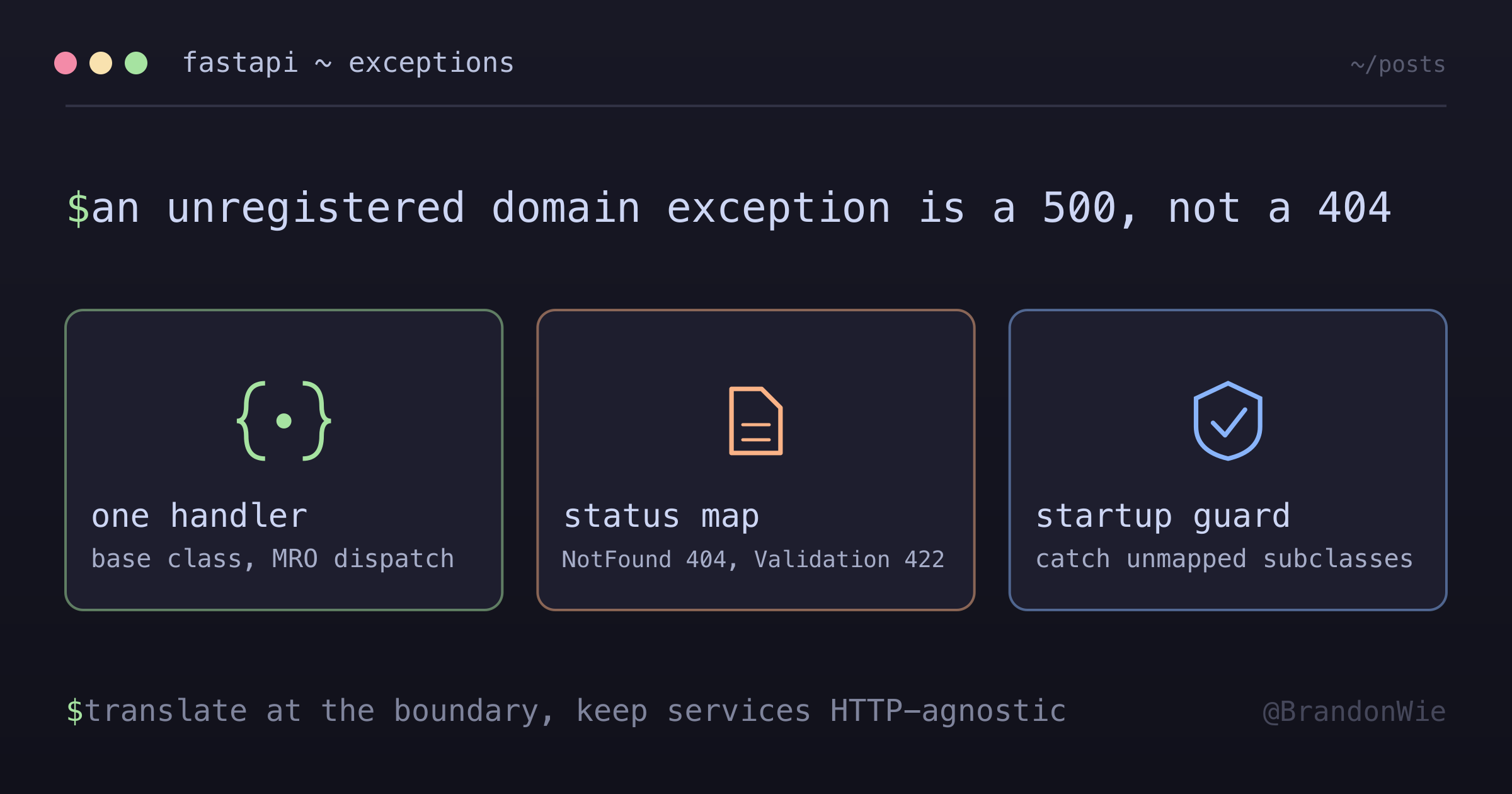
FastAPI domain-exception handler — stopping 500s on your 404s
Domain exceptions raised in the service layer come back as 500s until FastAPI is told otherwise. What I found registering one handler for the whole hierarchy, and the four gotchas a review pass surfaced afterwards.
On this page
- The setup that looks right
- Why FastAPI answers 500
- Three ways to close the gap
- Option A: one handler for the whole hierarchy
- Option B: catch and re-raise in each router
- Option C: raise HTTPException in the service
- Errors at the boundary
- Finding it in a codebase you did not write
- What review surfaced after the fix
- 1. assert disappears under -O
- 2. __subclasses__() only sees its own children
- 3. exc_info=True depends on ambient state
- 4. The guard depends on import order
- 5. 422 has two body shapes, and that is a contract smell
- When this fits, and when it does not
- Practical takeaway
- References
A GET for a note that did not exist came back as 500 Internal Server Error
instead of 404 Not Found. The service layer raised NotFoundError right where
it should have, and the router was a single pass-through line. Neither file was
wrong. The exception hierarchy had simply never been registered with FastAPI, so
the framework treated it as an unhandled crash.
This is what I found while fixing that in crucio, a personal project of mine, plus four things a later review pass turned up that I would not have thought of on my own. The fix itself is about ten lines; most of this post is about what sits around it.
The setup that looks right
The shape is the one most layered-architecture guides recommend. Domain exceptions live in one module and describe problems in the language of the domain, with no knowledge of HTTP:
# core/exceptions.py
class CrucioException(Exception):
    def __init__(self, message: str, details: dict | None = None):
        super().__init__(message)
        self.message = message
        self.details = details or {}

class NotFoundError(CrucioException): ...
class ValidationError(CrucioException): ...
class AuthenticationError(CrucioException): ...
class AuthorizationError(CrucioException): ...
class StorageError(CrucioException): ...
class ProcessingError(CrucioException): ...
The base class carries message and details so that whatever eventually
serializes the error has something structured to work with. Everything else is
an empty subclass whose only job is to be a distinguishable type.
The service raises those types when a business rule fails, without status codes and without importing anything from the web framework:
# features/notes/service.py
async def get_note(self, note_id: UUID, user_id: UUID) -> NoteResponse:
    note = await self.repository.get_by_id(note_id=note_id, user_id=user_id)
    if not note:
        raise NotFoundError(f"Note {note_id} not found")
    return NoteResponse.model_validate(note)
And the router stays thin, which is the whole point of putting the logic in a service:
# features/notes/router.py
@router.get("/{note_id}", response_model=NoteResponse)
async def get_note(note_id: UUID, current_user: CurrentUser, ...):
    return await service.get_note(note_id=note_id, ...)
Read those three files together and the design looks finished: the service is
HTTP-agnostic, the router is a pass-through, and nothing is duplicated. But if
NotFoundError is raised, the client still gets a 500 instead of a 404.
Why FastAPI answers 500
Nothing connects a class named NotFoundError to the status code 404.
CrucioException is an ordinary Exception subclass, and an exception that
propagates out of an endpoint with nothing registered to catch it is, by
definition, an unhandled server error. Starlette’s middleware stack (which
FastAPI sits on top of) puts ServerErrorMiddleware at the outermost layer
precisely to turn anything that escapes into a 500 response, with
ExceptionMiddleware inside it to dispatch the exceptions somebody did
register a handler for. Skip the registration and every domain exception in the
codebase falls through to the outer layer.
The wrong number in the response matters less than what that number does to everything downstream of it. Error monitoring pages on 5xx and ignores 4xx, which is the correct default, so a missing resource turns into an alert that looks exactly like a real fault until somebody opens it. Misclassified 500s cost attention that should go elsewhere, and they bury genuine 500s in noise. API consumers get the same confusion in a different form: “internal server error” when the honest answer is “that resource is not here.”
This ships easily because the obvious tests stay green. Unit tests on the
service assert that NotFoundError is raised, and it is. HTTP integration tests
on the happy path assert a 200 body, and they get one. Only a test that drives
the not-found path through HTTP sees the 500, and that is exactly the test
people skip, because a 404 feels too boring to be worth asserting on.
Three ways to close the gap
Once the cause was clear, there were three plausible fixes. Ranking them was mostly a question of where I wanted the translation from domain vocabulary to transport vocabulary to live.
| Approach | Where translation lives | Boilerplate per feature | Main risk |
|---|---|---|---|
| A: one global handler | App edge, one place | None | Unmapped subclass falls to 500 |
| B: per-router catch-and-reraise | Every router | Every endpoint | One forgotten router = silent 500 |
C: raise HTTPException in the service | Service layer | None | Service is coupled to HTTP |
Option A: one handler for the whole hierarchy
Register a single handler against the base class and dispatch on the concrete subclass inside it. Starlette walks the exception’s MRO when looking for a handler, so one registration covers every descendant:
# main.py
from fastapi import FastAPI, Request
from fastapi.responses import JSONResponse

from crucio.core.exceptions import (
    CrucioException,
    NotFoundError,
    ValidationError,
    AuthenticationError,
    AuthorizationError,
    StorageError,
    ProcessingError,
)

app = FastAPI()

_EXCEPTION_STATUS_MAP: dict[type[CrucioException], int] = {
    NotFoundError: 404,
    ValidationError: 422,
    AuthenticationError: 401,
    AuthorizationError: 403,
    StorageError: 500,
    ProcessingError: 500,
}

@app.exception_handler(CrucioException)
async def crucio_exception_handler(request: Request, exc: CrucioException):
    status_code = _EXCEPTION_STATUS_MAP.get(type(exc), 500)
    return JSONResponse(
        status_code=status_code,
        content={
            "detail": exc.message,
            "type": type(exc).__name__,
            "details": exc.details,
        },
    )
What I like about this: services keep raising domain exceptions without a
thought for transport, routers stay free of error-handling clutter, and a new
exception type costs one row in a dictionary. What I do not like: that row is
easy to forget, and forgetting it reproduces the original bug for the new type
only, which is a much quieter version of the same failure. The knowledge entry I
wrote at the time suggested guarding this with an assert at startup. Review had
opinions about that, which is most of the second half of this post.
Option B: catch and re-raise in each router
# features/audit/router.py
try:
    return await service.get_event(event_id)
except AuditNotFoundError:
    raise HTTPException(status_code=404, detail="Audit event not found")
except AuditServiceError:
    raise HTTPException(status_code=503, detail="Audit service error")
This is the most explicit option, and explicitness is a real virtue: the mapping
is visible at the call site and there is no registration to forget. The cost is
that the same three lines get copied into every router that can raise the same
exception. The failure mode is gradual rather than dramatic. A new endpoint
reuses an existing service, nobody copies the try/except, and that one endpoint
quietly returns 500 while its neighbours return 404.
Option C: raise HTTPException in the service
async def get_note(self, note_id: UUID) -> NoteResponse:
    note = await self.repository.get_by_id(note_id)
    if not note:
        raise HTTPException(status_code=404, detail="Note not found")
    return NoteResponse.model_validate(note)
Zero ceremony, and the mapping could not be more obvious. The trade is that the
service now knows about HTTP. Call that same service from a background worker or
a CLI command, and it raises a web-framework exception into a context with no web
framework to interpret it. Unit tests get slightly worse too: asserting on
HTTPException.status_code tests the transport rather than the rule.
I went with A. B and C are not wrong. For a small app that will never grow a non-HTTP entry point, C is genuinely fine, and B is defensible if you value explicitness over repetition. I picked A because the thing I wanted to protect was the service layer’s independence, and A is the only one of the three that keeps it.
Errors at the boundary
The principle underneath Option A is that translation belongs at the edge:
domain code states domain problems, and the boundary converts them into whatever
error vocabulary the transport speaks. The same shape shows up under different
names in other frameworks, such as @ControllerAdvice in Spring Boot and the
custom exception handler in Django REST Framework. When a pattern gets
reinvented that often, it is usually doing something real rather than papering
over a framework quirk.
It reminds me of Alexis King’s Parse, don’t validate, pointed in the outbound direction. Both are arguments for concentrating the conversion between an outside representation and an internal one at a single, well-defined boundary rather than letting it smear across the middle of the system. The analogy only goes so far. Hers is about types and the information you gain during parsing; mine is about mapping error classes to integers. The instinct is the same one.
Finding it in a codebase you did not write
If you want to check whether an existing FastAPI app has this bug, two greps answer the question:
# Domain exceptions defined...
grep -rn "class.*Exception(CrucioException)" core/
# ...and any handler registered anywhere?
grep -rn "add_exception_handler\|@app.exception_handler" .
Several matches from the first and none from the second means every one of those exception types is currently a 500.
What review surfaced after the fix
The minimal Option A above is correct, and I would have shipped it as-is. The change went through two validation rounds with AI reviewers (the Claude Code review action and GitHub Copilot), and four of their findings were things I had not considered. Three of the four were flagged independently by more than one reviewer at the same location, which I have started treating as a useful signal: two models with different pre-training are unlikely to hallucinate the identical false positive in the identical place.
1. assert disappears under -O
The startup guard I had sketched used an assertion to check that every subclass appears in the status map:
# WRONG — stripped by Python `-O`
_MISSING = set(CrucioException.__subclasses__()) - set(_EXCEPTION_STATUS_MAP)
assert not _MISSING, f"Missing: {_MISSING}"
Python’s language reference is blunt about what happens when optimization is
requested: “The current code generator emits no code for an assert statement when
optimization is requested at compile time.” Running under -O, or with
PYTHONOPTIMIZE=1 set in the environment, deletes the guard at bytecode
compilation. That environment variable is a plausible thing to find in a
production container image, added at some point for a small memory saving. The
guard then becomes a no-op in exactly the environment it was written to protect.
# CORRECT — unconditional
_MISSING = set(CrucioException.__subclasses__()) - set(_EXCEPTION_STATUS_MAP)
if _MISSING:
    raise RuntimeError(f"Missing: {sorted(cls.__name__ for cls in _MISSING)}")
The rule I took from this: assert is for tests and for invariants I only care
about while developing. Anything that must hold in production gets an explicit
if and a real exception.
2. __subclasses__() only sees its own children
The guard was also checking less than I thought. The data model documentation
describes type.__subclasses__() as returning a list of weak references to a
class’s immediate subclasses, which leaves grandchildren out. So a
second-generation exception slips past:
class QuotaExceededError(StorageError):
    """429 Too Many Requests, semantically."""
CrucioException.__subclasses__() returns the six direct children and stops.
QuotaExceededError is absent, so the guard is satisfied. At runtime
_EXCEPTION_STATUS_MAP.get(type(exc), 500) misses for the same reason, because
type(exc) is QuotaExceededError and nobody ever added it to the map. The
guard and the handler share one blind spot, so the check meant to catch the bug
is blind to exactly the case that causes it.
def _all_subclasses(cls: type) -> set[type]:
    """Direct children, grandchildren, and so on."""
    collected: set[type] = set()
    for sub in cls.__subclasses__():
        collected.add(sub)
        collected |= _all_subclasses(sub)
    return collected

_MISSING = _all_subclasses(CrucioException) - set(_EXCEPTION_STATUS_MAP)
If a companion unit test asserts the same coverage, it needs the same recursive helper, or it inherits the blind spot too.
3. exc_info=True depends on ambient state
Logging stack traces for 5xx and not for 4xx seems like a one-liner:
# LESS RELIABLE — implicit
log(..., exc_info=status_code >= 500)
exc_info=True tells the logging module to fetch the current exception via
sys.exc_info(), which returns whatever exception is being handled, or three
Nones when nothing is being handled anywhere on the stack. This works today
because Starlette’s ExceptionMiddleware calls the handler from inside its own
except block, so there is a current exception. That relies on a framework
internal rather than on a documented guarantee. A future refactor that dispatches
handlers through a task or a shield would break traceback capture without
breaking anything visible.
# MORE RELIABLE — explicit
log(
    ...,
    exc_info=(type(exc), exc, exc.__traceback__) if status_code >= 500 else False,
)
The tuple form reads the traceback off the exception object that was handed to the handler. It depends on nothing ambient, and the logging module accepts it directly.
4. The guard depends on import order
This one is the most uncomfortable, because the fix is partial. _all_subclasses
can only find classes Python has already imported at the moment it runs. If
exception subclasses live in feature modules (say
features/billing/exceptions.py defining QuotaExceededError(StorageError)),
the guard is only meaningful when those modules were imported first:
# main.py — order matters
from crucio.api.v1.router import api_router   # transitively loads all features
from crucio.core.exception_handlers import register_exception_handlers  # guard runs here
Reorder those two lines, or add a subclass in a module the startup import chain
never reaches, and the guard passes while covering nothing. There is no way to
make an import-time check immune to import order, so the honest answer is
defence in depth: keep the boot guard as a fast signal, and add a CI test called
test_all_crucio_exception_subclasses_are_mapped that uses the same recursive
helper. Pytest’s collection imports the whole test dependency graph, so the test
sees subclasses that module loading alone would miss. The guard fails fast; the
test is the one that is actually correct.
5. 422 has two body shapes, and that is a contract smell
Not a defect, but worth writing down. FastAPI already uses 422 for
RequestValidationError, whose body is a list of per-field objects shaped like
{"detail": [{"loc": [...], "msg": ..., "type": ...}]}. Mapping a domain
ValidationError to 422 as well means the same status code can also return the
envelope above, where detail is a plain string.
Both are honestly “unprocessable entity” from the client’s side, so sharing the
code is semantically right. The problem is for a consumer pattern-matching on the
body: it has to branch on whether detail is a list (schema error) or a string
(semantic error). Three ways out, in the order I would consider them:
- Document the dual shape prominently in the OpenAPI description and live with it. Keeping one envelope across the whole exception hierarchy is worth more than making one status code uniform.
- Map
ValidationErrorto 400 and leave 422 to FastAPI alone. Cleaner separation, but less precise semantics, since 400 says very little. - Reserve
ValidationErrorfor conflict-like cases and map it to 409, with a different domain exception for input-shape problems. More types to maintain.
I took the first. It is the option that admits the smell rather than trading it for a different one, and the documentation cost is a paragraph.
When this fits, and when it does not
The pattern earns its keep in any FastAPI application that has a domain exception hierarchy at all, and it matters most before a public API ships, when the difference between 404 and 500 becomes somebody else’s error-handling logic. The ongoing maintenance is one line per new exception type, plus the guard and test to make sure that line does not get forgotten.
It is not worth the ceremony for library code with no HTTP surface. Raise the domain exceptions there and let the caller decide what they mean. It is also not worth it in a prototype where 500-for-everything is an accurate description of the reliability anyway. And some APIs deliberately return the same code for missing and forbidden resources so that a probe cannot distinguish them. That is a real security pattern, and it wants a deliberate map entry rather than an accidental one.
One more thing worth doing at the same time, if the codebase has been around a
while: check whether some features are already doing Option B by hand. Mixed
conventions propagate, because the fastest way to write a new router is to copy
the one next to it. Standardising on the global handler and removing per-router
try/except blocks as you touch them is cheaper than leaving both patterns in
place and hoping the next person picks the right one.
Practical takeaway
Defining a domain exception hierarchy is necessary but not sufficient. The
hierarchy is inert until something at the app edge maps it to the transport’s
error semantics, and the failure stays silent in exactly the tests most likely to
be written. The whole pattern is one handler on the base class plus one
dictionary from type to status code, guarded at startup by an if rather than an
assert, and recursing rather than looking one level down.
References
- Install custom exception handlers — FastAPI:
registering a handler with
@app.exception_handler(...), the mechanism the whole post rests on - Exceptions — Starlette: the middleware stack that turns unhandled exceptions into 500s, and where registered handlers are dispatched from
- The
-Ooption — Python command line reference: and itsPYTHONOPTIMIZEenvironment-variable equivalent - The
assertstatement — Python language reference: states that no code is emitted forassertwhen optimization is requested type.__subclasses__()— Python data model: immediate subclasses only, which is why the recursive helper existssys.exc_info()— Python standard library: returns the exception currently being handled, or threeNones when there is noneLogger.debugand theexc_infoargument — Python standard library: the argument accepts an exception tuple, not just a boolean- Use the
RequestValidationErrorbody — FastAPI: the list-shaped 422 body that a domainValidationErrorends up sharing a status code with - Parse, don’t validate — Alexis King: the boundary-translation argument this pattern rhymes with
Comments · github discussions
repo brandonwie/brandonwie.dev · category "Blog Comments" · term fastapi-domain-exception-handler