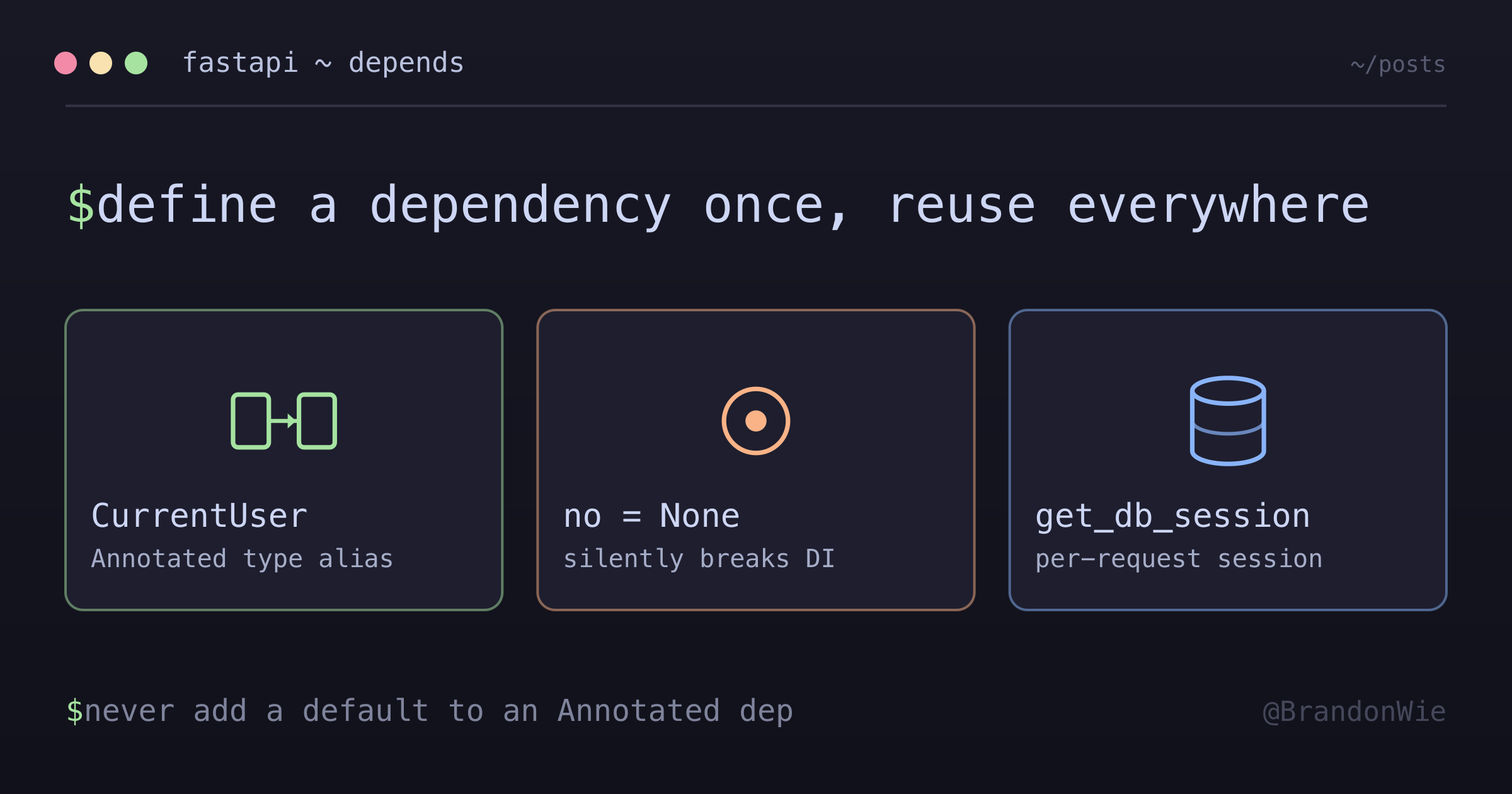
FastAPI Dependency Injection Patterns
How to use Annotated types with FastAPI Depends() for reusable, type-safe dependency injection across routers.
On this page
While consolidating authentication in a personal project, I found the same Depends(get_current_user) call repeated in router after router. Some passed user.sub through as a raw string; others converted it to a UUID. Nothing complained at the router boundary. The mismatch only surfaced as a database query failing on type, deep in the stack.
The fix wasn’t more validation. It was moving the dependency into one reusable type alias so every router receives the same thing the same way. FastAPI’s Annotated type pattern makes that possible with full type safety. It also has one silent failure mode that’s worth knowing about before you adopt it.
Difficulties Encountered
- A
Unionwrapper silently breaks injection: writingOptional[CurrentUser] = None(orCurrentUser | None = None) raises no error. FastAPI never calls the dependency function, the parameter simply arrives asNone, and you getNoneTypeerrors deep in the stack, far from the actual cause. - I wrote down the wrong cause: my note from that session blamed the default
value. Re-testing it for this post, a bare
current_user: CurrentUser = Noneinjects fine; theOptional[...]wrapper is what actually breaks injection. More on that below. - Type mismatch across routers: Some routers used
current_user.subas a string, others as aUUID. The bug only surfaced when a downstream query failed on type, not at the router boundary where the conversion should happen. - Docs show both old and new patterns: FastAPI docs cover both the legacy
param = Depends(func)and the newerAnnotatedpattern, so it isn’t obvious which one to adopt.Annotatedlives intypingfrom Python 3.9 on (earlier versions needtyping_extensions), and FastAPI has read it since 0.95.0.
Key Points
Annotated[Type, Depends(func)]embeds the dependency in the type itself, so one alias can be reused across routers. Instead of repeatingDepends(get_current_user)in every endpoint, you define aCurrentUsertype alias once and use it everywhere.- Never wrap the alias in
Optional[...]or| None. Once the outermost form of the annotation is aUnion, FastAPI stops looking forAnnotatedmetadata and theDependsis discarded without a word. If a dependency can legitimately return nothing, put theOptionalinside the alias. - Convert user identity at the router boundary (e.g.,
UUID(current_user.sub)) to avoid type mismatches deeper in the stack. If you leave this conversion to individual service methods, some will convert and others won’t. - Session injection via
Depends(get_db_session)ensures proper unit-of-work lifecycle per request: each request gets its own database session, closed automatically when the request ends.
The Solution
Create one type alias that carries both the dependency function and its return type. Define it once in a deps.py module, then import it in any router:
from typing import Annotated
from fastapi import Depends

# Define reusable type alias (once, in deps.py)
CurrentUser = Annotated[
    KeycloakTokenClaims,
    Depends(get_current_user)
]

# Use in any router (clean, no Depends() boilerplate)
@router.get("/items")
async def list_items(
    current_user: CurrentUser,  # bare alias — no Optional[...] wrapper
    session: AsyncSession = Depends(get_db_session),
) -> list[Item]:
    user_id = UUID(current_user.sub)  # Convert at boundary
    ...
The CurrentUser type carries the dependency with it, so no Depends() call is needed at the router level. The session parameter still uses the traditional pattern because database sessions are typically not shared across a deps.py type alias (they’re per-request by nature).
The UUID(current_user.sub) conversion is deliberate: it ensures every downstream function receives a proper UUID object, not a string that might or might not be a valid UUID.
Common Pitfall
Three forms that look similar, only two of which actually inject:
# BAD: the Union wrapper hides the Depends metadata — injection never runs
async def endpoint(current_user: Optional[CurrentUser] = None):
    ...  # current_user is None; get_current_user was never called

# GOOD: bare alias — FastAPI reads Depends from the Annotated metadata
async def endpoint(current_user: CurrentUser):
    ...

# GOOD: genuinely optional — Optional goes INSIDE the alias
OptionalUser = Annotated[
    Optional[KeycloakTokenClaims],
    Depends(get_optional_user),
]

async def endpoint(current_user: OptionalUser):
    ...  # get_optional_user runs and may return None
The first form is dangerous because of how it fails. FastAPI doesn’t raise an error and doesn’t log a warning. Optional[CurrentUser] is Union[Annotated[...], None], and FastAPI only inspects Annotated metadata when Annotated is the outermost form, so it never sees the Depends at all. It falls back to treating the parameter as ordinary request data (an optional query parameter on some versions, a request-body field on others), and a plain GET supplies neither, so the None default wins. Your code then fails somewhere else entirely, usually as an AttributeError: 'NoneType' has no attribute 'sub' deep in a service method, far from the router where the actual mistake lives.
A correction
My note from that session recorded the cause as “adding = None breaks Annotated injection.” Writing this post, I went back and tested it, and that is not what happens. A bare current_user: CurrentUser = None still calls the dependency on every FastAPI version I tried (0.95.0, 0.100.0, 0.110.0, 0.115.0, 0.128.0, and 0.141.1), and the default is simply never used. It’s dead code, not a trap.
The only form I could get to reproduce the silent bypass is the Union wrapper. The symptom I debugged was real; the cause I wrote down was not. I did not find either behavior spelled out in the FastAPI docs, so treat this as observed rather than specified. It held on every version above.
When to Use
- Multiple routers share the same dependency. Authentication and database sessions are the most common cases. If three or more routers call the same
Depends()function, it’s time for anAnnotatedtype alias. - You want IDE autocomplete on the injected type.
CurrentUsergives you autocomplete forKeycloakTokenClaimsfields, while bareDepends()gives youAny. - The dependency requires consistent type conversion at the boundary, such as
strtoUUID. Centralizing this in the type alias prevents inconsistencies. - You plan to create variants.
AdminUser,OptionalUser, andServiceAccountcan all be defined as separate type aliases with different dependency functions.
When NOT to Use
- One-off dependencies: If a dependency is used in a single endpoint, inline
Depends(func)is simpler and more explicit than creating a type alias. - Optional dependencies, if the nesting feels fussy:
Annotatedhandles them, but only withOptionalinside the alias and a dependency function that returnsNonefor anonymous callers. The traditionaluser: Optional[Type] = Depends(func)form is still fully supported and reads more plainly for a one-off anonymous-allowed endpoint. In that form theDependscomes from the default value, so theUnionnever hides anything. - Non-FastAPI frameworks: The
Annotated[..., Depends()]pattern is FastAPI-specific. Other frameworks (Flask, Django) have different DI mechanisms.
Why This Matters
The Annotated dependency pattern might seem like a small refactor, but it addresses real maintenance pain:
- Type safety: IDE autocomplete works with the concrete type (
KeycloakTokenClaims), not a generic dependency placeholder. You catch type errors at the editor level, not at runtime. - Reusability: Define once in
deps.py, import everywhere. When you switch auth providers (say, from Keycloak to Auth0), you update one type alias instead of every router file. - Clean routers: No repeated
Depends(get_current_user)calls cluttering your function signatures. The dependency is embedded in the type itself. - Composable: Need an admin-only endpoint? Create
AdminUser = Annotated[KeycloakTokenClaims, Depends(get_admin_user)]. Need optional auth?OptionalUser = Annotated[Optional[KeycloakTokenClaims], Depends(get_optional_user)].
Practical Takeaways
The Annotated[Type, Depends(func)] pattern is FastAPI’s recommended form for dependency injection on Python 3.9+. Adopt it when you have dependencies shared across multiple routers, which is almost always the case for authentication and database sessions.
The one rule to remember: keep Annotated on the outside. Writing current_user: Optional[CurrentUser] = None bypasses dependency injection entirely, because FastAPI only reads Depends metadata when Annotated is the outermost form. It won’t warn you. The parameter just arrives as None, and the error shows up far from the actual cause. If the dependency really is optional, move the Optional inside the alias.
For new FastAPI projects, create a deps.py file early and define your shared dependencies as Annotated type aliases from the start. It’s much easier than retrofitting the pattern across existing routers later.
Comments · github discussions
repo brandonwie/brandonwie.dev · category "Blog Comments" · term fastapi-dependency-injection-patterns