class-validator @IsHexColor Accepts Alpha-Hex Forms
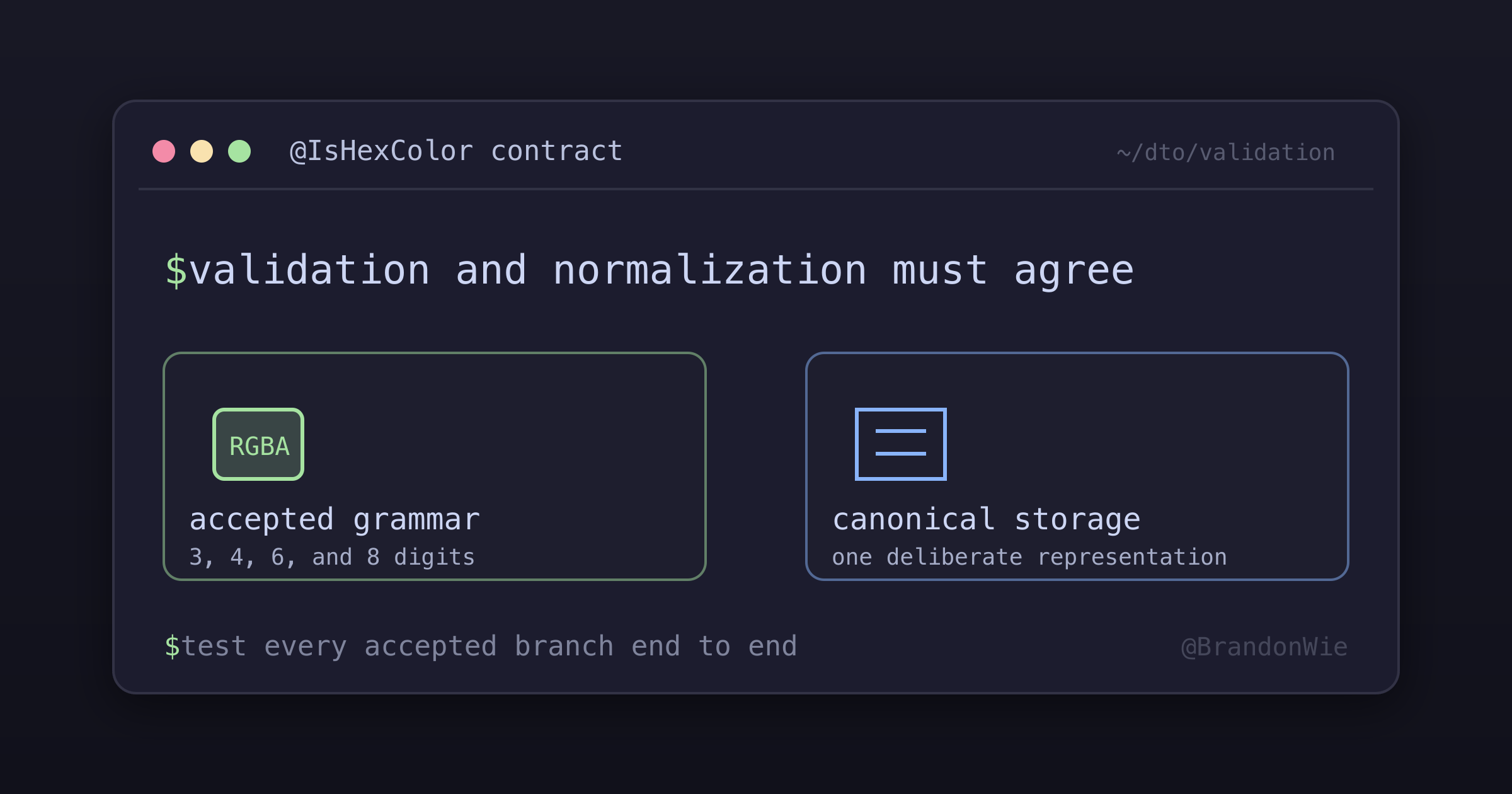
`@IsHexColor()` (class-validator, backed by validator.js `isHexColor`) accepts 3, 4, 6, and 8-digit hex strings, including alpha forms `#RGBA` and...
A DTO accepted a color that the corresponding normalizer did not understand.
Both pieces looked reasonable alone: @IsHexColor() validated the input, and
the normalizer handled the familiar three- and six-digit forms. Together they
allowed a value that violated the storage invariant.
The hidden detail is in the dependency chain. class-validator delegates
@IsHexColor() to validator.js, whose current regular expression accepts three,
four, six, and eight hexadecimal digits, with an optional #.
Compare the accepted grammars
The validator’s effective grammar is:
const hexColor = /^#?([0-9A-F]{3}|[0-9A-F]{4}|[0-9A-F]{6}|[0-9A-F]{8})$/i;A normalizer that only expands #RGB and lowercases #RRGGBB leaves #RGBA
and #RRGGBBAA outside its contract. Those values still pass validation.
Downstream lookups then see a valid but noncanonical value. A palette Map, cache,
or search index can miss the value and choose the wrong classification even
though the request passed its DTO.
Choose one contract at the boundary
If the product only supports opaque RGB, narrow validation to the forms the normalizer can represent:
import { Matches } from 'class-validator';

class ColorInput {
  @Matches(/^#?([0-9a-fA-F]{3}|[0-9a-fA-F]{6})$/)
  color!: string;
}
Then normalize both accepted branches into a single six-digit lowercase form:
function normalizeOpaqueHex(input: string): string {
  const value = input.replace(/^#/, '').toLowerCase();
  const expanded =
    value.length === 3
      ? value
          .split('')
          .map((digit) => digit + digit)
          .join('')
      : value;

  return `#${expanded}`;
}
If alpha is part of the product contract, take the opposite approach: retain
@IsHexColor(), define a canonical eight-digit representation, and normalize
all four accepted lengths deliberately. Silently passing alpha forms through is
the dangerous middle state.
Practical takeaway
Validation breadth and normalization breadth must match. When reviewing a normalizer, start from the validator’s implementation rather than its friendly decorator name, enumerate every accepted branch, and test each one through the full storage and lookup path.
This issue does not apply when alpha is a first-class value and the system already stores it canonically. In that case, rejecting four- and eight-digit forms would narrow a valid product feature.
Comments · github discussions
repo brandonwie/brandonwie.dev · category "Blog Comments" · term class-validator-ishexcolor-alpha-forms