BeautifulSoup + lxml memory overhead — why scrapers need size caps
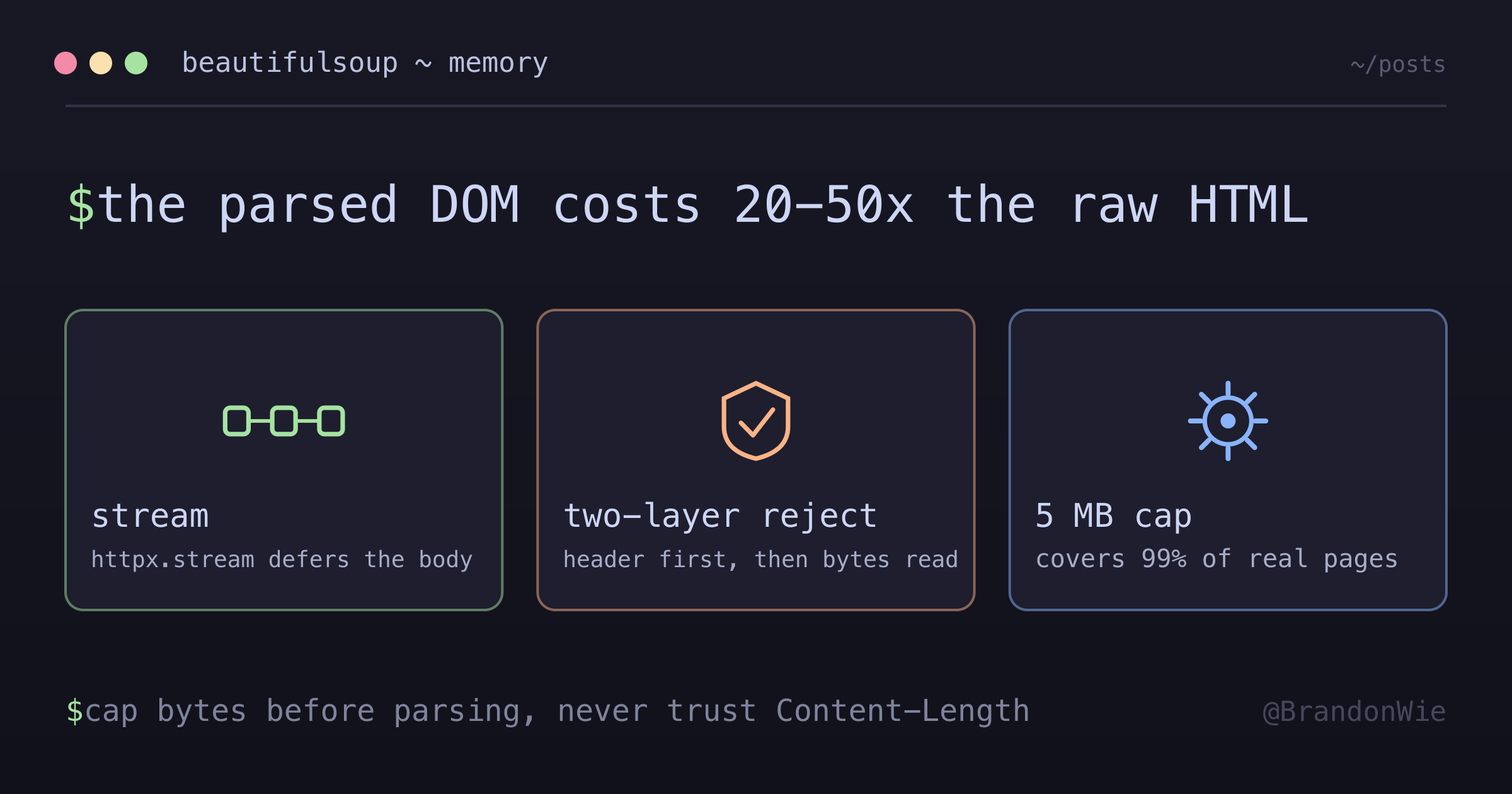
A scraper that fetches a page with httpx and hands the body to BeautifulSoup is an OOM vector, because the parsed tree costs many times the raw HTML size. Streaming plus a two-layer size reject is what I ended up with.
On this page
The scraper in crucio, my own side project, started out looking like every tutorial I had read:
with httpx.Client(timeout=30, follow_redirects=True) as client:
    response = client.get(url, headers={...})
    response.raise_for_status()

soup = BeautifulSoup(response.text, "lxml")
# ... extract content ...
Four lines, and correct in the sense that it does what it says. It is also an OOM vector. I did not think of it that way until memory pressure in that stack turned into an actual incident, and the process that died was not the one doing the parsing. That misattribution turned out to be the most useful part of the whole thing, so it gets its own section further down.
Byte size is not memory size
The thing I had wrong was treating the HTML byte count as a proxy for the memory the parse would cost. It isn’t close. In this stack the parsed representation ran roughly 20-50x the raw HTML size, so a 5 MB page landed as something like 100-250 MB of Python heap, and a 20 MB page (a JS-heavy single-page app dump, say) could plausibly reach 500 MB to 1 GB.
That falls out of how the parser works. lxml builds a full DOM tree, so every element becomes an object with its own header, string storage gets duplicated for text nodes, and attribute dictionaries add their own per-element cost. None of that is visible in the byte count of the response.
I read 20-50x as an order of magnitude, not a constant. It is specific to the parser, the document shape, and the Python version, and lxml publishes its own benchmark figures, including memory usage per parser, which are worth reading before adopting anyone’s multiplier, mine included. If the number matters to your budget, measure it on documents that look like yours.
Two facts that turn overhead into an outage
Overhead alone is survivable. Two other properties are what make it dangerous.
Default HTTP clients materialize the body eagerly. requests.get(url),
httpx.Client().get(url), and aiohttp.ClientSession().get(url) all download
the complete body before handing back a response object. By the time you hold
something you could measure, you have already paid for it. Streaming exists in
these libraries precisely because the default is not streaming, and the HTTPX
quickstart introduces it as the way to avoid loading an entire response body into
memory at once.
Content-Length is not a size guarantee. RFC 9110 defines it as the length of
the representation’s data, but a response is not required to carry it: with
chunked transfer coding the framing comes from the chunks themselves and no
Content-Length appears at all, which RFC 9112’s message-body-length rules spell
out. Servers can also send 0, and a hostile server can advertise a small value
and then deliver gigabytes. A check built only on the header is one a misbehaving
server can opt out of.
Put those together with a memory-constrained worker (Celery with
mem_limit: 512m, a Cloud Run service at 512 MB, a Kubernetes pod with a request
limit) and one large page is enough to kill the process. The page does not even
have to be malicious. A PDF URL that got categorized as an article, or a site
that dumps its entire catalog into one document, does the same thing.
Where the cap can live
Once I accepted that a limit was necessary, the question became where to put it, and the candidates are not interchangeable.
| Where the limit lives | Catches | Misses |
|---|---|---|
| Content-Length header check | Oversize bodies from honest servers, before any read | Chunked responses with no header; servers that understate the size |
| Size check after download | Nothing that matters | The entire point. The memory was already allocated |
| Byte counting while streaming | Every oversize body, regardless of what headers say | Nothing on correctness; costs a rewrite into streaming mode |
| Process memory limit | The absolute worst case, as a backstop | It enforces by dying, which is the outcome you were preventing |
The header check is close to free and it is the only layer that can abort before a single byte of body arrives, but it is only as honest as the server. Byte counting is complete, and it only starts protecting you after the first chunk has landed. The two cover each other’s gaps, which is why the version I shipped uses both. A process-level limit still belongs in the deployment as a last line, though the way it enforces the cap is by killing the worker, which is the outcome I was trying to avoid in the first place.
The HTTPX docs actually sketch the first layer themselves: their streaming
section shows opening a stream, comparing Content-Length against a threshold,
and only calling read() when it fits. What that snippet does not address is the
case where the header is missing or wrong, which is the case that motivated all
of this.
The fix: stream first, reject twice
import logging
import httpx
from bs4 import BeautifulSoup

logger = logging.getLogger(__name__)

DEFAULT_MAX_RESPONSE_BYTES = 5 * 1024 * 1024  # 5 MB

class BeautifulSoupScraper:
    def __init__(
        self,
        timeout: int = 30,
        max_response_bytes: int = DEFAULT_MAX_RESPONSE_BYTES,
    ) -> None:
        self.timeout = timeout
        self.max_response_bytes = max_response_bytes

    def fetch_content(self, url: str) -> dict:
        # Stream the response so oversize bodies can be rejected BEFORE
        # the whole payload lands in memory.
        with httpx.stream(
            "GET",
            url,
            timeout=self.timeout,
            follow_redirects=True,
            headers={"User-Agent": "..."},
        ) as response:
            response.raise_for_status()

            # Fast-path reject — Content-Length header (abort before any bytes)
            content_length_hdr = response.headers.get("content-length")
            if (
                content_length_hdr is not None
                and content_length_hdr.isdigit()
                and int(content_length_hdr) > self.max_response_bytes
            ):
                return self._oversize_response(url, int(content_length_hdr))

            # Slow-path reject — byte accumulation (header missing/lied)
            chunks: list[bytes] = []
            bytes_read = 0
            for chunk in response.iter_bytes():
                bytes_read += len(chunk)
                if bytes_read > self.max_response_bytes:
                    return self._oversize_response(url, bytes_read)
                chunks.append(chunk)

            body_bytes = b"".join(chunks)
            body_text = body_bytes.decode(
                response.encoding or "utf-8", errors="replace"
            )

        soup = BeautifulSoup(body_text, "lxml")
        # ... extract as usual ...

    def _oversize_response(self, url: str, observed_bytes: int) -> dict:
        logger.warning(
            "Rejecting oversize response from %s (observed=%d, cap=%d)",
            url, observed_bytes, self.max_response_bytes,
        )
        return {"url": url, "title": "", "content": "", "content_length": 0}
Four things in there are doing the work.
httpx.stream() replaces httpx.Client().get(), which defers the body download
so that nothing is fetched until chunks are iterated. This is the change that
makes every other check possible, and it is also the change with the largest
blast radius on existing code, because response.text and response.content are
unavailable inside a stream context.
The reject is two-layered. The header check handles servers that tell the truth, and the accumulator handles servers that do not. Neither alone is enough, and running both costs one dictionary lookup on the common path.
Oversize returns empty content instead of raising. The caller already knows how to handle “extraction produced nothing,” so rejection reuses that path instead of introducing an exception type that every call site would have to learn. That was a deliberate trade: it keeps the happy path clean, at the cost of making rejection quieter than a raise would be.
The rejection also logs a warning, which is how you find out that the quiet path is being taken. Without the log line, a cap that starts rejecting legitimate pages after a site redesign looks the same as a scraper that finds nothing interesting.
Why 5 MB
The number is empirical, not principled. Legitimate web pages are overwhelmingly under 1 MB of HTML, so 5 MB leaves a wide margin for the honest edge cases: image-heavy articles, single-page apps, long-form posts, Wikipedia featured articles. Above that threshold, the realistic explanations are a deliberately oversized page, a file download that got mistaken for an article, or a binary blob with no extractable text, and the scraper wants none of those anyway.
The other half of the reasoning is the budget on the other side. A 5 MB document parsing into roughly 100-250 MB of heap still fits inside a 768 MB worker with room for everything else the process is doing. If you are extracting from sources that are legitimately large, like scientific papers or government documents, the cap should move, and the new number should come from a measurement.
A detail my original note skipped
iter_bytes() yields content after HTTP content decoding, while iter_raw()
yields the bytes as they arrived. Content-Length describes the encoded body. So
the two layers in that code are not measuring the same quantity: the fast path
compares against compressed wire size, and the slow path counts decompressed
bytes.
That asymmetry happens to work in the cap’s favor. A small gzip payload that
expands enormously sails past the header check and gets stopped by the
accumulator, which is exactly where you would want it stopped. But if what you
actually mean to limit is bandwidth instead of memory, iter_raw() is the
iterator that matches the header, and the decode has to move after the check.
I did not reason about this at the time; it is only obvious reading the docs
carefully afterward.
The symptom showed up in the wrong place
The part that stayed with me is that the OOM kill did not land on the worker doing the parsing. It landed on Prometheus, because the worker’s memory pressure, combined with metric emission, pushed Prometheus past its own tight limit first. The component that died was simply the one with the least headroom.
That generalizes further than I expected. Memory is a shared resource with a single global pressure signal, so the crash site tells you who was closest to their ceiling, not who caused it. When an OOM shows up somewhere that has no plausible reason to allocate, it is worth asking which neighbor got hungry before reaching for the victim’s limit.
When this is worth it, and when it isn’t
I would reach for this in a production scraper that ingests arbitrary user-supplied URLs, in any memory-constrained worker, and anywhere a scraper OOM would take down a shared parent, like a multiprocess worker pool or a queue consumer.
I would skip it when the URL set is fixed and well-behaved with predictable sizes, when the scrape runs in a dedicated process with generous memory (a 4 GB VM doing one job at a time absorbs this without noticing), or when the caller already caps the input. A validator that rejects binary endpoints before the scraper ever sees them is enforcing the same policy earlier, and doing it twice buys little.
Practical takeaway
If a scraper accepts URLs it does not control, the size limit has to be enforced during the read. The header check is worth keeping as a cheap fast path, but the byte counter is the part that actually holds, because it is the only layer that does not depend on the server being honest. And when the memory does blow up, the crash site is evidence about headroom before it is evidence about fault.
References
- Streaming Responses — HTTPX quickstart
—
httpx.stream(),iter_bytes()vsiter_raw(), and the Content-Length conditional-load pattern - Streaming responses (async) — HTTPX — the same mechanics for an async client
- Installing a parser — Beautiful Soup documentation
— what choosing
"lxml"actually selects underneath BeautifulSoup - Benchmarks and Speed — lxml — lxml’s own parser benchmarks, including per-parser memory usage figures
- RFC 9110 §8.6 — Content-Length — what the header means and when a sender is expected to include it
- RFC 9112 §6.3 — Message Body Length — the framing rules under which a response carries no Content-Length at all
Comments · github discussions
repo brandonwie/brandonwie.dev · category "Blog Comments" · term beautifulsoup-streaming-response-cap