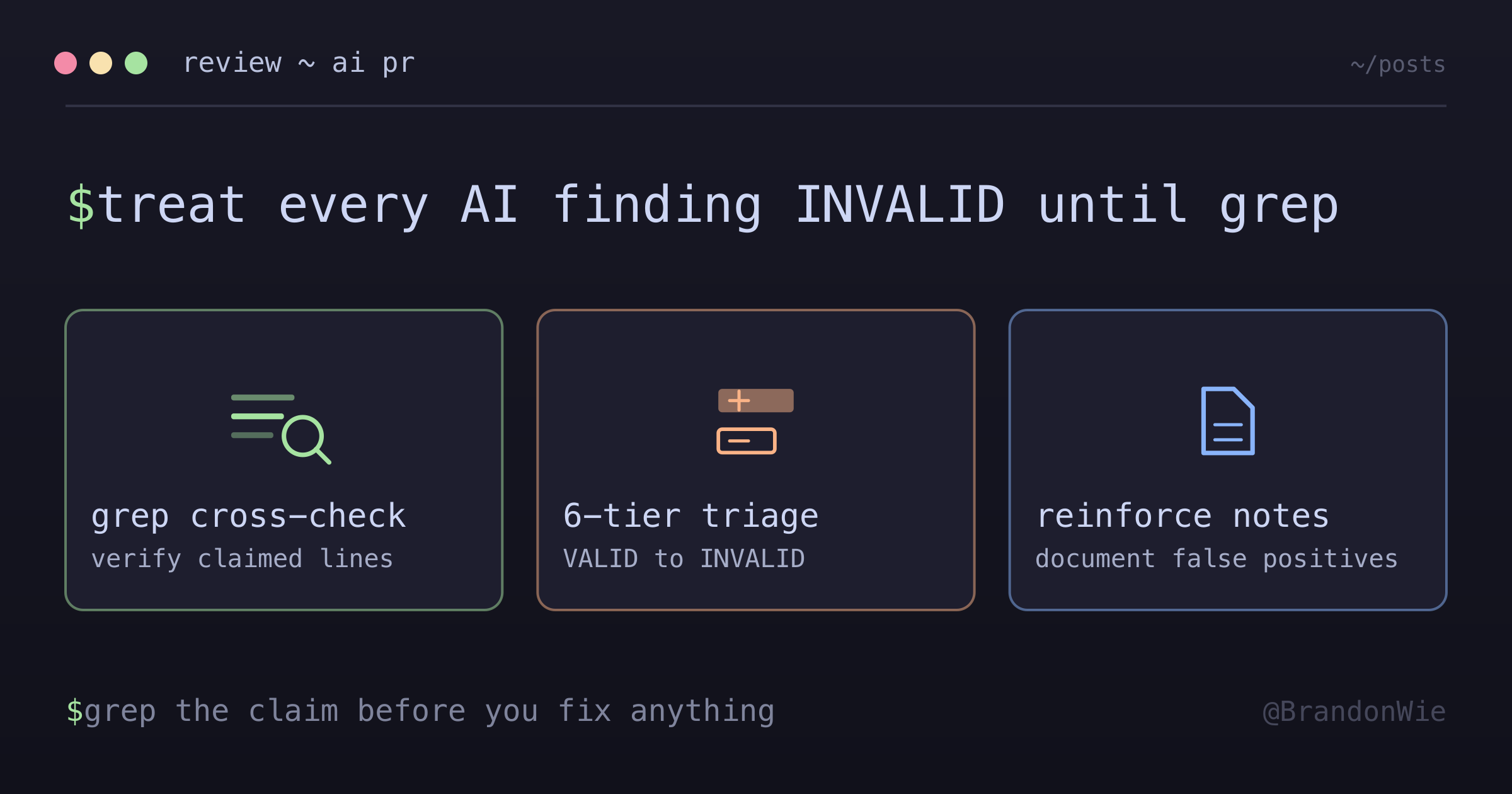
AI PR Review Validation Patterns
Fifteen patterns where AI code reviewers (Claude, Copilot, Codex) produce false positives, plus the classification framework and reinforcing-comment templates that keep triage fast.
On this page
- Classification Framework
- Common AI Confusion Patterns
- 1. Stale Diff / Feature Exists
- 2. Request Lifecycle Misunderstanding
- 3. Webhook Flow Misunderstanding
- 4. Variable Reassignment Blindness
- 5. Process Model Misunderstanding
- 6. Pydantic Model Mutability Assumptions
- 7. Factory Pattern Default Mismatch
- 8. Cross-File Blindness
- 9. Cross-Branch Confusion
- 10. Large Diff Blindness (GitHub API 406)
- 11. Authorship Scoping for Release PRs
- 12. Markdown Formatting Hallucination
- 13. Cross-Skill Name Confusion (Phantom Comparison)
- 14. Stale Local Read Under a Live Parallel-Lane Checkout
- 15. Spec-Authority Confusion (correct in general, wrong per protocol)
- Cross-Agent Convergence as a Severity Signal
- Reinforcing Comment Templates
- Workflow
- Real-World Examples
- Example 1: A NestJS API service (claude[bot])
- Example 2: A Python ETL pipeline (GitHub Copilot)
- Example 3: crucio PR #6 Round 2 (CodeRabbit + Claude Bot)
- Example 4: A release PR on a NestJS API service, Rounds 1+2 (Copilot + Claude)
- Example 5: A feature PR on the same NestJS API service, Rounds 1+2 (Claude)
- Example 6: 3b-forge PR #3 Round 1 (4 reviewers — Claude + Copilot + Codex + CodeRabbit)
- Example 7: A shell-classification PR on my own knowledge-base repo (Claude, 4 rounds plus an independent spec-check)
Classification Framework
Not every AI review comment deserves the same treatment. Some are genuine bugs, others are stylistic preferences, and some are flat-out wrong. A simple VALID/INVALID binary stopped being enough for me fairly quickly. I needed more granularity to keep triage fast.
| Classification | Criteria | Action |
|---|---|---|
| VALID BUG | Real bug, security issue, will cause failure | Fix immediately |
| VALID IMPROVEMENT | Correct suggestion, improves code quality | Fix immediately |
| GOOD-TO-HAVE | Correct but low-priority improvement | Fix if easy, skip if risky |
| CONTROVERSIAL | Debatable: valid concern but cost/benefit unclear | Evaluate case-by-case |
| OPTIONAL | Nice-to-have, stylistic, not urgent | Ask user |
| INVALID | Wrong, misunderstood context, doesn’t apply | Document + add reinforcing comment |
The two tiers I added later, GOOD-TO-HAVE and CONTROVERSIAL, turned out to matter most on release PRs. On a feature branch I can usually address everything. Triaging 19 findings on a develop-to-main merge is a different job, and there I had to separate “correct and worth the risk” from “correct but not worth touching right now.” GOOD-TO-HAVE covers improvements where the fix is easy and the risk is low. CONTROVERSIAL is for findings where the AI has a valid point, but the cost of fixing outweighs the benefit in the current context: adding type guards to 27 test files during a release, say.
Common AI Confusion Patterns
1. Stale Diff / Feature Exists
What it looks like: Agent claims feature is “missing” but it exists in current code.
Why it happens: AI reviews PR diff, not current file state. If feature was added in earlier commit, agent may miss it.
Example:
Agent: "CRITICAL: the analytics methods return Promise.reject('Not implemented')"
Reality: the service is fully implemented, ~1,400 lines
Prevention: Add reinforcing comment:
// NOTE: This service IS FULLY IMPLEMENTED. All five metric calculations
// are complete and production-ready via the consolidated summary method below.
2. Request Lifecycle Misunderstanding
What it looks like: Agent suggests transactions/locking for operations that don’t need them.
Why it happens: AI doesn’t understand framework-specific request lifecycle (NestJS, Express).
Example:
Agent: "Race condition between parent fetch and move - add database locking"
Reality: NestJS HTTP requests execute synchronously in single-threaded event loop
Prevention: Add reinforcing comment:
// NOTE: NO RACE CONDITION exists between parent fetch and move operation.
// This entire method executes synchronously within a single HTTP request context.
// Node.js single-threaded event loop guarantees sequential execution.
3. Webhook Flow Misunderstanding
What it looks like: Agent suggests wrapping webhook handlers in transactions.
Why it happens: AI doesn’t understand that external service already committed state.
Example:
Agent: "the bulk soft-delete call is not wrapped in a transaction with subscription creation"
Reality: the payment provider already committed the subscription; our code just syncs state
Prevention: Add reinforcing comment:
// NOTE: This is intentionally NOT wrapped in a transaction with subscription creation.
// External service already committed; webhook redelivery handles sync failures.
4. Variable Reassignment Blindness
What it looks like: Agent misreads assignment flow after destructuring.
Why it happens: AI sees destructuring, assumes all values come from same source.
Example:
Agent: "didResync can be undefined after the retry"
Reality: the recovery branch below sets it explicitly, not from the retry result
Prevention: Add reinforcing comment:
// NOTE: Set explicitly here (not from retryResult) because a 410 recovery IS a resync event.
didResync = true;
5. Process Model Misunderstanding
What it looks like: Agent flags module-level singletons as thread-unsafe or suggests adding locks.
Why it happens: AI defaults to a threading mental model, but many production setups use process-based workers. Celery with prefork, or gunicorn with worker processes, gives each worker its own memory space, so there is no shared state to protect.
Example:
Agent: "Global _llm_service is not thread-safe — use threading.Lock"
Reality: Celery prefork = separate processes; each gets its own global namespace
This one came up in a Python project where CodeRabbit flagged every module-level variable as a thread-safety issue. In a Django/Celery stack running prefork workers, each process has its own copy of the global namespace, so nothing is shared across threads and there is nothing to lock.
Prevention: Add reinforcing comment:
# NOTE: Celery prefork model = separate processes, not threads.
# Each worker process gets its own _llm_service singleton. No locking needed.
6. Pydantic Model Mutability Assumptions
What it looks like: Agent claims that assigning attributes to a Pydantic model after construction will fail or raise an error.
Why it happens: AI assumes Pydantic models are immutable by default. Pydantic v2 models are mutable unless you explicitly set model_config = ConfigDict(frozen=True). Without that config, attribute assignment works just fine.
Example:
Agent: "GenerateContentConfig assignment after construction won't work"
Reality: Non-frozen Pydantic v2 model — attribute assignment is valid
If you’re using Pydantic v2 without frozen=True, post-construction assignment is perfectly valid. The AI just doesn’t check the model config before flagging.
7. Factory Pattern Default Mismatch
What it looks like: Agent flags a constructor’s default parameter value as inconsistent with production configuration.
Why it happens: AI compares the constructor signature in isolation, ignoring that a factory function always provides an explicit value. The default only exists as a fallback for testing or direct instantiation, and it never reaches production.
Example:
Agent: "WhisperSTTService default device='cpu' may not match production config"
Reality: Factory always passes device=settings.WHISPER_DEVICE explicitly
This pattern shows up whenever you have a constructor with sensible defaults paired with a factory that overrides them. The AI sees the mismatch between the default and the config value, but doesn’t trace the actual call path.
8. Cross-File Blindness
What it looks like: Agent asks about behavior defined in another file.
Why it happens: AI reviews files in isolation, doesn’t check related files.
Prevention: Add cross-reference comment:
// NOTE: Related logic in reconcile.helper.ts:120 handles the resync flag9. Cross-Branch Confusion
What it looks like: Agent claims code contradicts an assertion, citing line numbers that don’t match the PR branch.
Why it happens: This is a subtle one. When a PR targets develop instead of main, the AI reviewer sometimes analyzes the main branch code instead of the actual target branch. If you made a change in a prior PR that’s already merged to develop, the reviewer sees the old code from main and flags a contradiction that doesn’t exist.
Example:
Agent: "The implementation sets deletedAt unconditionally — toBeNull() should fail"
Reality: on develop those lines are a NOTE comment; the if-block was removed in an earlier PR
I hit this on a release-track PR where Claude analyzed main branch code and flagged a test assertion as incorrect. On develop, the lines it cited were already replaced by a comment, because the production code had changed in the previous PR. The assertion was correct for the current develop state.
Prevention: Add reinforcing comment at the test site:
// NOTE: The deletedAt-setting code was removed in an earlier PR. This test verifies
// the post-removal behavior: child records only get status = Deleted, no deletedAt.
10. Large Diff Blindness (GitHub API 406)
What it looks like: AI reviewer returns no comments or very sparse feedback on release PRs.
Why it happens: GitHub caps how much of a pull request diff it will serve. The docs put it at 20,000 lines or 1 MB of raw diff data, with a further cap of 300 files in a single diff. Release PRs (develop to main) cross that line easily, and when they do, asking for the diff media type on “Get a pull request” comes back 406 — one of the documented status codes for that endpoint.
One caveat on that sentence. GitHub documents the size limits, and separately documents the 406; it does not document a link between them. The causal story is my reading of repeated hits between January and July 2026, not a contract you can rely on. The effect is the same either way: a reviewer that depends on that endpoint gets no data, so it either produces an empty review or falls back to guessing from file names.
Workaround: Generate diffs locally with git diff origin/main..origin/develop and split across review agents by domain. That sidesteps the API limit and gives each reviewer a chunk it can actually read.
11. Authorship Scoping for Release PRs
What it looks like: Review findings flag code written by other team members.
Why it matters: Release PRs are often multi-author squash merges. Reviewing every line the whole team wrote burns time and produces noise I can’t act on, because I don’t have the context behind someone else’s implementation decisions. I stick to my own commits unless the severity is CRITICAL.
Technique: Check authorship before triaging:
git log origin/main..HEAD -- {file} --format="%h %ae %s"Mark findings on other people’s code as N/A in the finding registry, and escalate only CRITICAL ones regardless of author. On one release PR, that took 7 of 15 unique findings off my plate before triage started.
12. Markdown Formatting Hallucination
What it looks like: Reviewer claims markdown tables have formatting issues (e.g., “leading || produces empty first column”) when the tables are perfectly valid.
Why it happens: Copilot sometimes generates formatting complaints by pattern-matching against common markdown issues without actually parsing the file content. Unlike other confusion patterns where the AI misreads code logic, this one is purely fabricated. The reviewer invents a syntax problem that does not exist anywhere in the file.
What makes this pattern especially costly is that it scales with the number of similar files. When reviewing documentation-only PRs with many identical file structures (e.g., 11 READMEs generated from the same template), the hallucination repeats across every file and the finding count balloons.
Example:
Agent: "The tables in this README start each row with `||`, which GitHub
renders as an empty first column."
Reality: Tables use standard `| col | col |` format — no double pipes anywhere.
I hit this on crucio PR #40, where 12 of 18 Copilot findings (67%) were this exact hallucination across 11 README files. Not a single table formatting issue existed. The first instinct was to check each file individually, but after confirming the second finding was identical, batch-dismissing the rest saved over an hour of triage time.
Prevention: For documentation PRs, spot-check one flagged file before triaging the full list. If the first finding is a false positive, batch-dismiss all similar findings without individual review.
13. Cross-Skill Name Confusion (Phantom Comparison)
What it looks like: The reviewer cites specific line numbers and field names that look authoritative, but grep -n against the actual file shows entirely different content. The “missing fix” the reviewer suggests would actually break the file under review, but it would be correct for a different skill or module that shares a name root.
Why it happens: When two skills share a name root and both are available in the session’s skill registry, AI reviewers can mentally merge their schemas and review the PR against the OTHER one’s behavior. The model produces line-level “findings” that reference content which doesn’t exist in your file but DOES exist in the conflated sibling.
Example (3B PR #19, late April):
Codex reviewed an import of /interview (a markdown-only Socratic skill, zero runtime dependencies). Its findings claimed:
- “curl version check at SKILL.md:33”. Line 33 was a
## Instructionsheader, and there is no curl anywhere in the source. - “MCP asks questions at SKILL.md:93”. Line 93 was a code-confirmation example, and the source explicitly says “no MCP tools” at line 38.
- “Replace summary with
ooo seedartifact”. Butooo seedis the artifact of/ouroboros:interview, a different skill in the same session’s registry. - “Tighten MCP response contract:
meta.session_id,meta.is_complete”. The source has no MCP layer; it’s a pure conversation engine.
All four findings would apply to /ouroboros:interview (Python/MCP/produces ooo seeds). Codex appears to have conflated the two skills based on shared name root plus shared session availability. Only one of five findings (a dead filesystem link) was valid.
Why this fails AI reviewer heuristics:
- Skill registries surface multiple skills with overlapping names (
/interviewand/ouroboros:interview). - LLM reviewers sometimes cite “the skill” without grounding which one.
- Confidence stays high because the OTHER skill IS internally consistent. The reviewer’s mental model isn’t broken, it’s just pointed at the wrong target.
- Output looks specific (line numbers, field names) but is fabricated for the file under review.
Prevention: cross-check discipline. For every AI review finding that references specific lines, files, or APIs, run:
grep -n -i '<claimed-string>' <claimed-file>
sed -n '<claimed-line>p' <claimed-file>
If the grep returns empty or the line shows different content, the finding is either hallucinated or comparing against a phantom version. Treat every unverified claim as INVALID until grep confirms it. This adds about 5 seconds per finding and catches cross-skill confusion that would otherwise drive 30+ minutes of wasted fix work.
Reviewer asymmetry (data point, same PR): the 3b-forge plugin review on the same PR was grounded, with 4 of 5 findings valid. Plugin reviewers operating on the actual repo file structure produce higher-precision output than session-scope reviewers (Codex) when the session contains skill name collisions.
14. Stale Local Read Under a Live Parallel-Lane Checkout
What it looks like: A function you “just read” doesn’t match the committed version. git status flips between two consecutive commands. A CI run you checked with --limit 1 looks skipped while the real run is in progress one line down.
Why it happens: This one is different from the other thirteen, because the stale state is yours, not the AI reviewer’s. When another session shares the same working checkout and is actively committing, your in-memory model of a file (or of git and CI state) goes stale between your read and your next claim. You end up reviewing or reporting against bytes that no longer match HEAD.
Example (codex-hud PR #20):
The syncPatchedRuntime body I read was the parallel lane’s mid-edit working-tree state (reconcile-first); the committed version (b51e659) had already reordered it to reconcile-after-repair. I nearly added a redundant guard against code that no longer existed. On the same PR, a “Claude review skipped?!” alarm turned out to be gh run list --limit 1 catching a skipped duplicate issue_comment event, while the real run was in progress one line further down the list.
The same failure mode cuts the other way, too. On PR #22 of this blog’s own repo, I dismissed a Claude review finding as a false positive because a bare working-tree read showed clean code. The finding was real. A concurrent session on the shared checkout had already fixed the bug locally (47e90be), so the pushed head the reviewer analyzed still had it. A second reviewer pass caught the miscall. Over-skepticism from a stale read costs just as much as over-trust: in a multi-session tree, validate AI findings against git show origin/<branch>:<file> and git log, never a bare working-tree read.
Prevention: Before any “done” / “nothing left” / “this is the code” claim on a shared checkout, re-verify ground truth:
git rev-parse HEAD
git status
git log --oneline
git show origin/<branch>:<file>   # the bytes the reviewer actually saw
Then read the actual file again, and don’t trust the in-memory model. For CI, list several runs, not --limit 1. And when a parallel lane is out-pacing you on the same files, stand down rather than duplicate the work; the session actively implementing owns those changes.
15. Spec-Authority Confusion (correct in general, wrong per protocol)
What it looks like: The reviewer validates a change against general language semantics and proposes a fix that is technically correct in the abstract, but contradicts the adopted protocol that governs the code. Worse, the review loop can then go fully clean on the regressed state, because the reviewer keeps reasoning about general correctness rather than about the spec.
Why it happens: An AI reviewer reads the diff and the surrounding code. It does not automatically read the specification document that decided why the code is deliberately stricter than the language allows. Where the spec narrows behavior on purpose, “what the language does here” and “what this code must do here” diverge, and the reviewer only has the first one.
Example (a review on my own knowledge-base repo, September): the code classifies shell commands and decodes double-quoted wrappers strictly, so that the recorded form is byte-equal to what was issued. The adopted spec permits exactly one non-recursive decode of an escaped-backslash pair; every other backslash sequence must be treated as undecodable and the command marked untested. In round 2, Claude recommended following POSIX double-quote rules instead: a lone \ before n stays literal, so "printf '%s\n' …" ought to decode. That is true for zsh. It is false for the spec, and the relaxed version shipped through a review round that came back clean. An independent spec-check caught it afterwards and forced the revert.
Detection:
- When a fix touches code that implements an adopted spec or protocol, diff the suggestion against the spec text, not only against language semantics.
- “The reviewer approved it” is not a conformance result. Reviewers validate plausibility; the spec defines correctness.
- Keep the spec citation in a comment next to the surprising strictness, so a later reviewer does not re-propose the relaxed form:
// NOTE: Decode exactly one escaped-backslash pair, per the adopted spec —
// even though POSIX would also accept a single backslash here.
Cross-Agent Convergence as a Severity Signal
Most of the patterns above come from a single bot commenting on a PR. Proactive review behaves differently, with several independent slice agents reading the same diff before anyone else sees it. There the agreement pattern between agents carries information none of the individual findings do.
Convergence raises confidence. On a proactive review of a sync-endpoint change, three agents with different mandates (safety, structure, runtime) each surfaced the same sync-cursor starvation defect from different evidence: under sustained load the cursor timestamp never advanced past the oldest pending record. That is a much stronger signal than one agent asserting the same thing three ways, and it is what promoted a latent, months-old timestamp bug from “someone’s opinion” to the thing worth fixing first.
Divergence carried signal too. Two agents split HIGH versus LOW on the severity of a single test assertion: one saw a silent-pass hole, the other saw the same hole masked by a preceding assertion. Both were right, and the split pointed straight at where the masking lived. Recording the disagreement was worth more than averaging it into a middle severity.
Two caveats I would not skip. Convergence is evidence of salience, not of truth. Every finding that drove a decision on that review still got re-checked against the source before triage, and one agent’s claim about client retry behavior turned out to be an assumption the repo cannot confirm. And agents handed the same prompt scaffold inherit its framing, so unanimous silence about something the prompt never named is the weakest evidence in the pile.
Reinforcing Comment Templates
| Pattern | Template |
|---|---|
| Feature Exists | // NOTE: [Feature] IS [implemented/handled] [here/below] - [brief description] |
| No Race Condition | // NOTE: NO RACE CONDITION - [framework] executes [operation] synchronously within single request |
| Intentional Design | // NOTE: Intentionally [omitted/designed this way] - [reason] |
| Cross-File Reference | // NOTE: Related logic in [file:line] handles [concern] |
Workflow
- Fetch both issue comments (claude[bot]) and review threads (Copilot)
- Classify each item using the framework above
- For INVALID: Identify pattern → Add reinforcing comment → Document
- For OPTIONAL: Ask user (Fix/Skip/Defer)
- Commit with descriptive message referencing review validation
Real-World Examples
Example 1: A NestJS API service (claude[bot])
Stats: 12 comments, 3 INVALID, 5 OPTIONAL, 4 VALID IMPROVEMENT
Key INVALID:
- Feature exists (analytics service fully implemented)
- Request lifecycle misunderstanding (no race condition in single-threaded event loop)
- Webhook flow misunderstanding (external service already committed)
Example 2: A Python ETL pipeline (GitHub Copilot)
Stats: 10 comments, 0 INVALID, 4 VALID BUG, 3 VALID IMPROVEMENT, 1 ALREADY FIXED, 2 OPTIONAL
Key VALID BUG:
- json.dumps() encoding -
put_object()requires bytes not str - Manifest key inconsistency - read/write using different keys
- S3 prefix normalization - paths without trailing slash produce malformed keys
Outcome: All bugs fixed, no false positives. Copilot review was highly accurate for infrastructure/data code.
Example 3: crucio PR #6 Round 2 (CodeRabbit + Claude Bot)
Stats: 14 items (6 CodeRabbit, 8 Claude Bot), 1 VALID BUG, 2 CONTROVERSIAL→FIX, 3 GTH→FIX, 1 SKIP, 6 INVALID, 1 DUP
This was the PR where three new confusion patterns emerged at once. The Python project uses Celery with prefork workers, Pydantic v2 models, and a factory pattern for service initialization, which are three things AI reviewers consistently get wrong.
Key VALID BUG:
extract_tagsmissingValueErrorhandler: retried permanent failures (bad config, safety filter) instead of failing fast
Key INVALID (new patterns):
- Process model (#5): Celery prefork = separate processes, not threads
- Pydantic mutability (#6): non-frozen model allows attribute assignment
- Factory default (#7): constructor default irrelevant when factory passes explicit value
- GitHub Actions format: comma-separated
"Tool1,Tool2"matches official docs
Outcome: 6 fixes applied, 6 INVALID items dismissed with evidence. Mixed accuracy: CodeRabbit had 4/6 INVALID, Claude Bot had 1 VALID BUG + 2 INVALID.
Example 4: A release PR on a NestJS API service, Rounds 1+2 (Copilot + Claude)
Stats: 19 raw findings → 15 unique after dedup. 1 VALID BUG, 2 GTH→FIX, 3 CONTROVERSIAL→SKIP, 1 INVALID, 3 DEFER, 7 N/A (authorship)
This was a release PR (develop to main) with a large diff that triggered the GitHub API 406 issue (#10). The workaround, generating diffs locally and splitting across agents by domain, worked well but introduced the authorship scoping challenge (#11). Nearly half the findings were N/A because they flagged code written by other team members.
Key VALID BUG:
- A
count()on the cross-integration move path was missingwithDeleted: true: soft-deleted child rows (cancelled recurring instances) went uncounted, so the parent routed to the single-item move instead of the batch move
Key INVALID:
- Stale Diff (#1): Korean README “removed” was actually renamed (git shows rename as delete+create)
Key SKIP decisions (CONTROVERSIAL):
- Soft-deleted records for sync: the WebSocket event handles deletions, not the batch fetch
- Type assertion for Google API: no type-safe alternative for
nullconferenceData clearing - Non-null assertions in tests: correct observation but 27 occurrences = wrong timing for release PR
Process learning: Claude’s structured review must be parsed per-finding (STEP 1C), not collapsed into one CR-1. Round 1 missed this; corrected in Round 2.
Example 5: A feature PR on the same NestJS API service, Rounds 1+2 (Claude)
Stats: Round 1: 8 items (5 INVALID, 2 CONTROVERSIAL→FIX, 1 GTH→FIX). Round 2: 2 items (1 INVALID, 1 GTH→FIX)
This is where Cross-Branch Confusion (#9) first showed up. Claude analyzed main branch code instead of the PR’s target (develop) and claimed a test assertion contradicted the implementation at the lines it cited. On develop, those lines were already a NOTE comment, because the deletedAt-setting code had been removed in the previous PR.
Key INVALID (new pattern):
- Cross-Branch Confusion (#9): Reviewer analyzed
mainbranch code instead of PR’s target (develop). ClaimedtoBeNull()contradicts the implementation at the lines it cited, but those lines are a NOTE comment ondevelop(thedeletedAt-setting code was removed in the previous PR)
Outcome: 3 fixes applied across both rounds, 6 INVALID dismissed. New pattern documented: Cross-Branch Confusion, where AI reviewers default to main branch context even when PR targets develop.
Example 6: 3b-forge PR #3 Round 1 (4 reviewers — Claude + Copilot + Codex + CodeRabbit)
Stats: 16 items: 9 VALID BUG/IMPROVEMENT, 6 GTH→FIX, 1 CONTROVERSIAL→VALID after user redirect. 0 INVALID. 0 DEFER. 18 threads resolved: 11 explicit replies plus 7 CodeRabbit auto-resolves. 16 atomic fix commits. Merged f56e066.
Scope: Wave 3 SSoT flip tooling: scripts/flip-to-forge.sh (new, 322 lines), a refactored scripts/check-3b-drift.sh, and docs. The scripts performed destructive rm and ln -s operations on a separate git repo through a YAML manifest. High-stakes, low-tests, narrow scope: ideal territory for a four-reviewer pass.
Cross-reviewer convergence:
| Finding | Claude | Copilot | Codex | CodeRabbit |
|---|---|---|---|---|
| Path-traversal guard missing | ✓ | ✓ | ✓ | — |
stat -f '%HT' BSD-only | ✓ | ✓ | — | ✓ |
| Post-flip mode relies solely on local state | ✓ | ✓ | ✓ | — |
Rollback leaves .flip-state.json | ✓ | — | — | ✓ |
| Exit-code 2 overloaded | — | ✓ | — | — |
Controversial handled via user redirect: R1-16 flagged scripts/check-3b-drift.sh:25, where exit code 2 covered both advisory drift and pre-flight failure. I classified it CONTROVERSIAL instead of immediately fixing it, then surfaced four options: split the codes, narrow code 2, keep the overload with a reinforcing comment, or defer to a follow-up issue. The user chose the split, so the fix landed after the VALID fixes and before the GOOD-TO-HAVE batch.
Thread-resolution learning: Copilot and Codex threads stay open until explicitly resolved through GitHub GraphQL’s resolveReviewThread mutation. CodeRabbit auto-closes some threads when referenced code changes; three of its five threads resolved without a reply. Line numbers also shifted as commits landed, so GraphQL thread IDs were the stable key for mapping findings to commits. As a cleanup step, the @claude review trigger comment and claude[bot]’s structured review both got minimized via minimizeComment(..., classifier: RESOLVED) once the round summary was posted, which leaves the PR conversation showing only the human-readable audit trail.
Key INVALID count: 0. Convergence across three or more agents was a perfect positive predictor on this PR. The likely reason: the scope was narrow enough for agents to reason end-to-end, the scripts performed destructive operations that biased reviewers toward caution, and four independent reviewers reduced individual false positives.
Process learning: Gate CONTROVERSIAL decisions between VALID and GOOD-TO-HAVE work. VALID fixes can move first, CONTROVERSIAL items deserve a clean user decision point, and low-risk improvements can batch after that. Bundling all three tiers into one confirmation step creates the wrong latency for each decision type.
Example 7: A shell-classification PR on my own knowledge-base repo (Claude, 4 rounds plus an independent spec-check)
Stats: Round 1: 3 valid issues, all fixed. Round 2: 2 valid issues, all fixed. Round 3: clean. Then an independent spec-check found that the round-2 fix itself violated the adopted spec’s pair-only decode rule, along with stale commit references left behind by a trailer-normalization rewrite. Both fixed, and round 4 came back clean.
This is where Spec-Authority Confusion (#15) showed up. Reviewers get things wrong; that much is ordinary. The notable part here is that the review loop had already declared the regressed state clean before anything caught it.
Key signal: the PR-review loop and the spec-check are different gates, and they verify different things. Claude verifies plausibility against the diff. The spec-check verifies conformance against the governing document. Both passed on their own axis; only the second one was competent to catch the violation. If your code implements a written protocol, a clean review round is not evidence of conformance, and you need the second gate as a separate step.
Reviewer self-withdrawal is a signal in its own right. Shown the spec text, Claude withdrew its own earlier suggestion instead of defending it, and once it had the governing document it re-derived the correct answer. A reviewer that reverses itself on new evidence is behaving well; the failure was that nobody had handed it the evidence in the first place.
Comments · github discussions
repo brandonwie/brandonwie.dev · category "Blog Comments" · term ai-pr-review-validation-patterns